Friday, March 6, 2020

Writer Spotlight: Leslie Helakoski


Charlie Barshaw coordinates our quarterly Writer Spotlight feature and interviews writers of SCBWI-MI. In this piece, meet author and illustrator and former SCBWI-MI Regional Adviser Leslie Helakoski.


From Louisiana to the Upper Peninsula: Leslie Helakoski's extraordinary journey in words and pictures


You worked during your developing years at your parent’s Montessori-style “Thinking School.” What of that early school experience do you treasure most?

My parents were all about finding the teachable moments in every day activities which influenced raising my own children and my writing. My biggest take-away was learning to understand and value how kids approach learning and problem solving in different ways. It’s a big part of why I wrote the book WOOLBUR.


You earned a degree in Advertising and worked as a designer and illustrator. Eventually you earned a degree in Illustration from Northern Michigan University in the U.P. You worked for ad firms in Wisconsin, Pennsylvania, and Louisiana, but were you really prepared for Yooper winters? 

No, after growing up in south Louisiana, I was certainly not prepared for Yooper winters. But I’d met my husband while he was visiting in Louisiana and that was that. The first things I bought were snow boots and a totally inadequate coat.

But living in the UP helped me nurture the writing seed inside myself. And living in a new environment opened my eyes up to so many new things, ways and ideas. I think living in a different place from where you grow up helps you write for a broader audience.


In an interview you say you joined SCBWI in 1998 “mainly because I wanted to be an illustrator.” But your first five books were written but not illustrated by you. What is the difference between advertising design and picture book illustrating?

It took me a long time to figure out the difference between design and illustration. For me it was realizing illustrating includes character development and showing part of the story, while design can be strictly about how something looks. It was hard letting go of my plans to illustrate my early books but I can see now that I wasn’t ready to do them justice.

This is where immersing myself in picture books played a role. I needed to read read read, and look look look at as many books as I could that were being published then.


Many of your book series are well-known (Woolbur, Big Chickens). But take us back to 2002 with the publication of The Smushy Bus. How did your first picture book publication come about? 

My first book sale---I saw an ad in the back of a writing newsletter asking for humorous books that had a learning aspect to them. I was working on The Smushy Bus at the time, which is one big math problem. I sent it in.

Happily, Lerner Publishing was interested in the manuscript and picked it up. I didn’t know anything about the industry. No experience, no agent, no knowledge. SCBWI was a lifeline and I’ve been a member ever since.

Your next four titles were written by you but illustrated by another artist. Yet, you really wanted to illustrate your own text. What changed that allowed you to illustrate Fair Cow? 

I think my work matured over the years. By the time I wrote my fifth book, Fair Cow, I had been studying picture books for several years, taking classes with illustrators, studying some of my favorite painters. I thought I was up to the task.

When Harper Collins made an offer on the manuscript, but did not want me to illustrate, I was torn. I really wanted to illustrate one of my books. I eventually passed on the offer with the hope that someone else would be interested.

Shortly after that, we sold the manuscript to Marshall Cavendish, a smaller publisher who was willing to have me illustrate. It took me longer than I thought it would but I finally achieved one of my dreams.

Your primary goal was to illustrate your own books, yet you admitted that when it came to Doggone Feet you’d rather let another artist tackle the project. You eventually did illustrate it. How did you come to terms with the difficult dog-eye perspective?  

I often think at the beginning of a project, that I am not the best choice to illustrate a book. It seems that denial and whining are a big part of my process. After some self-doubt and tons of sketches, I might change my mind.

Handling perspective from under a table for Doggone Feet, did have me extra worried. I’m not a highly realistic artist. Eventually, I realized I didn’t have to be. I could make the perspective wonky, which fit with my style of art, and freed me up to play with the art.

You told Cynthia Leitich Smith in a “Cynsations” interview that “after ten years of selling books rather steadily, you hit a wall--nothing was selling.” Finally, in 2017, Hoot and Honk was published. What changes did it take to break through the barriers? 

Hoot and Honk cover 
Picture books themselves changed 20 years ago. Much shorter stories and concise language were what was selling. Teaching standards became important in marketing. Non-fiction and STEM projects were surging.  Paying attention to what is selling is always important.

I knew I had to shorten my texts. And I literally went through an early draft of Hoot & Honk with a marker blacking out every other word (or so.) I came up with a more clipped version which somehow worked.

The book was about a nocturnal bird and a diurnal bird, so I had some science/biology at hand and I knew Compare and Contrast was something educators focused on, so I kept that in mind as I was writing the final text.

Recently, Are Your Stars Like My Stars? was published, written by you and Illustrated by Michigan artist Heidi Sheffield. Did you play a role in choosing her as your artist  

I’ve known Heidi for many years through SCBWI and we have been in an author/illustrator crit group together for several years. I’ve always admired her work.

When I sold STARS to Sterling Publishing, I knew my art was not a good fit. My editor and I both wanted something ethereal and beautiful. My style of art is more playful and whimsical, so I was OK about not illustrating.

We were considering several artists when it hit me that Heidi’s work might be a good fit. I talked to Heidi to see if she would be interested. When she said yes, I sent the editor a link to Heidi’s work suggesting her as a possibility. They were pretty quick to say yes, and contacted her agent to set up a deal.

Heidi grasped the concept about seeing each other in different ways and her art highlighted the text beautifully. We’re happy that it’s been one of the best-selling books at independent bookstores in Michigan this winter.


You spent more than ten years as the Co-Regional Adviser for SCBWI-MI. What are your proudest accomplishments during your reign?  

Being Co-Regional Advisor for 11 years was a great privilege and adventure. Encouraging a strong sense of community was an early and continuing goal.

To that end, we started regional shoptalk meetings around the state. Our fabulous members expanded on these by offering to share their journeys and information with their own and other regions. These meetings have become a great perk of membership. We all have so much we can learn from each other.

Our members’ willingness to share has been phenomenal. Along the way, we also strengthened our illustrator community with great programming, stellar volunteers, and strong illustrator coordinators. Over 9 years, we held 3 large multi-region events. The Marvelous Midwest conferences were able to bring big national style events at an affordable rate to the Midwest.
   
By far, my biggest accomplishment was pulling Carrie Pearson in to be Co-RA with me. She and I were in sync from the beginning and putting our heads together for our region was a great joy. My heart-felt thanks goes out to all of our volunteers for making Michigan a strong and vital chapter.

Author Darcy Pattison appeared as a presenter at an SCBWI-MI conference years ago. Today, you and Darcy teach “PB&J, Picture Books and All That Jazz” for Highlights Foundation. Did you first meet her at our conference?

Yes. I first met Darcy at our Michigan event many years ago. We became friends who looked at each other’s work occasionally. Then, years later, we met up again when we were both speaking at an event in Pennsylvania held at Highlight’s Barn.

We knew we had a lot to offer PB writers and came up with the idea to collaborate on a workshop partly because we approached writing so differently. We felt we could offer a lot of information in different ways.

Our PB&J (Picture Books and All That Jazz) has been running each June for 6 years now. It’s an intense 4 days but we feel it is the equivalent of attending 4 or 5 conferences. Many of our attendees go on to sign with agents or sell manuscripts after attending.

Anything you wished I’d asked?

Since retiring as RA, my husband and I sold our home in Kalamazoo and are dividing our time between Louisiana and Grand Rapids or the Upper Peninsula.

I’m always working on a few manuscripts in differing stages. STARS came out in January and a book I illustrated for the Kalamazoo Regional Educational Service Agency 
(KRESA) will be out this spring and circulated to schools around the state.  I have two manuscripts that are ready to go out.

And I’m working on a mid-grade novel---which is soooo different from picture books. We’ll see where that goes.

But wherever I am, I am sure I’ll be writing, or talking about writing. I mean really, what’s better than doing what you love?


Leslie Helakoski grew up in the Louisiana bayous, found employment and her husband Up North. She has written 11 picture books and illustrated three of them. She spent more than a decade as the Co-Regional Adviser of SCBWI-MI.


Charlie Barshaw submitted his full YA manuscript to a big-name literary agent. While finishing up revisions on his MG novel about a squirrel invasion, he's tinkering around with a new YA ghost story.

Sunday, March 1, 2020

Book Birthday Blog with Maria Dismondy

Welcome to SCBWI-MI's Book Birthday Blog! 
Where we celebrate new books by Michigan's children's book authors and illustrators


Congratulations to Maria Dismondy on the release of her new book, Sunny Side Upbringing!


Congratulations on the release of Sunny Side Upbringing! What inspired you to write this parent’s guide?

I have been blogging about my parenting journey since 2011. I have been researching child development since 2000, and even more after I left the classroom and began traveling as a speaker to schools and conferences. Several colleagues have told me that this is a book I needed to write. They felt that I had a way of sharing research in a simple way that left parents feeling empowered and ready to take action versus fall asleep reading about what they should and should not be doing to raise good kids.

You’re well known for your publishing company, Cardinal Rule Press, and your children’s books! How does writing a guidebook for parents compare to writing picture books for kids?

These areas are connected in so many ways. I write for children and educate them in school assemblies each year. As a parent educator, I have been speaking at conferences and events for what seems like forever, but I didn’t have a book to share my message in a more cohesive way. Writing Sunny Side Upbringing feels like I hit the nail on the head and found the missing puzzle piece to the work that I do! 


Cardinal Rule Press, founded by Maria Dismondy, is a traditional publishing company located in southeast Michigan. Learn more about Cardinal Rule Press here.

You know better than anyone, parenting is a topic that spans a lot of detail, and has been written about in many different ways! How did you go about researching and organizing all that content into this guide?

Common themes started to populate in my research and I realized that parents today are up against a lot and getting back to the basics is the answer to a lot of these issues. The difference between this guide and other parenting books is that it is all inclusive. Each chapter is broken down by a character trait and talks about issues around that trait. I chose the traits based on a few reports claiming our current college graduates are missing essential skills when entering the work force. Basic skills like communication, problem solving, creativity and more! 


Some of the themes covered in Sunny Side Upbringing

What was the design process like? How much communication was there between you and the designers and photographers?


The process was organized but when you are working with glue, glitter and young children, there are a lot of unknowns! The photoshoots were extremely stressful. The photographer was awesome and helped make the sessions go smoothly. The designer was amazing as well. The book was over 70K words when delivered to her. There was so much content. Some of which had to be taken out. We had big plans for the layout, which turned out far better than we ever thought it would. The book is a hardcover with a concealed spiral so the book lays flat when open which is every parent's dream. Especially since the book won’t close when you are trying to do an activity and check back on the directions. There is also an interactive poster in the back of the book in a little pocket that folds out for families to use together. The book is at a wonderful price point, $22.95, and the soft cover will be released in the Fall at $19.95.

A two-page spread on reading time from Sunny Side Upbringing

Your guide features a lot of crafts and activities for parents to do with their kids! How did you develop these crafts? What were the inspirations?

I was a teacher for over a decade and crafting brings me joy! My children and I spend a lot of time getting messy with projects and I always had my hands in creating something since I was young. My entire family is artistic-my mom and sister especially.
This page from Sunny Side Upbringing features a variety of letter and mail-themed activities

If there’s just three key things that parents could take away from this guide, what would you want them to be?


Spend more time with your children, be intentional about that time (model the character traits you want to instill in them) and be your child’s advocate. Your children will grow up before your eyes and if you have dreams of who you want them to be, be a part of the process! For example, something important to my husband and I is work ethic with a healthy balance of fun. These are two values we are constantly modeling to our children and talking to them about. 

What’s next for you? Any new books in the works, or events coming up? How can people learn more about you and your work?

Beginning March 1st I will be speaking at schools in Michigan daily for March is Reading month while squeezing in book signings and media events for the release of Sunny Side Upbringing. This will be my last book for awhile. I am focused on the publishing side of my work; acquiring new authors and mentoring them as they prepare for the release of their books with our company, Cardinal Rule Press. I love to connect with others in the industry and am still a bit old fashioned when I say “Email me!” However, I am active on Instagram and both my author platform and publishing website are up to date. MariaDismondy.com and CardinalRulePress.com.

 A little bit about the book:

A month-by-month parenting companion packed with activities, inspiration and nuggets of research based knowledge to help navigate the real-life ups and downs of parenting while remaining rooted in your core family values. 

Research suggests that college students today are graduating without essential skills like communication, problem-solving, creativity and more. Scary stuff! Sunny Side Upbringing was written in response to this research and my desire to flip the script. It’s a tool that provides actions parents can take to raise kind and caring kids. Of course, we don’t have time to read every piece of parenting research, so this book has done the heavy lifting for parents so they can jump in and make an immediate impact.


A little bit about the author:

After the release of her award-winning title “Spaghetti in a Hotdog Bun,” Maria resigned from a decade of teaching and worked on growing her business and her family. Fast-forward to present day, Maria is a trusted leader in the industry, having penned ten books, is a parent educator, and a sought after public speaker. She lives on a little lake in the heart of Metro Detroit with her husband Dave and three book-loving children. Find out more at www.MariaDismondy.com.


Wednesday, February 26, 2020

Book Birthday Blog with Deborah Diesen

Welcome to SCBWI-MI's Book Birthday Blog! 
Where we celebrate new books by Michigan's children's book authors and illustrators


Congratulations to Deborah Diesen on the release of her new book, Equality's Call!


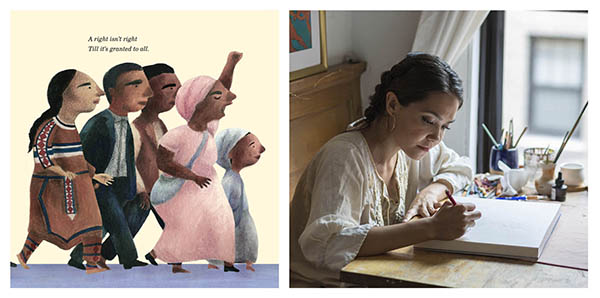
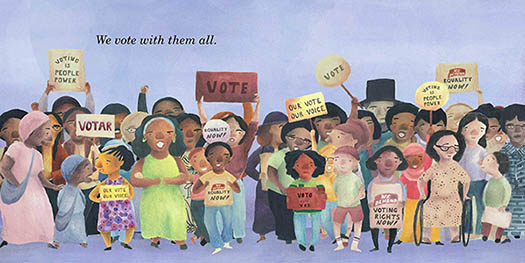
Equality's Call, released on February 18th, follows the history of voting rights and voting rights activists in America

Congratulations on the release of Equality’s Call! How did the inspiration for this book come about?

Thank you! And thank you for hosting me here on the SCBWI-Michigan blog!

Equality’s Call came about after a conversation that I had with my younger son a few years ago, as we were noting that the 100th anniversary of the 19th Amendment was coming up.  We talked about how it hadn’t really been that long since women gained the right to vote.  Our conversation got me to thinking about perhaps writing a picture book about a few of the well-known figures of the women’s suffrage movement, showing how their commitment and efforts led to the passage of the 19th Amendment.

As I began to work on the book, though, my manuscript evolved.  As I learned more about the women’s suffrage movement, I realized that my understanding of the movement was very incomplete.  For instance, I discovered that the women I was most familiar with, while important and significant, did not represent the full depth or breadth of the women who spoke up about the right to vote.  I also discovered that many white suffragists excluded women of color from their activities.  And I learned that the passage of the 19th Amendment didn’t mean that all women could vote as of 1920.  Barriers to citizenship as well as racially-motivated voter suppression profoundly limited the right to vote.  This changed my perspective on the story I had thought I was going to tell.

Another component of my manuscript evolving was that I realized that looking at only one aspect of enfranchisement (in this case, of women gaining the right to vote) without looking at the whole of our country’s voting rights history is not possible.  We cannot understand changes in voting rights without examining the interconnectedness of who has and hasn’t been allowed to vote at various points in our country’s development, and of how voting rights connect to larger themes of our country’s history.

What emerged from this process was a picture book that takes readers from our nation’s founding, when only white men with property were allowed to vote, to the present.  It highlights milestones of progress as well as issues that remain.  The main story is written in an accessible style – it’s a brief 400 words, in rhyme, with a recurring refrain – in order to allow even very young children to hear it and learn from it; there are also several pages of backmatter to provide a deeper dive for older readers.  The book is honest – it doesn’t mythologize the past or minimize the concerns of the present – but in a way that I hope will uplift and encourage kids.  Voting rights are a critical component of our civil rights, and it’s never too soon for young people to start learning about the importance and power of standing up for and using those rights.

Magdalena Mora’s wonderful art for Equality’s Call brings the book alive.  It’s her first picture book, but I know you’ll be seeing many more from her.  She’s an amazing artist who is passionate about visual storytelling as a tool for social change.


Illustrations for Equality's Call were created by Magdalena Mora

How did the writing and research process of Equality’s Call compare to your previous books?

Equality’s Call is my 15th picture book, but my first ever nonfiction picture book, and nonfiction research is quite a bit different than writing dialogue for talking fish!  In fact, not long after starting the story, and again when working on the backmatter, I nearly threw in the towel.  I’m not a historian or a voting rights expert, and I was overwhelmed by the complexity of the history and the issues.  I felt profoundly unqualified to be writing on the topic of voting rights.

But even as I struggled, I realized that the struggle could and should be a part of the process.  Putting myself in the position of being a learner, and going on a learning journey, is what allowed me to create a book that I hope will take kids on that journey, too.  Equality’s Call is not a comprehensive reference work, but it’s a synthesis of what I learned and is meant to serve as an engaging entry point for kids to begin to learn more.

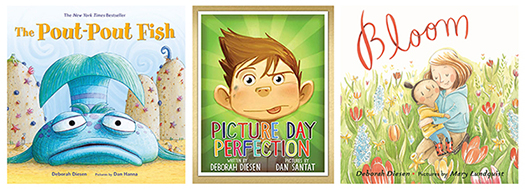
Deborah's previous books include titles like Picture Day PerfectionBloom, and the New York Times Bestseller, The Pout-Pout Fish! Find more of her books here.

You’re well known for that poetic, rhyming style of writing that’s featured in many of your books, including your latest one! How did you develop that voice?

I’ve always loved the way words sound, and I’ve been fond of writing in rhyme since elementary school.  My earliest creative efforts were rhyming poems, and my interest in rhyme has been lifelong.  Not everything I write lends itself to rhyme, but I love to work with it when I can, because I think rhythm and rhyme in writing can help a story cohere in a uniquely layered way.  It’s also a fun challenge to write in rhyme.  It’s frustrating when it isn’t working, but very satisfying when it finally comes together.


In addition to talking about the history of voting rights, you’ve also used Equality’s Call and its teacher and student handouts to encourage voting participation in local communities! Was this message and call to action something you saw happening with your book from the beginning? 

In writing Equality’s Call, the learning journey that I took into the past heightened my awareness of present-day voting rights issues.  It also impressed upon me the importance of sharing that knowledge with kids so that they will know what their rights are, how those rights came to be, and what we need to do to ensure those rights remain in place.  I didn’t anticipate taking on an advocacy role when I began, but I’m glad it’s where I ended up!


What’s one thing you hope your readers will take away from Equality’s Call?

There are actually three main ideas I hope young readers will take away from Equality’s Call.

The first is a recognition of the importance of voting.

The second is a clear understanding that barriers to the right to vote are wrong.  We can and should expect our government officials to make voting easy, accessible, convenient, accurate, and fair.

The third is an expectation of all of us to speak up for voting rights and civil rights.  There’s a question posed on the last page of the book, after the mini-biographies of voting rights activists:  “How will you answer equality’s call?”

Answering that question is on all of us.


What’s next for you? Do you have any events coming up or new books in the works? Where can people connect with you and learn more about your work?

My web site (www.deborahdiesen.com) is the best place for finding updates about my upcoming books and events.  Also on my web site are some handouts for teachers and parents to use with Equality’s Call.

Thank you so much for giving me this opportunity to talk about Equality’s Call.  I’ve enjoyed your questions, and I really appreciate you hosting me here today! 

A little bit about the book:

The founders of the United States declared that consent of the governed was a key part of their plan for the new nation. But for many years, only white men of means were allowed to vote. Equality's Call looks back at the activists who worked to secure the right for all to vote, and it also looks forward to the future and the work that still needs to be done.  

A little bit about the author:

Deborah Diesen is the author of many children’s picture books, including The Pout-Pout Fish and Equality’s Call. She loves playing with words and rhymes and rhythms, and she believes everyone should own at least one rhyming dictionary.


Monday, February 24, 2020

Book Birthday Blog with Deb Pilutti

Welcome to SCBWI-MI's Book Birthday Blog! 
Where we celebrate new books by Michigan's children's book authors and illustrators


Congratulations to Deb Pilutti on the release of her new book,  Old Rock (is Not Boring)!


Congratulations on the release of Old Rock (is Not Boring)! What inspired this story?

Thank you! I take a lot of walks in the woods, and I often will wonder what a rock or tree might have witnessed over time. I drew a picture of a rock that I thought was funny and wondered if I could write a story about the character. Then I became stuck, because ROCKS DON’T DO ANYTHING, they just sit there. It seemed like a boring premise. Once I thought more about how rocks are formed, and what they might have seen through the millennium, I realized there was an abundance of not-boring experiences Old Rock could have.


You created a charming “Make Your Own Rock Character” activity sheet to go along with your newest book. You’ve also offered activity sheets, teacher’s guides, and even event kits for previous books! Why do you make these extra materials? What value would you say they hold for your readers?

I find it inspiring whenever I see a teacher connect curriculum to a book or theme, sometimes in surprising ways. It creates opportunities for students to delve deeper into a subject, be creative or just have fun. Plus it’s a nice leave-behind for school visits. 

Before you wrote and illustrated picture books, you did a variety of graphic design, product design, and illustration. Can you tell us a little bit about why you made the transition to picture books?

When I was a young adult, it was my desire to become a “serious designer,” and create corporate logos and posters and brochures. It seemed like the kind of thing an adult would do. If I had been paying attention to what I was truly passionate about, I might have made the transition sooner. The projects I enjoyed most had a playful or illustrative component and told a story. It never occurred to me that writing and illustrating for children was something I could do. When it did finally dawn on me, I began to study children’s books and joined SCBWI and a critique group. At first it was something I tried on and off, until I realized being published would not become a reality if I did not take the work seriously and treat it like my job.


As both the author and illustrator of your books, you work with the written and visual aspects of your story. When a new story idea first comes to mind, is it usually in images or words? How do you balance text and visuals through the creation and revision process of your books?

Each story is a little different. Many of them have started with a character sketch. Then I try to learn more about the character  and develop a premise for the story. I write and revise until the idea feels pretty buttoned down. At that point, I start sketching and put together a dummy to take to my critique groups. They let me know if there are problems with plot or if I need to revise or cut text (always). Then on to more revising.

What’s something you hope your readers will take away from Old Rock’s exciting tales?

This is a difficult question. It isn’t something I think about when I’m writing. I just try to find the story or character’s truth and hopefully entertain in the process. That said, it would be nice if readers thought, “Everyone or (thing) has a story to tell.”


What’s next, any events coming up or new ideas in the works? How can people connect with you and learn more about your work?

 I’m having a launch party for Old Rock at Nicola’s in Ann Arbor on February 29 at 11:00 am along with Deborah Marcero, author/illustrator of In a Jar. I’ll also be participating in a panel at KidlitCon in Ann Arbor on March 27-28. You can find out more at www.debpilutti.com or @dpilutti on Instagram and Twitter.

A little bit about the book:

Old Rock has been sitting in the same spot in the pine forest for as long as anyone can remember. Spotted Beetle, Tall Pine, and Hummingbird think just sitting there must be boring, but they are in for a wonderful surprise.

Fabulous tales of adventurous travel, exotic scenery, entertaining neighbors, and more from Old Rock’s life prove it has been anything but boring.

A little bit about the author:

Deb Pilutti writes and illustrates for children. She feels lucky to have a job where reading, playing with toys and watching cartoons is considered “research.” Before becoming an author & illustrator, Deb was a graphic designer and created toys for Oliebollen.com and graphics for SeaWorld and Warner Brothers theme parks.


Friday, February 21, 2020

Working with a Small Press by Wendy BooydeGraaff


Working with a small press/publisher is a unique experience. A working definition of a small press is a small, traditional publishing house which publishes fewer than thirty titles a year. Many small publishers have specialties or market niches that they fill. Examples in the children’s book world include Arbordale Publishing, Enchanted Lion Books, Tilbury House Publishers, Penny Candy Books, and many, many more.

Each publisher is unique, just as each book is unique. To capture a smattering of experiences, I reached out to a few fellow authors:

  • Jean Alicia Elster says, “Unique to my experience with Wayne State University Press is the fact that my books Who's Jim Hines? and The Colored Car are still on their list—even though they were published in 2008 and 2013 respectively. The books are still selling, I'm still doing lots of author visits and conferences and Wayne State University Press still promotes them. I like that Wayne State University Press has given the books time to develop an audience, particularly since the subject matter is very relevant in today's social/political climate.”


  • Kristin Wolden Nitz, published with Peachtree, says, “All three of my novels are still in print. They probably all would have been remaindered long ago with a Big Five publisher. My YA mystery Suspect, which came out in 2010, was on display at an ALA event as few as three years ago.”


  • Kristin Bartley Lenz says of Elephant Rock Books, “My YA novel was the only one being published that year, so I got all of the attention from the entire team. I had a weekly phone call with Jotham for several months while we edited. I was able to be involved in the creation of the cover design and the marketing/promotion plan - my opinion mattered and every step was discussed along the way. They arranged for me to speak on a panel at the NCTE/ALAN annual convention and sent me to the Heartland Fall Forum for a “speed-dating” lunch with independent book sellers throughout the midwest.”


  • Robin Newman raves, “I LOVE, LOVE, LOVE being a Creston Books author. I would not be a published author today if it weren’t for Creston and the amazing, you-take-my-breath-away, publisher and editor Marissa Moss. All Creston authors are given the opportunity to attend big conferences, like ALA. Generally large publishing houses only invite their big-name authors to attend these kinds of events. Likewise, large publishing houses may only invite their big-name authors and moneymakers to participate at certain book festivals. This is never an issue at Creston. On Creston's website it states unequivocally: 

"Creston Books is author/illustrator driven, with talented, award-winning creators given more editorial freedom and control than in a typical New York house. We work hard to promote every book we print, not just the few we think will sell the best."


And finally, some advice from Rob Broder, publisher at Ripple Grove Press:
“Read as many picture books [or whatever you are writing—RGP only publishes picture books] as possible. Study them. Love them. Write something that’s from the heart... write very, very well, and make the story unique.”


Wendy BooydeGraaff is the author of Salad Pie, a children's picture book published by Ripple Grove Press. Her work for adults has been published in Emrys Journal Online, Kveller, The Emerson Review, Third Wednesday, Rune Bear, Leopardskin & Limes, SmokeLong Quarterly, and is forthcoming in Jellyfish Review and So It Goes. Find her @BooyTweets and say hello.


Coming up on the Mitten Blog:

Book Birthdays, a Writer Spotlight, and our SCBWI-MI Nonfiction Conference and Mentorship Competition.

https://michigan.scbwi.org/2020/01/07/building-your-nonfiction-toolbox-michigan-scbwi-spring-one-day-event/

For those who:

  • asked for more nonfiction programming in our state, this conference is for YOU!
  • asked for a way to find critique partners or groups, this conference is for YOU!
  • asked for time to learn from successful creators and time to apply these new learnings to their own projects, this conference is for YOU!
  • wanted to interact with an editor who is actively acquiring nonfiction projects, this conference is for YOU!
  • wonder why and how their friends are selling nonfiction manuscripts or getting nonfiction illustration jobs, this conference is for YOU!
For many people, nonfiction is the path to breaking into the children's publishing world. There's never been a better time. Learn why and how from people who are doing it. 

Registration is open. Seats are limited. Click THIS CONFERENCE IS FOR ME! to learn more and reserve your place.


  • And here's another great opportunity to learn about writing for children and teens. Several SCBWI-MI authors and illustrators are presenting at KidLitCon in Ann Arbor on March 27-28. Learn more about this free event here: https://kidlitcon.org/2020-program/.


Thursday, February 20, 2020

Book Birthday Blog with Amy Nielander

Welcome to SCBWI-MI's Book Birthday Blog! 
Where we celebrate new books by Michigan's children's book authors and illustrators


Congratulations to Amy Nielander on the release of her new book,  Grama's Hug! 


Congratulations on the release of Grama’s Hug! You’ve talked with us in a previous interview about this book, its inspirations, and its earlier stages. Can you tell us about your journey from there to now?

Thank you so much! I’m happy to be on the Book Birthday Blog sharing more insights from my journey. The final artwork phase lasted roughly six months. I upgraded my workstation before I began so I was learning and doing at the same time. When I wrapped artwork up, I spent quite a bit of time researching how to best promote my book. I eventually discovered a budding group of debut 2020 Authors/Illustrators linking arms to promote each other. Perfect 2020 Picture Books officially formed last summer and our social media pages are in full motion via Facebook, Twitter and Instagram. You can learn more about us through our website (created by the lovely Lisa Katzenberger). Working as authors/illustrators can be quite solitary at times. I am grateful to be part of this supportive group of talented women whom are always cheering me on. I absolutely recommend the group promotion strategy! 


Previous to this book release was your wordless picture book, The Ladybug Race. You’ve mentioned that Grama’s Hug also started out as a wordless book. What was the moment or thought that lead you to give Grama’s Hug words? How was your experience creating a book with words compared to a wordless one?

Grama's Hug went from a nearly wordless story to a story with full text after the dummy was shared with more readers (and illustrations were settled on). Creating a book with words was definitely more challenging at that point. What helped me overcome the change of direction was spending time paging through the dummy on my couch, where I used to read picture books to my kids. It was in that peaceful place that the narrative and voice for both characters took shape.  

An example of Amy's illustration process, from sketch to finish

In your experience, how does being both a book’s author and illustrator impact the creation and publication process most? 

When I go back to the development of Grama's Hug and examine the final artwork/text phase a bit more, I’d say the element of time is impacted most. When I needed to revise text I could no longer work on illustrations. That progress came to a halt when I had to shift creativity gears. It wasn’t until text was finalized when I could flip back to working on illustrations. I imagine it is different for other Author-Illustrators though.

You often feature or talk about your dummy books in interviews and on your Instagram. What significance do dummy books play in your creative process?

I love creating dummies. They are like candy to me. The reward for getting a revision tightened up is, a dummy. I enjoy physically making them, then doting over their cute baby-book size. The purpose of every dummy I create is to help me figure out pacing and page turns. They also make the book feel a step closer to being real, which can be quite motivating. If I want to test out another illustration, new pages can be dropped in quickly. Dummies are critical to the process of picture book making for me.


A few of Amy's dummy books for Grama's Hug

What’s something you hope your readers, whether grandmas or young astronauts, will take away from Grama’s Hug?

My biggest hopes are readers believe in their dreams a little more, believe in each other
a lot more and make every goodbye memorable.

What’s next for you? Any events coming up, or new books in the works? How can people connect with you? 

My official book launch is Saturday, February 22nd at Barnes & Noble in Troy, from 11am-12pm. If there are any SCBWI members in the area, I’d love to meet you! I’m also an artist in the Muskegon Museum of Art Exhibit, 20 for 20: Celebrating Michigan Illustrators. A reception and Book Fair will conclude the exhibition on April 9th. As far as new books go, my agent will be submitting a couple more picture books soon. Readers can visit my website to learn about future book signings/events.

A little bit about the book:

Grama's Hug is about a devoted grama and her space-loving granddaughter, May. The story follows the pair during May’s elementary years as they become an inseparable team. They create art, birdwatch and prepare inventions for the annual space fair. They never, ever say goodbye without a hug until that moment (almost) slips away one day. 

A little bit about the author: 

Amy Nielander is a children’s picture book author and illustrator. She strives to spread joy and inspire others through her stories and school visits. Her first wordless picture book, The Ladybug Race (PomegranateKids), received international recognition as a finalist entry in the Silent Book Contest and later earned a Bronze Metal Book Award by Independent Publisher. Her second picture book, Grama’s Hug (Page Street Kids) received a starred review from Booklist and released January 28th, 2020. Amy lives in Michigan with her family and works alongside her sweet, chair-sharing havanese (whom she adores), every day. 

Website: https://www.amynielander.com/
Twitter: @nielanderamy 
Instagram: @amynielander
Facebook: https://www.facebook.com/nielanderamy/