Showing posts with label Kristen Uroda. Show all posts

Tuesday, August 5, 2025

Book Birthday Blog with Kristen Uroda


Welcome to SCBWI-MI's Book Birthday Blog!

Where we celebrate new books from Michigan's authors, illustrators and translators.


Congratulations to Kristen Uroda on the release of Scientists Like Me: Stories, Advice, and Inspiration from 25 Trailblazers with Experiments to Try at Home


Your work includes a variety of genres, clients and projects, and this year, you have two new books releasing. How do you keep yourself organized?

My biggest secret isn’t fancy, I’m afraid! After more than a decade juggling illustration and graphic design alongside school or a full-time job, I’ve learned through trial-and-error what I can realistically take on and where my limits are.
 
For me, staying organized means being clear-eyed about what’s sustainable. Sometimes that means turning down projects to protect my health and sanity because I see this work as a marathon, not a sprint. So if saying no to a gig means I can enjoy dinner with my family tonight, sleep well, and avoid burnout later down the line, then that’s absolutely worth it to me.
 
Beyond that, I lean on project management skills I’ve picked up over the years that I definitely didn’t learn in art school! I’m normally a pretty optimistic person, but when I plan, I look at things with a very pessimistic mindset: I think about the unexpected hiccups like power outages, getting sick, or delayed feedback, and how I know I’ll always hit a few spreads that take three times longer than I expect. For editorial work, there’s fewer surprises because the turnaround is so tight, but for picture books I build in my own buffer time so I’m not derailed by the inevitable surprises and I can reasonably manage more than one large project at a time.

Which illustration is your favorite in the book and why?

It’s hard to pick just one because they were all such a joy to create! But Jane Goodall’s portrait stands out in my memory as I really admired Dr. Goodall as a child, so it felt especially meaningful to illustrate her. Throughout the book, we assigned each field of study its own color palette—Medicine, Natural Sciences, Social Sciences, and so on. Jane falls under Social Sciences, which was represented with purple. But of course, she’s so closely tied to the deep, green jungles where she did her pioneering work! Using the designated purple palette with hints of green was a fun creative puzzle, and I love how it turned out.


Jane Goodall

What do you hope readers will take away from the book? 

I hope readers come away thinking: science is cool! I love how this book highlights a wide range of scientists—both familiar faces and inspiring new voices so my biggest hope is that every reader finds someone they connect with and feels motivated to explore and ask questions, just like these scientists did. 


Karlyn Beer


Alan Turning
 
 
Nadine Caron


What are your marketing plans for the book and where can we find it? 

Hachette Book Group is handling most of the marketing and outreach, and I’m excited to see the book make its way to science fairs, classrooms, and libraries where curious minds can discover it.
 
But it’s available wherever books are sold! 

What's next for you? 

As shared previously, I’m currently illustrating my 5th picture book and continuing to illustrate covers for the Race to the Truth series with Crown Books. Last year was pretty busy, so I’m taking it slow this year to recalibrate a bit, think about some personal projects, and learn how to garden a little too. 

More about the book . . . 

Perfect for science loving kids, this book offers engaging profiles of twenty-five diverse scientists in fields ranging from physics to medicine to programming, paired with hands-on activities that let young readers jump right into the work.
 
From doctors and physicists, mathematicians and marine biologists, to AI experts and more, Scientists Like Me profiles a diverse collection of historic and contemporary scientists and encourages readers to discover their own scientific passions.


Written in partnership with the Kamin Science Center, Scientists Like Me is the perfect book for any kid who loves observing and discovering. It’s for any adult hoping to invigorate a young person’s interest in science. Most of all, it’s for anyone who’s ever wondered about the incredible world around us and wanted to find out more. 

Published by:  Hachette Book Group

More about the author . . . 

Kristen Uroda is a Michigan-based artist who creates vibrant illustrations that inspire people to dream, hope, and imagine a better, kinder world. 


Beginning her career in editorial illustration, Kristen has expanded her work to include publishing, creating picture books and illustrated book covers. Known for her light, joyful style and bursts of color, Kristen uses her art to spark joy, inspire connection, and renew moral imagination. 

Bluesky: @kristenuroda.bsky.social


Tuesday, July 1, 2025

Book Birthday Blog with Kristen Uroda


Welcome to SCBWI-MI's Book Birthday Blog!

Where we celebrate new books from Michigan's authors, illustrators and translators.


Congratulations to Kristen Uroda on the release of Miss Betti, What Is This? How Detroit's School Lunch Lady Got Good Food on the Menu


You create illustrations that inspire people to dream, hope, and imagine a better, kinder world. Please describe your creative process for this inspirational book.

The creative part felt really smooth. Lela Nargi’s script was rich enough to help me think of a lot of concepts and imagery, but light enough that I didn’t feel pigeonholed into illustrating scenes literally. Additionally, everyone I worked with at Sleeping Bear Press gave me a lot of leeway and freedom to go wild.
 
Since this was more autobiographical, I started by doing some research on Miss Betti—trying to read articles about her work and videos and interviews she’s done. The first thing that became really apparent was her joy and love for nurturing children through healthy foods and meals. And her smile was contagious! I knew I wanted to bring her playful energy into the book with some small pieces of humor. One of my favorite spreads is the one with the principal cowering from children surrounding him with their protest signs, demanding a salad bar and Miss Betti just laughing in the back. I love being able to lean a little zany when I can.
 
But overall, I wanted to imbue this feeling of community care and celebrating healthy food in schools, which I believe is every child’s right and our responsibility as adults and caregivers to advocate for. And I hope that spirit comes through—because when we champion healthy food in schools, we're nurturing children, certainly, but also the minds and bodies of tomorrow's innovators, leaders, changemakers, and community builders, and teaching them how to care for the generations that will come after them.


What was the most difficult part in illustrating the book? 

There really wasn’t one! If anything, just balancing the bright, rich colors.
 
I originally started out planning to transition the colors from boring and beige to colorful as the children learned to love healthy food, but whenever there were scenes with the children and Miss Betti, her brightness, determination, and energy was just getting drained whenever she was surrounded by more muted colors. I went through a few iterations of trying to get the right palette and eventually abandoned beige and went all in on the color.
 
Using more muted colors to make brighter ones pop more is certainly solid color theory advice, but sometimes you can be a rebel and break the rules. And because I had enough opportunities to play with facial expressions—boring or sad or grossed out—I didn’t need to ask the color to do the emotional heavy lifting of the story. Instead, I could lean into the bright blue of Miss Betti’s uniform and the rich “lunch tray” red.  


What do you hope readers will take away from the book?

I hope readers see Miss Betti's success story as proof that one person truly can transform an entire system. As her particular journey shows the incredible impact of having nourishing food in schools and the possibility of growing it ourselves through urban gardening, I hope readers feel inspired to get involved in similar advocacy—whether that's attending local school board meetings, advocating for urban gardens in city councils, or starting conversations about food justice in their own communities. Imagine the power of teaching upcoming generations not just to live in harmony with our earth, but to understand that caring for our environment and caring for each other are inseparable. Systemic change needs the momentum of many, but it can begin with one person's courageous action.

What are your marketing plans for the book and where can we find it?

I’ll be working with Sleeping Bear Press to collaborate on the marketing together, but my hope is that, as it’s about a local Detroiter and Michigander, we can get this book in every school and library across Michigan—to start!
 
I also hope to distribute it to local urban gardens I've volunteered with, community centers, and food justice organizations as I think Miss Betti’s story is really lovely and inspirational and her story could be a great educational tool for leaders of those gardens and organizations.

What's next for you?

I’m currently illustrating my 5th picture book and continuing to illustrate covers for the Race to the Truth series with Crown Books. Last year was pretty busy, so I’m taking it slower this year to recalibrate a bit and think about some of my own stories I’d like to tell some day. :)    

More about the book . . .

Miss Betti knew wholesome, nourishing food. She also knew the kids in Detroit's public schools were not getting wholesome, nourishing lunches. Luckily, as Detroit's school lunch lady, Miss Betti had the power to make a change. She started small—with fresh apples and sweet potato fries—but soon she was filling lunch trays with a rainbow of tasty choices. And then, Miss Betti looked toward some of the empty city lots across Detroit. She started an urban gardening program to teach students about growing fruits and veggies—filling schools' salad bars with fresh fare.


A true story about big goals and small steps in America's Motor City.

Publisher: Sleeping Bear Press 

More about the author . . .

Kristen Uroda is a Michigan-based artist who creates vibrant illustrations that
inspire people to dream, hope, and imagine a better, kinder world.
Beginning her career in editorial illustration, Kristen has expanded her work to
include publishing, creating picture books and illustrated book covers. Known
for her light, joyful style and bursts of color, Kristen uses her art to spark joy,
inspire connection, and renew moral imagination.

Bluesky: @kristenuroda.bsk.social


Tuesday, April 4, 2023

Book Birthday Blog with Kristen Uroda


Welcome to SCBWI-MI's Book Birthday Blog!

Where we celebrate new books from Michigan's authors, illustrators and translators.


Congratulations to Kristen Uroda on the release of Can We Please Give the Police Department to the Grandmothers?


The story originated from the award-winning poem written by Junauda Petrus. What was your creative process to develop the illustrations?

In the beginning, I had a few meetings with Junauda, her editor Andrew Karre, and Assistant Art Director Anna Booth, to understand the emotions and feel they wanted the illustrations to have. They were so much fun to work and dream with and we were all aligned that it should feel playful, celebratory, intimate, and bold. They gave me a lot of trust and creative freedom to go wild with my imagination.
 
As I was reading the script and imagining what this world would look like, I did some research on Midwest cities like Minneapolis, where Junauda lives, Chicago, and Milwaukee to get a feel for the architecture. I also took inspiration from Detroit, where I was born, and stories my mother would tell me about what Detroit used to be like when she was a kid. There was a time when everyone knew each other and looked out for their neighbors. People would sit on their stoops, chat with one another in front of corner shops, and cruise down the streets in their cars playing Motown music. She still tells me stories of eating fresh watermelon on hot days as the swimmobiles (imagine semi-trucks carrying giant pools!) rolled through the streets for kids to play in.
 
Cars are also a major theme within the book. Instead of police cars, the grandmothers roll around in super cool vintage cars. Being from the Motor City, I had a lot of inspiration to pull from to give the cars their own personality and role as supporting characters.
 
After establishing a strategy for the feeling the story should convey and all the characters that would be needed, next came figuring out how to align the illustrations to tell a cohesive story. Eventually, I fell on the idea of sketching out the journey one grandmother takes as she’s patrolling her neighborhood from sunrise to sunset and all the people and events she encounters in a day.
 
Ezra Jack Keats’ work and Sesame Street played a big role in getting the color and playfulness right. I wanted to capture this feeling of a vibrant, inner-city neighborhood full of life and love contrasted with green spaces and brownstones. A neighborhood that feels safe but also real—like you could turn some corner street and this place and the people in it would actually exist. There’s so much pain in communities today caused by systemic racism and discrimination. I think it can be easy to look at the current status quo and feel helpless and cynical about change. But when people, of all ages, read Junauda’s words and see these illustrations, I want them to feel a sense of familiarity and longing that fuels a sense of hope that change is possible. That a neighborhood like this can be a reality. Systems, like societies and rule of law, were created to function in specific ways which means they can also be reimagined, improved, and recreated to function in better ways. So every time someone picks up this book, I hope they feel inspired to stand up and push back on a system that’s harming and killing people. Whether that’s pushing for new policies or working to build relationships with their neighbors so people feel seen and connected, we can all play a part in imagining a new way of living together and taking care of one another—it starts with believing it’s possible.  


What was the most difficult part in illustrating the book?

I don’t think there was necessarily a difficult part, but it was a new challenge because it was my first full picture book. I’ve worked in the field of editorial illustration for so long that I’m used to creating quick one-off illustrations. Creating a full narrative of illustrations was a different mindshift and a learning curve. While it takes a lot more planning, research, and thought, you can also go slower in what you say in each visual because you don’t have to pack everything into one concept. But I loved it! And I’m looking forward to the next one. 

What inspires you to illustrate?

I think I’m naturally drawn towards using my hands and mind to create and communicate, whether it’s using clay, a camera, or pencils. I feel most at peace when I’m in the flow of taking a complex idea or emotion and making it tangible in a way that can be understood by and shared with others. And I feel more aligned with a higher purpose when people can see my work and it touches something within their soul.
 
Maybe it’s something innate in human nature to draw what’s inside of us but visual art is one of the oldest forms of communication. We drew before we wrote. We used, and still use, pictures to educate and inspire. I guess I’m following the path paved by artisans who came before me who used visual language to tell stories, connect to others, and shape the world.


What are your marketing plans for the book?

Thankfully, Penguin Random House is managing all of the marketing, so I just have to touch base on a few things here and there and share things on my social media platforms and tell all my friends to tell all of their friends about it.

What's next for you?

Currently, I’m working on several book cover projects and I’m still doing editorial jobs as they come in. Can We Please Give the Police Department to the Grandmothers? was about a year-long labor of love, so I am enjoying a bit of a breather as I work on less labor intensive projects, but I hope to continue doing picture books in the future, whether stories from others or stories of my own—because I have quite a few!  

A little bit about the book . . .

Based on the viral poem by Coretta Scott King honoree Junauda Petrus, this picture book debut imagines a radically positive future where police aren’t in charge of public safety and community well-being.
 
Petrus first published and performed this poem after the shooting of Michael Brown in Ferguson, Missouri in 2014. With every subsequent police shooting, it has taken on new urgency, culminating in the 2020 murder of George Floyd by a Minneapolis police officer, blocks from Junauda’s home.
 
In its picture book incarnation, Can We Please Give the Police Department to the Grandmothers? is a joyously radical vision of community-based safety and mutual aid. It is optimistic, provocative, and ultimately centered in fierce love. Debut picture book artist Kristen Uroda has turned Junauda’s vision for a city without precincts into a vibrant and flourishing urban landscape filled with wise and loving grandmothers of all sorts.

Publisher: Penguin Random House

Order link:


A little bit about the illustrator . . .

Kristen Uroda is an artist best known for her vibrant, joyful illustrations. Often softly formed yet boldly colored, her work aims to express beauty in the ordinary moments, celebrate the poetry within diverse faces and figures, and tell stories that inspire reflection and social and civic change.
 
While her career started in editorial illustration, she has most recently moved into narrative illustration with her first picture book, Can We Please Give the Police Department to the Grandmothers? coming in 2023.
 

Instagram: @itskristenuroda


Friday, April 29, 2022

A Day in the Life of an Illustrator by Kristen Uroda

Before I sit down at my desk to do any kind of work in the morning, I drink a hot cup of matcha and do some kind of physical activity like stretching, jump roping, or going for a quick walk. I find that when I skip this step, I feel more easily distracted, less focused, and stiffer at the end of the day. I’m not perfectly consistent, but I’m a big advocate of putting the pencil down regularly and tending to one's physical and mental health.


I’m a decently early riser, maybe more by habit and less by preference, but I enjoy working at times when it feels like the rest of the world is quiet. My most focused working hours span between 7:30AM-12:00PM, but I have periods of deep states of flow between 10PM-3AM. I try to shut off as many distractions as possible and avoid checking emails, text messages, and social media during these times because I can easily go down a rabbit hole.

If I’m working on an editorial project, I'll grab my tablet or a stack of sticky notes and write down some ideas I may have based on the title alone and then I read through the brief several times, looking for key words or paragraphs as “hooks” for the image. If the brief is on a complex topic or about a person, I’ll do supplemental research, looking up other articles and/or biographies to get a deeper sense of the subject. I do more writing than drawing in this initial stage, creating some mind maps or sentences of concepts I’d want to explore further, as ideas come rapidly and sometimes it’s faster to briefly describe in words what I’m thinking before doing a few squiggly thumbnails. The goal is to just get the ideas out as quickly as possible to sift through later.


For the first sketch, I was really intrigued by the idea that, "storytellers shape this world, and our understanding of it." So surrounding a planet within this starburst are various storytellers doing different activities like writing, thinking, speaking, editing, etc. I thought it would still get at the idea of how to craft a story but is more about how storytelling is this dynamic creative event.


This second sketch is a lot more focused on the craft of storytelling. When I think of those two words (craft + storytelling), I think of weaving as the phrase "weaving stories" is familiar and there are a number of cultures that use textiles, like weaving, as a storytelling tradition. So, in front of a large hanging loom sits a woman, weaving a picture and pulling on threads from various places surrounded by butterflies. 


The third one is more simple and straightforward. I was thinking about how the point of storytelling is about connection and how a good story can captivate us, so in the middle of an enthralled crowd is a person energetically sharing a story.


After the initial brain dump, I’ll go on Google and Pinterest for visual inspiration, color palettes, to see what has already been illustrated before, and gather reference photos as needed. Once I feel I have enough information, I’ll start making more detailed sketches and connecting everything I’ve digested up until that point. I try to take this stage as slow as possible while taking frequent breaks to give my brain time to synthesize and make unique connections.


I followed pretty much the same steps when illustrating the picture book I’m currently working on, but took a lot more time thinking about character design and going out to observe and people watch as small details—like the right haircut or polka dots instead of stripes on a shirt—can really impact the feel of the story and how readers connect with the characters.
From there, once I submit the sketches and one is approved by the art director, I’ll go to the final! The process at this point is simple—I just color things in and try to make it look nice.


Kristen Uroda is an artist best known for her vibrant, joyful illustrations. Often softly formed yet boldly colored, her work aims to express beauty in the ordinary moments, celebrate the poetry within diverse faces and figures, and tell stories that inspire reflection and social and civic change. While her career started in editorial illustration, she has most recently moved into narrative illustration with her first picture book coming in 2023. She also works as a design researcher at Civilla, a Detroit-based studio dedicated to changing the way public-serving institutions work using human-centered design thinking and design research.


Friday, January 7, 2022

Interview with Kristen Uroda, BIPOC Scholarship Awardee and Featured Illustrator

In a series of quarterly interviews, we’ll introduce you to the four new members who were awarded the 2021 BIPOC scholarships. We begin with Kristen Uroda, an illustrator who harkens from Detroit, MI. Welcome to SCBWI-MI, Kristen!


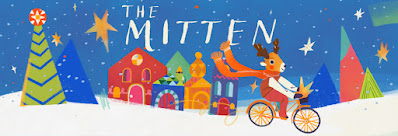
Kristen Uroda's Winter 2022 Mitten Banner


How will the SCBWI membership be useful to you?


Even in the short time since I received the SCBWI membership, it’s been an incredible resource to learn about the children's book industry, different ways to level up my skills, and discover other illustrators in my own backyard. There’s such a wealth of information and opportunities to connect with the larger community that is rare to find if you’re doing this all on your own. I’ve learned so much already from the digital workshops, I wish I could have joined sooner!


Southern Poverty Law Center
2022 Calendar
We’d like to get to know you! Tell us about your past creative work in the area of children’s literature or related areas of interest or expertise.


I am a Michigan native, born in Detroit. I like to say that I’m a creator, innovator, and storyteller passionate about art and design that makes a difference and makes the world a more beautiful place. I love turning problems, stories, and abstract concepts into illustrations that inspire reflection, action, and social and civic change.


The Skillman Foundation Annual Report:
Celebrating 60 Years of Service (cover)

For the last decade, my sweet spot has been in editorial illustration, mainly for news sites and publications, but I originally went to art school (Massachusetts College of Art and Design) with the intention of focusing on children’s books, comics, and narrative illustration. While I do love the editorial world because I come across a lot of unique stories that I have the honor of visualizing, I’ve been waiting for the right time and opportunity to jump into the children's book industry. I recently got my chance with my first picture book deal that should be completed this coming year. 


What in your childhood or youth piqued your interest in writing or illustrating? What were some of the major influences that led you to this road?


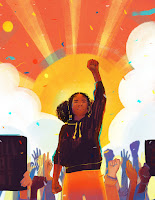
NPR: 
Short Wave Celebrates Black Excellence
In Scienc
e
The first time I can remember really being in awe of what hands could create with a simple crayon and paper happened one day when I was practicing drawing stars. I was young, maybe 5, and at the time, the best I could do was drag the crayon across the page to make messy lines-criss-crossing stars. And I clearly remember at one point, asking my mom if she could draw stars with me, so she sits down, grabs a crayon and then draws this perfect, no crisscrossed lined star flawlessly and that absolutely blew my mind.


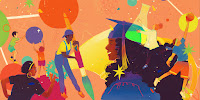
C&EN: 
Chemistry textbooks still lack gender and racial representation
At that point, I was forever hooked to the pursuit of understanding the connection between the mind, the mind's eye, and mark making. Every time I came across someone who could draw well, I thought, “I want to do this too.” I think that desire also helped open my eyes to the artists that were around me, mainly in my picture books, which I had a ton of. My favorites were Eric Carle, Don Freeman, Ezra Jack Keates, Dr. Seuss, Marcus Pfister, Ludwig Bemelmans, Tomie de Paola, Maurice Sendak, Shel Silverstein, E. H. Shepard, the incredible duo Leo and Diane Dillon, and many more. A lot of these illustrators inspired me to read, write, and draw stories.


NPR: 
If You Feel Thankful, Write It Down.
It's Good For Your Health
Even today, I’m still a pretty big nerd for picture books, comics, and animated films. I can’t go into a bookstore or library without stopping by the children’s section and being in awe at the number of amazing artists and storytellers out there. And it’s great seeing such a diversity of artists these days too. Throughout childhood and even college, it was rare to see female illustrators and illustrators of color in the spotlight. It’s only within the last decade that I’ve seen illustrators like myself becoming more visible.


Please share anything about your current projects or what’s ahead in your creative work? We’d love to hear about it!


NPR: 
Stop being so mean to yourself.
Here are 5 tips to help you break the cycle
I’m not sure how much I can share as the official press release hasn’t come out yet, but I am currently working on illustrating my first picture book that should be coming out in the next year or so. It’s based on a poem written by a Black artist and activist. It was a product of the grief she felt after Michael Brown was fatally shot by a police officer in 2014 but it’s a really joyful and playful vision of community-building and healing. 


As it’s my first picture book, there’s been a lot of learnings gained, but I’ve had so much fun and the team I’m working with have been great! I’m excited for it to enter into the world and excited for whatever stories I get to illustrate next. 


Thank you, Kristen, for sharing your story and illustrations with our SCBWI-MI community. We look forward to seeing more of your creative work!


 --Isabel Estrada O’Hagin, 

SCBWI-MI Outreach Coordinator