
Charlie Barshaw coordinates our regular Writer Spotlight feature and interviews writers of SCBWI-MI. In this piece, meet award-winning author/illustrator Lynne Rae Perkins
You grew up in Pennsylvania, in a mythic childhood of fields and woods and "the Boney Dump,” tons of same-age kids, and a curfew of when the streetlights came on. How much did that carefree childhood figure into the writer you’ve grown into?
There was a lot of freedom in our childhoods, alongside some pretty firm expectations at home. There was a lot of room for daydreaming, a lot of making our own fun. A lot of sitting on the curb popping tar bubbles with our toes. We had good neighbors; funny, kind people.
There was somehow freedom and being sheltered at the same time, which sounds good except that adolescence really threw me for a loop. I think the writer I am was formed by that mythic but circumscribed childhood running up against growing up and encountering the rest of the world. That’s not unusual, though – we all have to find our own way through it.
You tell the story of meeting Ava Weiss, art director at Greenwillow Books. You were looking to illustrate, but she sensed you had a writing soul that shone from within your art, that stories lurked there untold. She asked if you could put words to your pictures. And you did, resulting in your first picture book Home Lovely. How much did your fortunate teaming with Ava Weiss and Greenwillow Press affect how and what you produced?
Actually, I only thought (at the time) that Ava Weiss saw the writer in me. She told me later that she always asked artists if they also wrote. But thinking she saw that in me made me think it might in fact be in there. When Greenwillow Books wanted the story I sent, I thought, maybe this is something I can do.
I think the best gift, aside from that first connection, has been that Greenwillow has always wanted to see what I’m working on. They have been open to and patient with my ideas, which are sometimes vague and patchy and hypothetical at first. It has made a huge difference to me to know that someone will look at what I am doing.
What motivated you to go from the picture book Clouds for Dinner, to the middle grade novel, All Alone in the Universe? Writing is writing, but how do you think differently when approaching a picture book versus a novel?
 I studied printmaking in undergrad and grad school. I had made a series of etchings, collaborating with a printmaker friend in California, and was getting started on another suite. These etchings were visual, of course, but there was writing on them, too.
In an interview with the Horn Book you describe a morning routine where Bill brings you a thermos of coffee, and you daydream in your room before heading for work in your studio. This state between dreams and reality seems to be your comfort zone. How do you find the right balance between visions and reality?
I might have exaggerated the daydreaming part in that Horn Book piece. I do give myself time to wake up, but then I usually read a couple of poems, write in my notebook, or write a postcard to a friend. More than daydreaming or visions, it’s a time where I let thoughts float in and out of my head, and sometimes write them down. Processing what happened the day before, stuff like that.
Several of our artist friends decided that we needed to spiff them up. They were clay artists, so they brought their broken pieces, aka shards. For about 12 years, we have spent the Monday after the Suttons Bay Art Fair adding to the mosaic. The rule is, if you put it on the wall, you have to grout it.
It's always a really fun day. It’s like parallel play – we each pick our own little project for the day and putter away. Everyone is welcome, all ages. For me, it’s also an exercise in letting go of control – people have their own ideas. Usually, the surprises are happy ones.
What amazes me is that I walk between the walls every day, and I nearly always see something I’ve never noticed before.
What’s next for Lynne Rae Perkins?
I just finished an illustrated young novel about a girl who travels with her dad and her grandma to visit an old friend of the dad’s in a Central American country. She learns some Spanish words and makes a friend of her own. The theme that formed in my mind while I was making this book was that tiny friendships hold the world together.
Coincidentally (ha, ha), I have been studying Spanish for a few years now, and have traveled to Guatemala twice. (Where do you get your ideas? people ask . . .)
The book is called At Home in a Faraway Place, and is scheduled to come out next winter.
Here are a few more Shardfest photos, because art:
You grew up in Pennsylvania, in a mythic childhood of fields and woods and "the Boney Dump,” tons of same-age kids, and a curfew of when the streetlights came on. How much did that carefree childhood figure into the writer you’ve grown into?
There was a lot of freedom in our childhoods, alongside some pretty firm expectations at home. There was a lot of room for daydreaming, a lot of making our own fun. A lot of sitting on the curb popping tar bubbles with our toes. We had good neighbors; funny, kind people.
There was somehow freedom and being sheltered at the same time, which sounds good except that adolescence really threw me for a loop. I think the writer I am was formed by that mythic but circumscribed childhood running up against growing up and encountering the rest of the world. That’s not unusual, though – we all have to find our own way through it.

You tell the story of meeting Ava Weiss, art director at Greenwillow Books. You were looking to illustrate, but she sensed you had a writing soul that shone from within your art, that stories lurked there untold. She asked if you could put words to your pictures. And you did, resulting in your first picture book Home Lovely. How much did your fortunate teaming with Ava Weiss and Greenwillow Press affect how and what you produced?
Actually, I only thought (at the time) that Ava Weiss saw the writer in me. She told me later that she always asked artists if they also wrote. But thinking she saw that in me made me think it might in fact be in there. When Greenwillow Books wanted the story I sent, I thought, maybe this is something I can do.
I think the best gift, aside from that first connection, has been that Greenwillow has always wanted to see what I’m working on. They have been open to and patient with my ideas, which are sometimes vague and patchy and hypothetical at first. It has made a huge difference to me to know that someone will look at what I am doing.
What motivated you to go from the picture book Clouds for Dinner, to the middle grade novel, All Alone in the Universe? Writing is writing, but how do you think differently when approaching a picture book versus a novel?

As I remember it, I started writing All Alone in the Universe because I was trying to figure out one of the etchings, what it was about. Then I kept writing. Then I found myself in the middle of a bunch of writing and thought, how do I get out of this?
It often happens that way for me – I think I’m going to make something short and simple and then it gets more complicated, which means it’s a novel.
In terms of writing picture books vs. novels, I think you just think about who you’re talking to. But I think kids are capable of handling some complex ideas, if someone helps them along. I always think of my picture books as being read by a child and an adult together.

In terms of writing picture books vs. novels, I think you just think about who you’re talking to. But I think kids are capable of handling some complex ideas, if someone helps them along. I always think of my picture books as being read by a child and an adult together.
How did you come to terms with winning the Newbery, the Holy Grail of children’s book writers? Did it affect your writing life? Your author life?
I confess that when Criss Cross received the Newbery, I didn’t completely grasp what a big deal it was. It did feel like a huge affirmation, and I was of course very, very happy about it, but all of the experiences were so new for me – I’m not sure how well I handled it. I could have used a coach to accompany me everywhere.
I confess that when Criss Cross received the Newbery, I didn’t completely grasp what a big deal it was. It did feel like a huge affirmation, and I was of course very, very happy about it, but all of the experiences were so new for me – I’m not sure how well I handled it. I could have used a coach to accompany me everywhere.
There were some super lovely parts, like when Wild Rumpus Bookstore in Minneapolis had someone perform Hector’s songs. And there were some humbling moments, like when I arrived at our local art museum for a reception after a tour, planning on “winging it,” and learned that winging it isn’t something that I personally should count on being able to do. I was more or less speechless.
The Newbery did give me the confidence, for quite a long time, that my ideas were good ideas. I think it surprised me to find that for some people, a Newbery book is supposed to be for everyone. And my book wasn’t for everyone. Though I re-read it not too long ago and found that I like it pretty well.
You describe somewhere a car ride as a way to view experience. You’re in a car, you don’t like the music you’re listening to. Now, you’re in the car behind, with better music, maybe more room in the backseat, maybe a better vibe in the car. You see the same things out the window, but you have different reactions to them. Is that virtual-mood-shift-car-ride the secret to your ability to inhabit the minds of different characters?
It’s so interesting to me that ten people can be in one place and there will be ten different experiences of what’s going on. I’m always grateful when someone – a writer, a poet, a friend, a stranger – gives me an insight into a way of experiencing something that has never occurred to me.
Though not too many different ones at once – I get overwhelmed.
Your books and blogs and extra-curricular add-ons abound with creative mind-stretching ways to explore the world around us. Were you ever a teacher? Or do you just love playing?
I think I just like making stuff. One of my favorite books as a child was the Alcoa Aluminum Foil Company’s Book of Decorations (that you could make with a billion rolls of aluminum foil, of course). When our kids were little, we had crafts afternoons with friends. I was always at the table long after the kids had moved on to other games.
How have you evolved as an artist over your years of creating books? Which medium(s) do you prefer to use lately?
I think I’m getting better at it. Maybe. At times.
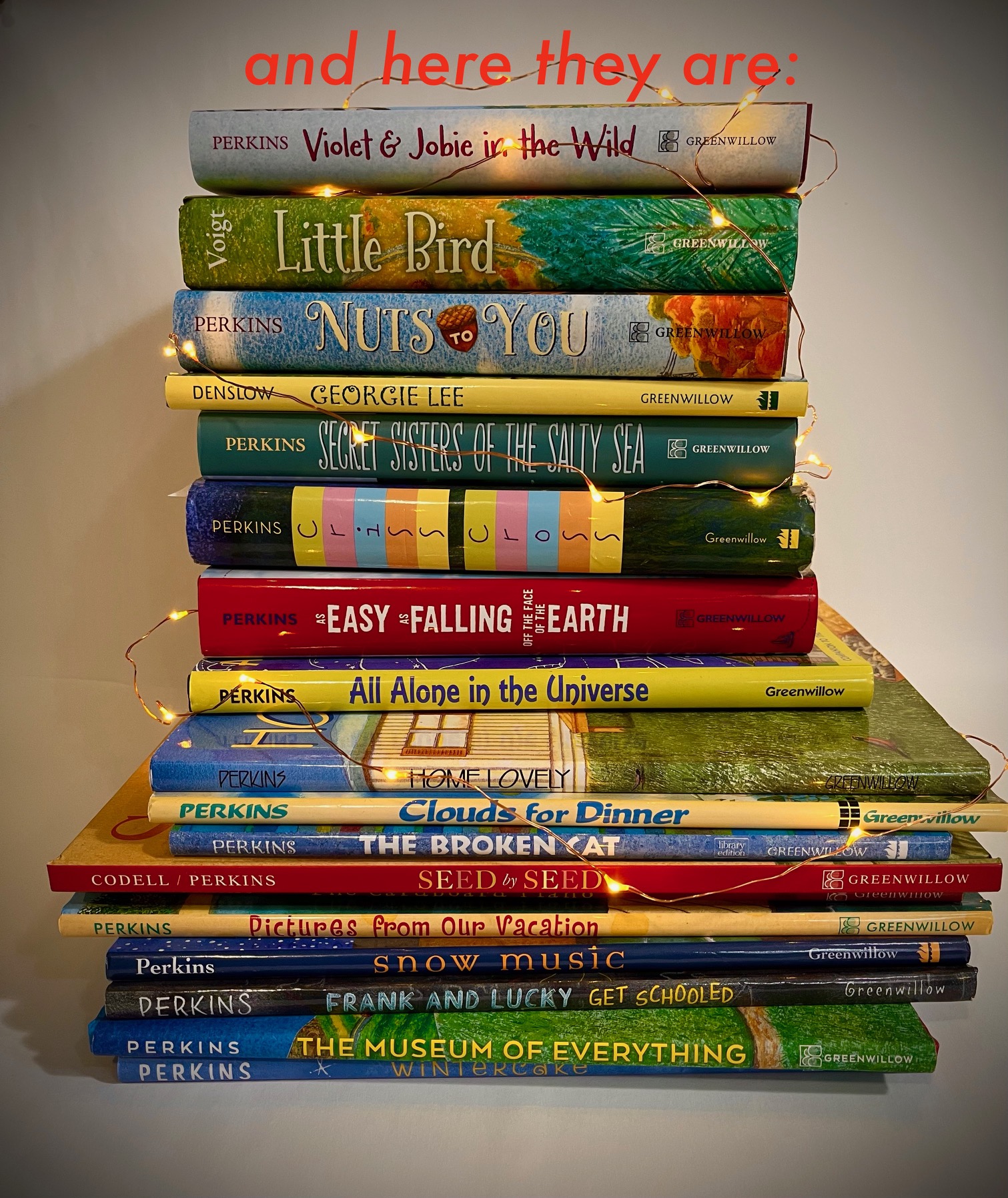 |
| Perkins' body of work (so far) |
The Newbery did give me the confidence, for quite a long time, that my ideas were good ideas. I think it surprised me to find that for some people, a Newbery book is supposed to be for everyone. And my book wasn’t for everyone. Though I re-read it not too long ago and found that I like it pretty well.
You describe somewhere a car ride as a way to view experience. You’re in a car, you don’t like the music you’re listening to. Now, you’re in the car behind, with better music, maybe more room in the backseat, maybe a better vibe in the car. You see the same things out the window, but you have different reactions to them. Is that virtual-mood-shift-car-ride the secret to your ability to inhabit the minds of different characters?
It’s so interesting to me that ten people can be in one place and there will be ten different experiences of what’s going on. I’m always grateful when someone – a writer, a poet, a friend, a stranger – gives me an insight into a way of experiencing something that has never occurred to me.
Though not too many different ones at once – I get overwhelmed.
Your books and blogs and extra-curricular add-ons abound with creative mind-stretching ways to explore the world around us. Were you ever a teacher? Or do you just love playing?
I think I just like making stuff. One of my favorite books as a child was the Alcoa Aluminum Foil Company’s Book of Decorations (that you could make with a billion rolls of aluminum foil, of course). When our kids were little, we had crafts afternoons with friends. I was always at the table long after the kids had moved on to other games.
How have you evolved as an artist over your years of creating books? Which medium(s) do you prefer to use lately?
I think I’m getting better at it. Maybe. At times.
I use watercolor more than anything else.
You wrote and illustrated your own books for many years before you got a chance to illustrate for another author. How different is your approach to illustrating when it’s not your words? How many books have you solely illustrated?
I’ve only illustrated one picture book and two novels by other authors. It thrills me when I can make a piece of art that I hope speaks to the spirit of the book, and to the author. But I am always guessing a little bit, in a way I am not with my own books. I think that’s not a bad thing – it’s like how we are guessing a little bit when we have a conversation with someone.
Do you dabble in art “not on the page”? Sculpture, macrame, dioramas, found objects? What kind of art have you NOT produced that you’re still looking forward to tackling?
Actually, I just finished making some videos for some schools that are reading Nuts to You, and having Young Authors events. I’m having fun figuring out how to do it (iMovie), with little bits of animation, and various tripods, etc.
I also like “stunt food” – rice cubes, checkerboard cakes, cookies that look like mice. Stuff like that.
In Violet and Jobie in the Wild, you give your mice characters human emotions. You’ve featured many furry creatures in your work. How do you maintain your sense of childlike curiosity and wonder in this jaded world?
Doesn’t everyone give their mice characters human emotions? To be honest, I never expected to make stories about furry creatures, they kind of snuck up on me.
In a way, I think that having animals as characters does something that setting your story in another time period also does – it gives the reader a certain distance from the story, in a good way – it lets the reader look at emotions that might feel too strong if they were set right in our own lives.
 Your husband Bill is a craftsman who builds furniture from “twigs and bark.” That description downplays his talent, in that his work has been displayed at the Smithsonian. Is Bill Perkins the reason we’ve got you in Michigan? You said he introduced you to the concept of self-employment. You both seem to embrace the challenge of having yourself as your boss.
Yes, Bill is the reason I am here! And self-employment, as we all know, has its challenges, of course. But I think that by now we are too addicted to doing whatever we want to work for anyone else.
You wrote and illustrated your own books for many years before you got a chance to illustrate for another author. How different is your approach to illustrating when it’s not your words? How many books have you solely illustrated?
I’ve only illustrated one picture book and two novels by other authors. It thrills me when I can make a piece of art that I hope speaks to the spirit of the book, and to the author. But I am always guessing a little bit, in a way I am not with my own books. I think that’s not a bad thing – it’s like how we are guessing a little bit when we have a conversation with someone.
Do you dabble in art “not on the page”? Sculpture, macrame, dioramas, found objects? What kind of art have you NOT produced that you’re still looking forward to tackling?
 |
| mouse pastry |
I also like “stunt food” – rice cubes, checkerboard cakes, cookies that look like mice. Stuff like that.
In Violet and Jobie in the Wild, you give your mice characters human emotions. You’ve featured many furry creatures in your work. How do you maintain your sense of childlike curiosity and wonder in this jaded world?
Doesn’t everyone give their mice characters human emotions? To be honest, I never expected to make stories about furry creatures, they kind of snuck up on me.

In a way, I think that having animals as characters does something that setting your story in another time period also does – it gives the reader a certain distance from the story, in a good way – it lets the reader look at emotions that might feel too strong if they were set right in our own lives.

Yes, Bill is the reason I am here! And self-employment, as we all know, has its challenges, of course. But I think that by now we are too addicted to doing whatever we want to work for anyone else.
 |
| Ed Spicer provided this clipping |
In an interview with the Horn Book you describe a morning routine where Bill brings you a thermos of coffee, and you daydream in your room before heading for work in your studio. This state between dreams and reality seems to be your comfort zone. How do you find the right balance between visions and reality?
I might have exaggerated the daydreaming part in that Horn Book piece. I do give myself time to wake up, but then I usually read a couple of poems, write in my notebook, or write a postcard to a friend. More than daydreaming or visions, it’s a time where I let thoughts float in and out of my head, and sometimes write them down. Processing what happened the day before, stuff like that.
I’m at my most clear-headed and (maybe) generous first thing in the morning. Writing things down helps me think in a straight (sort of) line. And sometimes insights or ideas reveal themselves.
Ed Spicer told me about Shardfest and even supplied a few of his personal photos. Tell us about Shardfest (not to be confused with a music festival in the U.K.)
We built our house on a very uneven, lumpy, hilly lot. (But we got a good price on it!) We needed tall retaining walls to have a driveway, but they turned out to be ugly (brutalist?) concrete retaining walls.
Ed Spicer told me about Shardfest and even supplied a few of his personal photos. Tell us about Shardfest (not to be confused with a music festival in the U.K.)
We built our house on a very uneven, lumpy, hilly lot. (But we got a good price on it!) We needed tall retaining walls to have a driveway, but they turned out to be ugly (brutalist?) concrete retaining walls.
 |
| Shardfest wall, photo from Lynne |
Several of our artist friends decided that we needed to spiff them up. They were clay artists, so they brought their broken pieces, aka shards. For about 12 years, we have spent the Monday after the Suttons Bay Art Fair adding to the mosaic. The rule is, if you put it on the wall, you have to grout it.
It's always a really fun day. It’s like parallel play – we each pick our own little project for the day and putter away. Everyone is welcome, all ages. For me, it’s also an exercise in letting go of control – people have their own ideas. Usually, the surprises are happy ones.
 |
| photo from Ed Spicer |
What amazes me is that I walk between the walls every day, and I nearly always see something I’ve never noticed before.
What’s next for Lynne Rae Perkins?
I just finished an illustrated young novel about a girl who travels with her dad and her grandma to visit an old friend of the dad’s in a Central American country. She learns some Spanish words and makes a friend of her own. The theme that formed in my mind while I was making this book was that tiny friendships hold the world together.
Coincidentally (ha, ha), I have been studying Spanish for a few years now, and have traveled to Guatemala twice. (Where do you get your ideas? people ask . . .)
The book is called At Home in a Faraway Place, and is scheduled to come out next winter.
Here are a few more Shardfest photos, because art:
 |
| photo by Lynne Rae Perkins |
 |
| Shardfest in action photo by Ed Spicer |
 |
| Ann Perrigo (left) with other Shardfest artists photo by Ed Spicer |


