Friday, March 3, 2023

Three Reasons To Volunteer for the MRA Annual Conference: March 17 - 20


Did you know that volunteering for an event such as the Michigan Reading Association's Annual Conference, being held at the DeVos Place in Grand Rapids could be one of the best investments in your publishing career? Well, it’s true. Whether you're pre-published or have a bazillion books under your belt, participating in an event such as this can have a long-term positive impact on your marketing efforts. Let me tell you why.


  • Your Target Audience: The term “target audience” is a marketing term referencing the people that are most likely to be interested in a product or service – your books! The MRA membership is composed of teachers and librarians from all over the great State of Michigan. Friends, these lovely people are your target audience! They’re gatekeepers! And, by participating in the event in a genuine and authentically helpful way, these educators will have an opportunity to get to know you, whether you are pre-published or not.


  • Relationship Marketing: Publishing guru Tim Grahl has revised the definition of marketing as being, “The act of building long-lasting connections with people.” Oftentimes, these long-lasting connections develop into relationships, friendships that develop over a space of time. Tim says, “The more long-lasting connections you make with readers, the more books you will sell in a natural manner that reflects genuine connection rather than shady salesmanship” (YOUR FIRST 1000 COPIES, pg. 9). And how will you initiate such long-lasting connections? By volunteering at the MRA conference. That’s how.


  • Community Building: The word “community” is defined as a feeling of fellowship with others through the sharing of common attitudes, interest, and goals. The MRA believes that literacy is essential to success in life and that freedom to read is essential to our democracy. They are dedicated to making a difference in students’ lives by offering ongoing, sustainable professional development to the educators in Michigan.  Well, I share those common attitudes, interests, and goals. Don’t you? The good folks at the Michigan Reading Association are my kind of people. I’ll bet they’re yours, also.


If you are in the Grand Rapids area and desire to engage in a community building relationship marketing opportunity with your target audience, join me at the MRA Annual Conference being held at the Devos Center from Friday, March 17 to Monday, March 20. They need our help to make the event a grand success. Let’s be there for them.


If you’re interested, shoot me a note at debbadee5@gmail.com.  There is no cost to participate and the benefits are insurmountable!


Hope to see you in Grand Rapids!


Children's author, career educator & Pinterest marketing specialist, Debbie Gonzales is the founder of Pin Lit Marketing, a boutique Pinterest marketing agency for book sellers & creators. Deb is the author of a collection of early readers and the nonfiction picture book GIRLS WITH GUTS: THE ROAD TO BREAKING BARRIERS AND BASHING RECORDS. She’s the host & creator of Guides by Deb, a website consisting of over 300 standards-aligned educator guides for all genres. Learn more about Deb at debbiegonzales.com or guidesbydeb.com.


Wednesday, March 1, 2023

Book Birthday Blog with Nancy Bordine


Welcome to SCBWI-MI's Book Birthday Blog!

Where we celebrate new books from Michigan's authors, illustrators and translators.


Congratulations to Nancy Bordine on the release of What Do You See? Developing New Perspectives with Quilt Patterns


How did you come up with the idea for your book?

A writer’s adage says, “Write what you know.” I’ve taught school children quilt lore for years; I’ve seen the things about quilts that spark their imaginations. My wise writing coach urged me to include learning activities that connect to my book. I enjoyed creating all the connecting pieces.

What is something you hope your readers will take away from your book? 

The concept that we all have more in common than we think we do. The concept that we’re all one race, the Human Race, and we’re just different expressions of the human genome. The concept that you can gain understanding by looking at things from different perspectives. The curiosity to learn more about things.

What inspires you to write?

I’m a ‘dyed in the wool’ teacher. I enjoy opening minds to new concepts. Writing is a media with a broad reach that allows me to encourage the world to be more empathetic. Writing is something that will outlive me.

What was the most difficult part of writing this book?

The creative process is play for me. The most challenging thing has been marketing—selling my ideas to a publisher, developing effective social media platforms, generating interest amongst book sellers, etc. Marketing has been such a learning experience. I’m so grateful for my support group of fellow writers.


What's next for you?

I’m taking the leap from picture books to Young Adult Historical Fiction. My first novel will be about the 1880’s culture clash when Native American children in my area were kidnapped to attend Indian Boarding schools. The book juxtaposes the lives of an Anishinaabe girl studying to become a Medicine Woman and a Boston spinster schoolteacher who ventures to the wilderness to save ‘lost Indian souls'. The clash requires each woman to determine what she can hold onto, and what she can let go of, in order to survive in their new situations.

A little bit about the book . . .

What Do You See? Developing New Perspectives with Quilt Patterns is a colorful picture book featuring a diverse group of children interacting with inspirations for traditional quilt patterns. The children represent a wide range of heritages and abilities so that a young reader will be able to see themselves in the characteristics of one or more child in the book. The book includes adult-led learning activities that give children concrete concepts for developing empathy, appreciation for diversity, critical-thinking skills, creativity, and strategies for being more inclusive. It also includes unique biographies and colorful finger puppets of each character in the book. "WDYS?" contains a scannable link to more learning activities specific to Common Core Standards for Math, Geometry, and Fractions for Grades K-4.

A little bit about the author . . .

Nancy Bordine is a retired nurse, healthcare educator, and speaker who grew up at the feet of a grandmother who loved to make quilts. Nancy’s inherited love of quilts led her to become “The Quilt Lady” historical reenactor for thousands of local 4th graders for fourteen years. Nancy and her husband have been Foster Parents to a dozen children in crisis and have hosted exchange students from around the world. Of the many learning programs Nancy has designed in her career, she most enjoyed those focused on developing critical-thinking skills and diversity sensitivity.

https://www.facebook.com/missnancywrites 

https://www.missnancywrites.com/ 

Instagram @nancybordine

Email NancyBordine@gmail.com 


Friday, February 24, 2023

ChatGPT and the Dragon

I felt surprised when, in my "other life" as the managing editor of an academic journal, the subject of ChatGPT came up on the agenda of an editorial board meeting. Before that moment, it hadn't occurred to me that the ability of AI to generate content had progressed to the point where it was a problem or something that we needed to make a policy about. 

I knew, of course, that AI has been being developed for some time and also know about many jobs being lost to automation, but I had felt “safe” from its intrusion into my work. While I understand that my phone has been able to find answers to basic questions for some years, it doesn't come up with its own ideas. I assumed we were far away from AI doing creative work well.  

Can AI tell a story? What if I gave it very few guidelines to write a picture book – just the commonly recommended word limit of 500 words and that it be appropriate for a child to hear and a subject. I gave it the subject of a dragon, because my favorite of my current picture book manuscripts is about a dragon. What would it come up with? Can it do my work better than I can yet?

It made a surprisingly coherent story, with all the basic parts of a story and a nice arc. It did it quickly - more quickly than I can write and with a clearer plot than many first drafts I've written. If anything, it felt a little old fashioned, beginning with “Once upon a time” and ending with “The End.”

Can you tell me a story about a dragon that is fewer than 500 words and would be appropriate for a child to hear? Once upon a time, in a faraway kingdom, there lived a kind and friendly dragon named Daisy. Daisy lived in a cave deep in the forest and spent her days collecting shiny treasures and napping in the sun.  The people of the kingdom were afraid of Daisy because they had heard stories of fierce dragons that breathed fire and hoarded treasure, but Daisy was nothing like that. She loved to fly around the forest and play with the animals, especially the birds and butterflies.  One day, a terrible storm rolled in and destroyed the kingdom's crops. The people were in great need and the king sent out a call for help. Daisy heard the call and knew she had to do something to help. She gathered all the shiny treasures she had collected and flew to the kingdom.  When she arrived, the people were amazed to see such a friendly dragon. Daisy gave them all of her treasures, which they used to buy new seed and rebuild their homes. From that day on, Daisy was no longer feared by the people and was welcomed as a friend.  The kingdom flourished, and Daisy and the people lived happily ever after. And from that day on, every year, Daisy and the people of the kingdom would work together to plant new crops and make sure that everyone had enough to eat. The End.

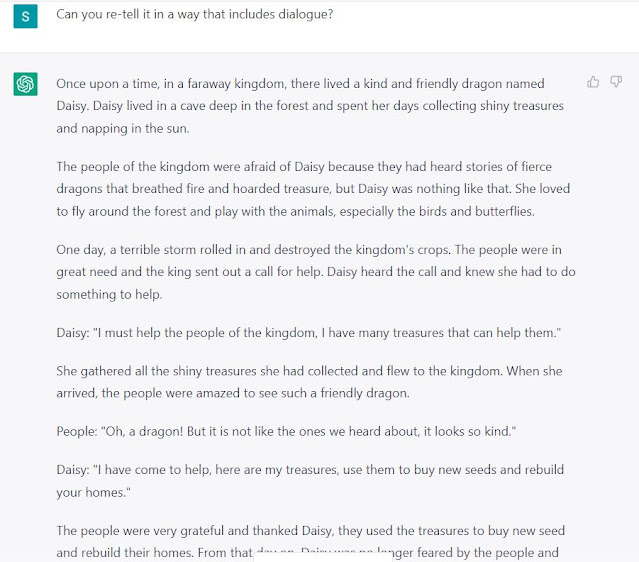
Could it revise, though? I thought about what I would have done differently if I had written this story, and it occurred to me that I would probably have used some dialogue. So, I asked it to re-tell it using dialogue. It was able to keep the structure of the story and have Daisy the dragon and the people saying a few things, but it didn’t really make the story better or sound natural (although it’s not as if every revision attempt I make necessarily improves a story either).

Can you re-tell it in a way that includes dialogue? Once upon a time, in a faraway kingdom, there lived a kind and friendly dragon named Daisy. Daisy lived in a cave deep in the forest and spent her days collecting shiny treasures and napping in the sun.  The people of the kingdom were afraid of Daisy because they had heard stories of fierce dragons that breathed fire and hoarded treasure, but Daisy was nothing like that. She loved to fly around the forest and play with the animals, especially the birds and butterflies.  One day, a terrible storm rolled in and destroyed the kingdom's crops. The people were in great need and the king sent out a call for help. Daisy heard the call and knew she had to do something to help.  Daisy: "I must help the people of the kingdom, I have many treasures that can help them."  She gathered all the shiny treasures she had collected and flew to the kingdom. When she arrived, the people were amazed to see such a friendly dragon.  People: "Oh, a dragon! But it is not like the ones we heard about, it looks so kind."  Daisy: "I have come to help, here are my treasures, use them to buy new seeds and rebuild your homes."  The people were very grateful and thanked Daisy, they used the treasures to buy new seed and rebuild their homes. From that day on, Daisy was no longer feared by the people and was welcomed as a friend.  The kingdom flourished, and Daisy and the people lived happily ever after. And from that day on, every year, Daisy and the people of the kingdom would work together to plant new crops and make sure that everyone had enough to eat. The End.

I was curious what kind of input it had to be able to come up with a story like this. Was it very similar to a book it had "read?" Would it be able to identify where it had gotten this form of story from? So, I asked it “Which books do you know that are similar to this story?"

It gave a response including five books and their authors and summaries. All the authors were real, but none of the books seemed to exist.

And that’s when I realized that AI sometimes just lies.

Which books do you know that are similar to this story?  There are many books that are similar in theme to the story of the friendly dragon named Daisy. Some examples include:  "The Little Dragon" by Margaret Wild, is a story about a dragon who learns to be kind to others and how to make friends. "Dragon's Heart" by Joel Ross, is a story about a dragon who learns the importance of kindness and compassion. "The Friendly Dragon" by Margaret Wild, this is a story about a dragon who wants to be friends with humans and he help them in the end. "The Dragon and the Knight" by Eric A. Kimmel, a story about a dragon who helps a knight to defeat a giant instead of fighting him. "The Dragon's Good Deed" by Dav Pilkey, A dragon learns to be a hero and helps the village in difficult time. These books all feature dragons that are kind and friendly, and they use their abilities to help others. They all convey the message of kindness, compassion and friendship.

When I asked if it was sure they existed, it apologized, admitting that “it seems that some of the books I mentioned may not exist” and listing five that do.

So, I guess the lesson is that you might be able to use it to generate some comps for something you're writing, make sure that the books the AI finds actually exist...

I am having trouble finding any of those books. Are you sure that they exist or did you take the names of authors who have written books about dragons and make titles that would fit the theme?  I apologize, upon further research, it seems that some of the books I mentioned may not exist. As a language model, I don't have the capability to check the availability of a certain book on the market, I can only generate text based on the information I have been trained on. However, I can recommend some similar books that are available:  "Dragon's Kindness" by Margaret Wild, this is a picture book about a dragon who wants to be kind, even when others are not. "The Last Dragon" by Jane Yolen, is a story of a dragon who is the last of her kind and helps a knight to understand the value of being kind and compassionate. "How to Train Your Dragon" by Cressida Cowell, A boy and a dragon become friends and go on adventures together, learning about loyalty, courage, and understanding. "The Dragon and the Nibblesome Knight" by Elli Woollard, A dragon and a knight become friends and help each other to overcome their fears and biases. "The Dragon and the Knight" by Eric A. Kimmel, a story about a dragon who helps a knight to defeat a giant instead of fighting him. I apologize for any confusion caused by my previous responses. I hope these recommendations are helpful.

What if it didn’t have the topic of a dragon? What if I asked it to write a picture book manuscript instead?

This time it separated the story by pages, and wrote a story about a seed that had a dream to grow into a strong tree and eventually did. It was kind of sweet.

Write a picture book manuscript with an audience of children ages 4-8.  Title: The Little Seed's Big Dream  Page 1: Once upon a time, there was a little seed. It lived in a warm and cozy place in the ground.  Page 2: The little seed had a big dream. It wanted to grow into a tall and strong tree, just like its parents.  Page 3: One day, a gentle breeze blew and whispered to the little seed, "It's time to grow."  Page 4: The little seed woke up from its long nap and started to stretch its roots and shoot.  Page 5: It poked its head out of the ground and saw the big, beautiful world.  Page 6: The little seed felt a little scared but also excited. It knew it had a big dream to fulfill.  Page 7: The little seed drank in the sunshine and rain, and soon it grew a little taller.  Page 8: It felt the wind blowing and swaying it back and forth, but it held on tight.

Page 9: Days turned into weeks, and weeks turned into months. The little seed grew bigger and bigger.  Page 10: One day, the little seed felt something strange. It felt a tiny bud growing on its branches.  Page 11: The little seed was amazed! It had never seen anything like it before.  Page 12: The little bud grew bigger and bigger, until one day, it opened up into a beautiful flower.  Page 13: The little seed was so proud of its beautiful flower. It had grown from a tiny seed to a tall and strong tree.  Page 14: The little seed looked around and saw all the other trees and flowers, and it knew it was part of something big and beautiful.  Page 15: The little seed looked up at the big blue sky and whispered, "Thank you, world, for helping me grow and fulfill my big dream."  Page 16: The end.


So, what does this mean for me? For us as writers? In short, I don’t know. I don’t like the feeling that I could be replaced by a machine, and for now I don’t think I can. Reading the stories generated by ChatGPT, my guess is that it can write in various "styles" but that it is missing something when it comes to the elusive concept of "voice." 

What do you think? How close is ChatGPT (or other AI software) to being able to do what we do? How can it help us or how can it hurt us? Please share your thoughts in the comments! 

I also just noticed that this topic will be discussed at an upcoming virtual Shop Talk for those of us who are interested. 

Tuesday, February 21, 2023

Book Birthday Blog with Katherine Higgs-Coulthard


Welcome to SCBWI-MI's Book Birthday Blog!

Where we celebrate new books from Michigan's authors, illustrators and translators.


Congratulations to Katherine Higgs-Coulthard on the release of Junkyard Dogs


How did you come up with the idea for your second book?

The idea for Junkyard Dogs actually started with Stan’s character. I was waiting in the carpool line to pick my kids up from school when I noticed a man walking along the road in a very quirky way. I was mesmerized by the way he rolled his hands and wanted to know more about him. Since interviewing strangers about their idiosyncrasies is generally frowned upon in polite society, I created a character sketch instead. It took years for me to find the right story for that character.
 
The story itself is inspired by something that happened in South Bend, IN in 2006. Several homeless men were found dead in manholes as a result of a dispute over a metal scrapping ring. While Junkyard Dogs is not the story of those crimes, Josh (the main character) does get dragged into a metal scrapping operation after his dad goes missing.

What is something you hope your readers will take away from your book? 

I think the main message in Josh’s story is that sometimes the people who are supposed to be your family can’t or won’t give you what you need, but that doesn’t mean you don’t deserve better or that you’re alone. In the end, Josh’s life does not turn out like he expected, but he is okay because people step in to fill the spaces left by his family. Josh’s story doesn’t end with a big happy bow—real life seldom does—but life doesn’t have to be perfect for us to be okay.


What inspires you to write?


I write to give voice to the struggles kids face. Families can be complicated and I explore many of the forms that can take in my stories. My first book, Hanging with My Peeps, is about a girl whose dad is unemployed. His get-rich-quick schemes are funny on the surface, but underneath those humorous moments is a girl who is struggling to fit in when her family can’t afford many of the things that the other kids have. Poverty is also a theme in Junkyard Dogs, but Josh also struggles because the adults in his life either don’t know how or don’t care to provide a nurturing home for him. I wanted Josh and his little brother to be okay, despite the failures of adults.


What was the most difficult part of writing this book?


There’s a scene where Josh explores the wreckage of his childhood home. That was hard for me to write because a lot of what he’s feeling came from my own memories of when I was a kid. My house burned down in fifth grade and, although no one was hurt, my family lost everything we owned. As Josh walks through the remnants of his house, I could smell the scorched metal, taste the soot and ash. It dredged up many painful memories for me, but it also helped me process them. Writing is great therapy. It gives me the time and space to take out difficult memories and consider them with the benefit of hindsight. Rewriting those memories with different endings for the characters of my stories is also cathartic.


What's next for you?


I am in the process of writing a YA ghost story, although like my other books, it is really a story about family dynamics. The story is inspired by a unique grave near my house—it is totally encased in tree roots.


A little bit about the book . . .


Some people dream of happily ever after, but all 17-year-old Josh Roberts wants is a roof over his head and for his little brother to be safe.
 
Josh’s father has gone missing without a trace. Now Josh and his 9-year-old brother, Twig, are stuck living with Gran in her trailer. Problem is, Gran didn’t ask to take care of any kids, and she’s threatening to call social services unless Josh can find his dad. After paying off Gran to take in his little brother, Josh risks truancy and getting kicked off his basketball team to take to the streets and hunt for his dad. But when Josh digs too deep, he suddenly finds himself tethered to a criminal scrapping ring that his father was accomplice to. If Josh wants to keep Twig out of the system and return to some sense of normal, he’ll have to track his dad down and demand honest answers.


A little bit about the author . . . 


Kat became a writer on the limb of a Sycamore tree when she was in elementary school. Since then she’s written in abandoned buildings, cemeteries, parks, and even on a tall ship, but her favorite place to write has always been the woods. Kat holds a doctorate in Education through Northeastern University. She has taught kindergarten, third, and fifth grades. Now she trains teachers at Saint Mary’s College and offers writing camps and classes for children and teens through Michiana Writers’ Center. She lives in Michigan and loves spending time with her family. 


www.writewithkat.com

Twitter @michianawriter1

Instagram kathiggscoulthard


Friday, February 17, 2023

Writer Spotlight: Angeline Boulley

 Paris, meth labs, flashlight batteries, pen, paper and a chardonnay: Indigenous author Angeline Boulley finds overnight success 36 years in the making

Charlie Barshaw coordinates our regular Writer Spotlight feature and interviews writers of SCBWI-MI. In this piece, meet "overnight success" Anishinaabe YA writer Angeline Boulley. 

Helpful pronunciation tips from her website: Angeline rhymes with ‘wine,’ and Boulley sounds like ‘bully.’

First, I have to ask, how did you enjoy your September trip to Europe? Was it all book tour, or were you able to stop and smell the Roman roses?

Angeline in Paris


For it being my first trip to Europe, I made it an adventure. I visited four cities in Germany over a two-week period and before spending two weeks in Paris. It was evenly divided between book events and free time. And, yes, I smelled the Parisian red geraniums!

You were working in Mt. Pleasant when you met two co-workers, strong Anishinaabe Kwewag, who served as inspiration for Aunt Teddy. Who were they, and how did they reflect the uniquely individual, no-nonsense yet compassionate character?

They are two sisters – Audrey and Bonnie. Both were leaders who advocated not just for their own department or family, but for the community as a whole and those who were the most vulnerable.

To someone looking on from afar, your debut novel’s progress might seem like an overnight success. 60 agents “liked” your pitch. The manuscript went out on submission Thursday, and you had your first offer by Sunday. There were a dozen bidders for the book at auction, and two weeks later, another spirited auction for the film rights (won by the Obama Netflix company!)

But it wasn’t “overnight” at all, was it?

It was an overnight success 36 years in the making! I first had the idea when I was a senior in high school, but I didn’t start writing my first draft until I was 44. It took another ten years to finish a draft that I felt was good enough to get agent representation.


While writing Firekeeper’s Daughter, you first awoke an hour before your school-aged kids to get some writing in. Then, 90 minutes before their alarm, and finally, you’d rise at 4:30 am to get three solid hours in before school and work. What was the draw of the early morning?

I was not a morning person, so it was a surprise to discover how enjoyable the early  morning could be. The house is quiet, my mind is calm, and the characters speak with clarity.

You described an episode, while waiting for your son’s hockey practice to end, where you climbed into the trunk of your car to make sure a person could fit in the trunk. When the tribal police came to ask if you were OK, you said, “I’m a writer. This is research.” What other “research” have you done for your books?

I attended a training at the Michigan State Police academy on different methods of meth production and how to identify clandestine meth labs. I interviewed FBI agents, IRS agents, Tribal law enforcement officers, and a former Assistant US Attorney for the Western District of Michigan.

You are actually a Firekeeper’s Daughter. Your father, a truck driver in the mundane real world, held the firekeeper role, and you claimed him to be “one of my greatest teachers.” What did you learn from him?

Firekeeper and daughter


He’s the first person I go to with questions about Ojibwe culture. Whenever I call to ask how to say something in Anishinaabemowin, he has to sleep on it. Although it was his first language growing up, he’s out of practice speaking Ojibwe nowadays. But he dreams in the language sometimes.

Firekeeper’s Daughter, which you pitched as Indigenous Nancy Drew meets 21 Jump Street, won a slew of awards: the Printz, the Morris, the American Indian Youth Literature Award, and was listed as one of Time Magazine’s 100 Best Young Adult Books “of all time.” You were surprised at the honors, and said, “For a Native author to win, I knew it was larger than myself.” What did you mean by that?

Each year since 2002, about 1% of all the books published for children and teens will feature a Native main character. It translates to around 60-75 books per year out of 3000 to 4000. Twenty years ago, it was 9X more likely that a story about Native Americans was authored by someone who was not Native themselves. We’ve always had great storytellers, but Native writers were not getting the book deals. The most infuriating aspect was seeing non-Native authors peddle “trauma / poverty porn” without regard for the actual Native people whose cultural knowledge and spiritual practices were being mined for the stories.

To use a baseball analogy, I felt that being a debut author was like getting one turn at bat in the major leagues. I worried that if I didn’t get on base, then it might harm other emerging Native writers from getting signed to the big leagues, i.e., traditional publishing. Other authors might get multiple times at bat, but for someone from an underrepresented community, it seems like you only get one shot. All this to say that winning an award and hitting the New York Times bestseller list feels like a home run. 

Kindergarten Angeline


You shared audio books with your father, and you, your mom and your siblings, would walk a mile to the library every Saturday. You would save your money to buy batteries for your flashlight so that you could stay up late reading when the rest of the family slept. Obviously, the love of reading ruled your young soul. What were some of your favorite books growing up, and what are some of your TBR pile now?

My childhood favorites include: I am the Cheese by Robert Cormier, Killing Mr. Griffin by Lois Duncan, and everything written by Judy Blume. My all-time favorites: The Marrow Thieves by Cherie Dimaline, The Round House by Louise Erdrich, The Hazel Wood by Melissa Albert, Heart Berries by Terese Mailhot, and Marcelo in the Real World by Francisco X. Stork. I also must shoutout my favorite audiobooks: The Girls I’ve Been by Tess Sharpe, Sadie by Courtney Summers, and Project Hail Mary by Andy Weir. 

Senior year Angeline


It wasn’t until high school that you found a book featuring a Native American protagonist, but when you finished, you were “less than satisfied.” What does it mean to you to be writing the truth of your Ojibway experience?

Since my book debuted during the pandemic, most of my events for the first six months were virtual. During the rare, in-person, socially-distanced events, both I and the readers were masked, so all you could see were each other’s eyes. But it happened more than once that an Indigenous woman would approach me and I asked her if I got it right (our experience as Anishinaabe kwewag) and she let me know that she felt seen. 

Author Debbie Reese believes “curtains” should be added to the windows, mirrors and sliding glass doors of cultural literature. You said, “I write to preserve my culture and edit to protect it.” Can you explain?

Indigenous knowledge is a precious resource. Being an Indigenous author comes with a responsibility to your community. Each author must decide when to pull the curtain across the window in order to protect that knowledge. For example, I decided not to include any actual ceremonies – such as what happens in the sweat lodge. But I did hear from an Indigenous reader from the southwest who felt that what I did share was beyond what would be appropriate in her community. She basically said, “Man, you northern Natives give it all away.” 

You described in a presentation how you were uncertain whether you could fulfill the two-book deal you’d signed, consoling yourself that if all you achieved was the one story, at least “I made it epic.”

But, while walking one day, a voice in your head said, “I stole everything they think I did, and stuff they don’t even know about.” You rushed to a nearby café and asked for pen, paper and a chardonnay. And thus was born Warrior Girl Unearthed. That’s the author’s dream, to have a character speak through them.

Can you tell us about the new novel, due out May of 2023?


It’s Indigenous Lara Croft, except she’s a 16-year-old who is raiding museums and private collections to bring our ancestors and their sacred items back home to Sugar Island.

FYI: -- There are 108,328 ancestors still held by museums required to comply with the Native American Graves Protection and Repatriation Act (NAGPRA), which was signed into law 32 years ago!

You were fortunate to land the talent of Indigenous artists for your two book covers. Can you tell us a little about the two cover illustrators?


Moses Lunham was the cover artist for FKD, which is the most stunningly beautiful book cover I have ever seen. He is Ojibwe from Kettle and Stony Point First Nation in Ontario.

Michaela Goade is the cover artist for WGU. She is Tlinget from Juneau, Alaska, and was the first Indigenous artist to win the Caldecott Medal, awarded for distinguished children’s book illustration, for We Are Water Protectors, which was written by Carole Lindstrom.

The numbers tell a horrifying story of the danger Indigenous girls and women face with the likelihood of assault and violence, and the unlikely prospects for prosecution and justice for the crimes they suffer. What can be done to alleviate this injustice?

This is such an overwhelming question. It deserves a dissertation, but instead, all I can give is a bullet point:

     Resources for tribes to implement the Special Tribal Criminal Jurisdiction provisions in the 2022 reauthorization of the Violence Against Women Act (VAWA), 25 USC 1304. This amendment to the Indian Civil Rights Act recognizes tribes’ inherent right to exercise criminal jurisdiction over non-Indians who commit violent crimes against Native Americans on tribal lands.

Finally, as a freshman at CMU, you recalled a euchre marathon that lasted all week. Maybe not something to brag about back home, but I suspect it was a mythic quest at the time. Are you still a pretty savvy euchre player?

Yes. I bank all of my pesky irritations, simmering petty grudges, and honey-dipped rage so as to unleash it on the euchre card table. Play at your own risk. 

Are there any questions you wished I had asked?

Who is your hero? Moira Rose.

What superpower do you wish you had? I wish I was an omniglot.

Unpopular take? Everyone hates the way Alex Karev was written off Grey’s Anatomy but no one has an alternative that I’d buy into.

Please share any social media links:

Twitter: @ fineangeline

Instagram / Pinterest / TikTok / Linkedin: @ angelineboulley

Facebook: @ angelineboulley/author


Wednesday, February 15, 2023

Book Birthday Blog with Michael Boucher


Welcome to SCBWI-MI's Book Birthday Blog!

Where we celebrate new books from Michigan's authors, illustrators and translators.


Congratulations to Michael Boucher on the release of The Snipe Hunters' Deadly Catch at Muskrat Creek


How did you come up with the idea for your book?

Early in my career I counseled a student while working at Catholic Family Service.  The student, already coping with abuse and neglect, had an understandable but felonious response to a traumatic killing in his family. Some months after I had returned to graduate school, the director of the agency asked me to return to the office for an in-person meeting. I drove the 138 miles without an explanation, but knowing that the director of the agency was one prince of a man and a dedicated professional.  The package I unwrapped was a piece of artwork from my student.  It was his response to the trauma. During the hospital incarceration that followed the trial, he had engaged in art therapy.  When the paper came off that package, there was not a dry eye in that office.  I had that painting for decades.  I never forgot him and resolved to tell his story. 

What is something you hope your readers will take away from your book?

Messages for young adults include: the queen of all virtues is COURAGE; principled men can make mistakes by trying too hard; there’s evil in this world and it must be confronted; in life there’s a need for forgiveness and the possibility of self-redemption; friendship, advice from trusted mentors, and prayer are tools for navigating tricky waters as well as tricky paths in life.

What inspires you to write?

In addition to answer one, I enjoy and find myself challenged by the creative writing courses I have completed as well as the training I'm currently completing with John Fox of BOOKFOX. Putting a pen to a blank page is akin to putting a canoe in an unknown river. Though one has a pen/paddle, one knows not what may be encountered, nor one's responses by the end of the journey.

What was the most difficult part of writing this book?

When I completed graduate training in how to teach college, I was advised: the ratio is ten-one: ten hours of preparation for a one-hour lecture (that was after you’d completed your degree in the field). The reading, research, and confirming source material for preparing a novel has been that and more.  So, the challenge is “time on task”. Fortunately, I’m retired and can largely set my schedule.  Note also my novel was 2.5 years in development once the publisher agreed to look at it. This included integrating artwork by a totally gifted illustrator who grew up on the Au Sable River and became an art professor! (An artist I, with guidance from above, found, not the publisher!)

What's next for you?

I finished chapter twenty of the sequel prior to Christmas.  The publisher made no promises but indicated they were intrigued enough to…” take another look.” 


A little bit about the book . . .

Danger ahead. Evil on the river . . .

15-year-old Kenny, just released from three years in a state hospital, slips away from his new school in the pre-dawn hours with Joe, a fellow student known for his skills in the wilderness of the Au Sable River Forest.

Braving brutal Michigan weather and a hijacked canoe, these Bosco Academy students must use both prayer and a hatchet to triumph over armed bandits.

A little bit about the author . . .

A tough but beloved nun assigned a Michigan history lesson.  Fr. Jacques Marquette was paddling a canoe, founding Sault Sainte Marie, discovering the Mississippi, and dodging headhunters.  I heard the “Call of the Wild.” 
 
I’ve paddled in Minnesota’s Boundary Waters, Ontario’s Quetico Wilderness, on four Great Lakes, completed Mountaineering Survival Training-Northwest Outward Bound School, and, with my daughter, earned the Presidential Fitness - Canoe Award, paddling 250 miles. I’m smitten by the majesty of God’s creation and the peace and serenity of Thoreau’s Walden Pond.
 
After college and graduate school, I was a counselor for Catholic Family Service, college instructor (sociology/psychology), school social worker, and an advisor/teaching assistant for Michigan State University.
 
I backpacked through ten European countries, visited Lourdes with my wife Catherine and worked Habitat for Humanity projects twice in Armenia.  In autumn, my two daughters and I enjoy watching my three grandchildren play soccer and football. 

https://www.storytel.org/snipehunters#.Y7nd1-LMLvU