Saturday, May 8, 2021

Book Birthday Blog with Tracy Bilen


 Welcome to SCBWI-MI's Book Birthday Blog!

Where we celebrate new books from Michigan's authors and illustrators.


Congratulations to Tracy Bilen on the release of Whisper! 


Congratulations on the release of Whisper! What inspired this YA mystery thriller?
Thanks, Lauren! When I was a kid, I used to notice this high-pitched whining noise that the T.V. would make when the volume was turned down. It always drove me crazy, but it never seemed to bother anyone else. I got to thinking, what if that sound wasn’t mechanical, what if that was the sound of a thousand people talking at once…make that a thousand dead people…and they were all trying to talk to the one person that could hear them?
 
Both your most recent release and your previous book, What She Left Behind, have a strong sense of suspense and mystery. They also explore themes of grief and trauma. What is it that draws you to writing about these topics?
I have always loved FBI stories, which explains why I made Jacob’s mom an FBI agent. And I devour books that make you desperately need to figure out how all of the pieces fit together. As for the grief aspect, I lost both my biological father and stepfather unexpectedly when I was relatively young, so I find it easy to tap into those feelings and unresolved issues in my writing.
 
How has marketing and promotion gone for Whisper? Do you have any advice for newly published authors looking to promote?
I had a blast making the book trailer for Whisper with the software on Biteable. I also did a Goodreads giveaway, which helps build your book’s presence on “to-read” shelves and often leads to reviews. I used Xpresso Book Tours to organize a book blast (where bloggers sign up to feature your book on their site on a specific day or week). And I ordered bookmarks just because they’re fun (you can get one, while supplies last, by sending me your address through the contact form on my website or via my Goodreads mail).
 
When it comes to planning out your books, are you more of a pantser or a plotter?
A pantser all the way! Usually the first 50 pages come to me all in a rush and I also know what the last scene will be. Next, I write scenes that I know I want to include. I give them fun titles using the “Heading” designation in Word. That way I can drag them around to where they fit best using the navigation pane that shows up on the left of the screen when you hit “Find”.
 
Who are some authors that you look up to?
  • Julia Walton for Words on Bathroom Walls
  • Kathleen Glasgow for the beautiful prose in Girl in Pieces
  • Harlan Coben for his character Myron Bolitar, basketball (almost) star turned sports agent / detective
  • Susan Vaught for Trigger, about a boy with a devasting injury and no memory of how it happened
  • Karin Slaughter because I adore Will Trent, who is deeply flawed but loves unconditionally
  • Kelley Armstrong for her books about a place where victims and criminals hide from the world in the Canadian wilderness
  • James Patterson for his short chapters and awesome plotting.
  • Jennifer Niven because of the voice in All the Bright Places
  • And of course, Shutta Crum, my former SCBWI Michigan novel mentor, for all that she taught me!
 
What’s next for you? Any fun ideas or projects in the works?
I’m working on a YA romantic thriller about the daughter of an American actress and the son of the president of France.
 
A little bit about the book:
Stop him.
After her friend Samantha is murdered, seventeen-year-old Olivia is the only one who still hears her voice.
Years ago, Jacob closed his eyes. In a park. Playing hide-and-seek. His little brother is still missing. And Jacob’s mom is the FBI agent who couldn’t find him.
Now Jacob has dreams he can’t explain. And draws faces of those about to die.
In a town terrorized by a serial killer, Jacob meets Olivia. Sparks ignite.
Until the voice in Olivia’s head echoes the warning in Jacob’s dream…
You’re next.


A little bit about the author: 
Tracy Bilen is the author of What She Left Behind (Simon Pulse) and Whisper (Mirette). She is a high school French teacher in Michigan where she lives with her husband and children. Tracy studied at the Sorbonne in Paris and taught Spanish at a high school ski academy. She loves biking, traveling, and red velvet cake.


Friday, May 7, 2021

Interview with Bea Jackson, Mentor for the 2021 Middle Grade – Young Adult Illustration Mentorship


SCBWI-MI is hosting two illustration mentorships this year. Today, we have an interview with MG/YA illustration mentor, Bea Jackson. Last Friday (April 30) we had an interview with the picture book illustration mentor, Dow Phumiruk. 

Bea Jackson loves telling stories through her art, from dynamic and diverse character design, to delightfully fun and energetic children’s book illustrations. She attended the College for Creative Studies and is the Grand Prize Winner of the L. Ron Hubbard’s Illustrator of the Future Award of 2007. She has illustrated several books including the New York Times best seller, Parker Looks Up, which was nominated for an NAACP Image Award for Outstanding Literary Work – Children’s. In addition to her work as a children’s book illustrator, character and concept artist, Brittany’s work has been featured on the covers of books, comics, and in various magazines and articles. 


What do you like best about illustrating?

What I like best about Illustration, is the process of completing a work. It can be challenging, frustrating and exciting, considering all the little things that go into bringing what’s in my mind onto the canvas. Sketching, finding references and inspiration, building a composition, finding the right colors, and just getting lost in the zone is very mentally stimulating for me-- and to see the final product at the end of it all is the cherry on top.  


How do you know when an illustration is both good and done?

I struggle with knowing when an illustration is good and done, especially with personal work. Most personal projects I do as an exercise to learn or put something into practice, so I always feel there is room for improvement, which makes it hard to settle. Though once I feel like I have a strong concept and colors that I can work with, I feel like I’ve hit a breakthrough where I can take the idea to completion. From there, I’m very strategic about how I complete my final render, by choosing different areas of the illustration I want to work on, gradually working through it till each part of it is rendered.


What is the most important thing you’ve learned about illustrating?

As an introvert, I often struggle with my words. I learned that for me, the most important thing about Illustrating is that it is a form of communication. Illustrations can connect with people without words to express a feeling, an idea, and or tell a story.  It can break the ice when it comes to connecting with people, and for me has bridged many gaps when it comes to discussing difficult topics, opening discussions with people that would otherwise be hard to get into. For people like me who struggle with casual conversation, using illustration to communicate has made it easier for me to reach out, connect, and be connected to. 


What is a typical illustrating day like for you?

A typical day of illustrating for me usually involves juggling multiple projects- usually 2 or 3 in one day. On average, I will spend a few hours working on one project before putting it away to work on the next after a break. It is a bit hectic, but by shuffling through it keeps me from overthinking one project, and I always come back to it with fresh eyes the next time I visit it. 

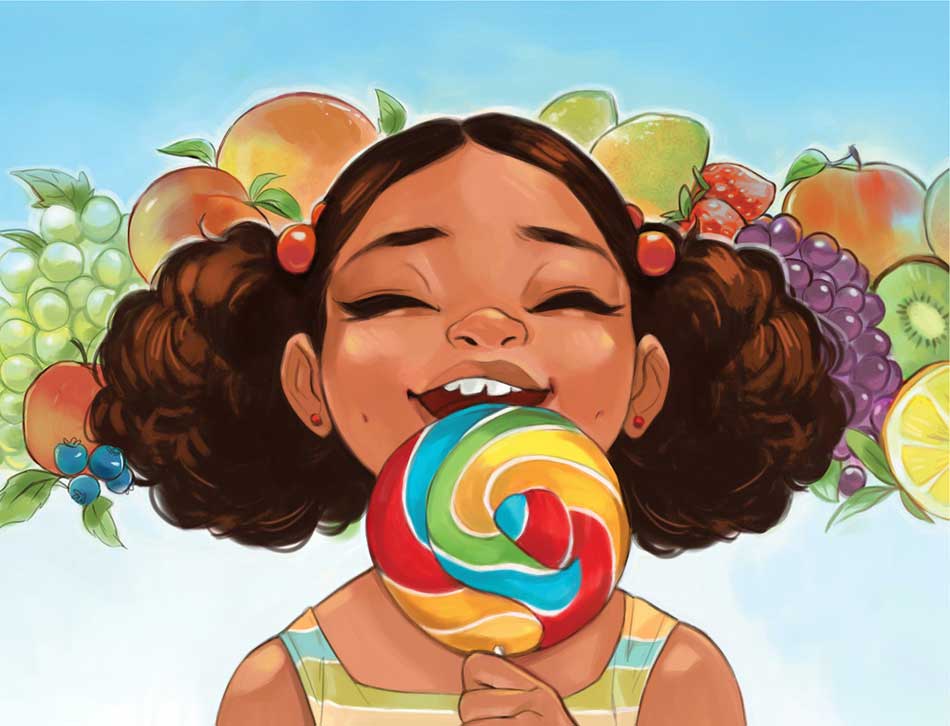
Art by Bea Jackson


What are your favorite art forms, software and media? 

Digital is my favorite art form, purely for its versatility, but I have a love for traditional in all its forms. There is something very beautiful about tactile art. I especially love traditional artwork that is rough, and sketchier. I love seeing the process in an artist’s works, their rough lines, and the character that comes with art that is less polished. 


What will you expect of the mentee?

I expect the mentee to feel free to ask questions, even the more difficult ones that often times artist avoid asking, like how to price your work. I wish to be as informative as I can, sharing the good, the bad and the ugly with the hopes that my experiences may help others, so feel free to ask the often-avoided questions. 

Do you have any advice for applicants?

Use these classes as an opportunity to connect and network with other artists. Much of the work I have found was the result of other artists giving me a hand up or opening the door for me. No matter what level you are, introvert or extrovert, connecting with good people is essential. 


Thank you, Bea, for chatting with us. 

The submission window for both mentorships opens May 17, 2021 at 8:00 am. The submission window closes when we have 30 applicants or June 7, 2021 12:00 midnight – whichever comes first. 

***Everything you need to know about applying for the PB illustration and MG/YA illustration mentorships can be found on the SCBWI-MI Mentorship page. 

If you missed Deb Pilutti's Zoom presentation on formatting your mentorship submission, go here for a link to the recording: https://michigan.scbwi.org/events/free-webinar-illustration-mentorship-discussion-with-deb-pilutti/ 

For questions, contact SCBWI-MI mentorship coordinator, Ann Finkelstein. 


Ann Finkelstein is a former scientist who discovered that writing novels is more fun than wrangling test tubes. Aside from coordinating our mentorship program, she helps Charlie Barshaw organize the Lansing Area Shop Talk (LAST).


Coming up on the Mitten Blog:

Picture book inspiration, interviews with scholarship and award winners, Ask the Editor, and a round of Hugs and Hurrahs. But first, it's time for a new Featured Illustrator! Join us next Friday to see our new spring/summer blog banner and read the Featured Illustrator interview.


Friday, April 30, 2021

Interview with Dow Phumiruk, Mentor for the 2021 Picture Book Illustration Mentorship.


SCBWI-MI is hosting two illustration mentorships this year. Today, we have an interview with the picture book illustration mentor, Dow Phumiruk. 
Next Friday (May 7), we’ll have an interview with MG/YA illustration mentor, Bea Jackson. 


Dow Phumiruk
is a former pediatrician who has found her passion in creating children's books.  She is currently a co-Regional Advisor for the Rocky Mountain Chapter of SCBWI. She has written and/or illustrated several books. Clients include HarperCollins, Henry Holt/Macmillan, Hachette Book Group, Abrams, Viking, Sleeping Bear Press, and Zonderkidz. She lives in Colorado with her husband of almost three decades, three artistic daughters, and a handful of small pets. She is the recipient of numerous awards including Winner, SCBWI Inaugural Narrative Art Award, 2017, Winner, SCBWI Postcard Contest 2016, 1st place RMC SCBWI calendar image contest 2015, and Winner, SCBWI Emerging Voices Award 2013 for Mela in the Jungle (published as Mela and the Elephant).


What do you like best about illustrating?


My favorite part of illustrating is that I am creating something from nothing. That’s pretty nifty, I’d say! If I am illustrating a story, I enjoy adding the visual dimension to bring it to life. From a vague notion of what a character or scene looks like in my head, I can solidify the feel of the story and then add details to enrich it. It’s usually somewhat of a surprise, really: I don’t always know what the art will look like until I have sketched it out. And then, I can almost hear a character introduce herself to me and say, “Nice to meet you!”

Illustration is also my form of self-expression. As much as it is a career, it is also a means for processing the world and life. This is another favorite part. If something bothers me, drawing often helps. 


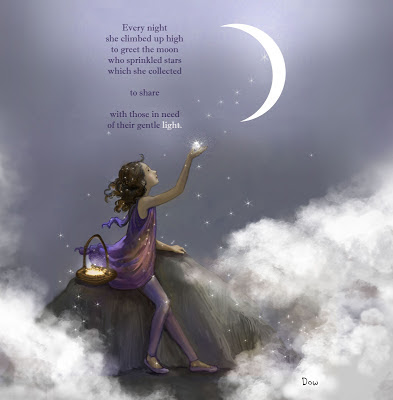
Art by Dow Phumiruk

How do you know when an illustration is both good and done?


It’s a process! It isn’t so until I’ve gone through several rounds of polishing the piece. First, it’s a rough sketch. Second, I add color and clean up edges. Third, I add lighting. Fourth, I will revisit the edges and confirm that my composition is ideal. I almost always flip the image to trick my brain into viewing it with “fresh eyes” this way (usually via the “transform --> flip horizontally” tool in Photoshop. If I still need another “new” perspective, I may print it out and look at it on paper. Unfortunately, after working on an image for days or longer, our brains end up biased. We can’t find issues as easily as if we were critiquing a piece that is brand new to us. We have to find workarounds like these.

And then, as with finding typos after sending an email to your boss or other important person, the act of submitting it as final art makes me somehow alert to additional areas to fix – ha ha! 

I think art revisions can just go on and on. Mostly it’s good after many hours invested, including a break in the process to come back with those fresh eyes, and it’s done when the deadline comes round!


What is the most important thing you’ve learned about illustrating?


A big lesson is to not compare your work and careers to that of others who are more successful. Whenever I’ve done this in the past, it has made me feel lesser than. I think it sets us back mentally. Instead, focus on goals for yourself and your individual path to success. For every wildly successful illustrator that you read about or see on social media, there are so many more who are working their way up to their full potential. Of course, you can and should try to celebrate and support other illustrators, but know that you must follow your own path for your own career.


What is a typical illustrating day like for you?


This varies quite a bit, depending on if I have an imminent deadline or not. Here is an average day:

I will wake up, take care of chores like walking the dog and answering emails, open up Photoshop, and start drawing! I take a lunch time break usually and get back to drawing again for the rest of the day. It’s pretty much just that, interspersed with other duties like attending to my youngest daughter or making dinner. Sometimes, if I get behind, I will draw in the evenings and/or ask my husband to pick up some of my around-the-house slack to stay caught up. I am lucky to have that help as I continue to strive for balance in my work. 

I adhere strictly to my self-imposed schedules – such as finishing one spread a week when in the final art phase of an illustration project. This is because I am at the point in my life where I don’t want to (can’t!) pull all-nighters. I love my sleep too much! So my work is always divided up to avoid a pile up when it is close to time to submit. I am almost always early for deadlines (ooh, I feel like I am jinxing myself by typing that), since I often allot time for each interim deadline generously.

Art by Dow Phumiruk

What are your favorite art forms, software and media? 


I work mostly on Photoshop CC, so digital art is my favorite. I started working in illustration later in life, and its flexibility allows me to experiment efficiently with colors and composition to learn quickly! It is by far my most valuable program for getting to final art. Along with Photoshop, I have my stalwart 2011 Intuous Pro 4 pen and tablet for drawing. Another essential for me.

I have an iPad Pro with Apple pencil for doodling when I am not at my desk, but doodling with pencil and paper is still my more frequent go-to. I also own a Mobile Studio Pro Wacom tablet, but I don’t seem to be using it much – I am too used to my desktop set up to get accustomed to the smaller screen and buttons on it. It’s handy for giving presentations onsite to show how I work digitally, but that has not been a big thing since pandemic mode!

Art by Dow Phumiruk


What will you expect of the mentee?


I hope a mentee working with me will be open to suggestions. I am enthusiastic about helping other artists grow, so I think having a mentee who is willing to work hard to improve her art is important. In addition, all artists should know how to present themselves professionally, and that is a nice foundation for success in any career. 


Do you have any advice for applicants?


Keep working on your art, whether or not you receive a mentorship this year. I often refer to the “Ps” of:
• Persistence: keep at it, take breaks if needed, but don’t give up too soon 
• Patience: the children’s book industry tends to move slowly
• Productivity: draw regularly and share if you can on social media (get your work out there!)
• Progress: look for ways to improve your skills.

These are each so important to developing your illustration career!


Thank you, Dow, for chatting with us. 

The submission window for both mentorships opens May 17, 2021 at 8:00 am. The submission window closes when we have 30 applicants or June 7, 2021 12:00 midnight – whichever comes first. 

Everything you need to know about applying for either the PB illustration or MG/YA illustration mentorship can be found on the SCBWI-MI Mentorship page. 

***On May 4, 2021 at 7:00 pm, Deb Pilutti will host a Zoom presentation on formatting your mentorship submission. See the SCBWI-MI Events Calendar for the link. 

For questions, contact SCBWI-MI mentorship coordinator, Ann Finkelstein. 


Ann Finkelstein is a former scientist who discovered that writing novels is more fun than wrangling test tubes. Aside from coordinating our mentorship program, she helps Charlie Barshaw organize the Lansing Area Shop Talk (LAST).


Thursday, April 29, 2021

Book Birthday Blog with Kirbi Fagan


 Welcome to SCBWI-MI's Book Birthday Blog!

Where we celebrate new books from Michigan's authors and illustrators.


Congratulations to Kirbi Fagan on the release of Summer of the Tree Army! 


Congratulations on the release of Summer of The Tree Army! What was the experience of illustrating this book like for you? What was your favorite part? How about the most challenging?
Thank-you!!! Working on a picture book is much different than the covers I’m used to working on. I loved focusing on something longer form. The sketching phase was the most fun, curating the colors, mood, compositions and design... I was eager to jump in, so much so that I started them on the airplane to the SCBWI NYC conference!

As for challenges, illustrating a book, the number of illustrations is simply a lot of work, making art can be very physical. 


As you were working, did you find yourself doing any research into the history of the Civilian Conservation Corps? What did your preparation and research look like?
Tons! Research fueled my inspiration. Sadly, I didn’t get to go to the CCC museum in Michigan due to COVID but there were plenty of resources and images I could look at at home. Because many images were in black and white I had to research colors separately. I wanted the images to be as accurate as possible, even the trucks you see in the book I matched from car color swatches from the period. 
 
 
What are some of your favorite image-making tools or techniques right now?
I’m crazy about my iPad! I also recently got a tilted tray table to sit comfortably with it - game changer! I’ve never been great about keeping a sketch book and I don’t make finished work on my iPad but the iPad has got me sketching constantly! 
 
 
When you sit down to work on one of your illustrations, what’s something you like to do to get yourself in the right frame of mind? A cup of tea or coffee? Maybe a certain type of music?
I start my days in the studio with journaling morning pages to clear my head. My mornings are most creative so I try not open email or anything that will take my mind away from the artwork. I often revisit encouraging mantras to help encourage me for whatever I may be going through that day, I may even write them repetitively in my morning pages. I like to be comfortable! Nothing like putting on my thick fuzzy house coat to get me settled in. 
 
 
You’ve done a lot of illustration for Middle Grade and YA literature, like your work for the Dark Waters series and Memory Thief. What is it that draws you to illustration for young readers?
Illustrating for children is a powerful thing. I’m drawn to the upper elementary school and middle grade age, I think it’s because that part of my life was very formative to the artist I am today. Working on covers for these ages, I’m pulled into all sorts of fantasy worlds and escapism, what could be better? 
 
 
Would you share a piece of advice for aspiring children’s book, Middle Grade, and YA illustrators?
Nurture yourself. Be kind to your ideas, soften your inner critic. There is a lot of science to suggest that when you are relaxed, that’s when ideas flow. It’s a constant struggle for me.  Making it a priority to reduce stress, holding yourself gently are often overlooked as a critical part of the creative process.
 
What’s next for you? Where can readers learn more about you and your work?
My next big step is writing my own stories and I hope to share more about that in the future.

You can find me on Instagram @kirbifagan

And for a closer look at whats going on in the studio, my new blog, Living Canvas. 
 

A little bit about the book:

When young Charlie Brightelot first spies the mysterious barracks in the woods near his home, he's not sure what to think. His father explains that the barracks will soon house young men serving in the Civilian Conservation Corps. President Franklin D. Roosevelt established the work relief program to help employ millions of young men during the Great Depression. Not everyone is happy to see these young men and Charlie's father questions their value. But when a fire threatens the forest, Roosevelt's "Tree Army" springs into action.
 
A little bit about the illustrator: 
Kirbi Fagan is a Metro Detroit based illustrator who specializes in creating art for readers. She is recognized for her cover art in Adult, YA, and Middle Grade fiction as well as her numerous covers for comic books on projects such as Black Panther/Shuri and Firefly.

Her illustrations are known for their magical themes, nostalgic mood and feminine heroines. Kirbi was traditionally trained as an oil painter but now works in mixed media techniques including digital drawing tools. She received her bachelor’s degree in Illustration from Kendall College of Art and Design. Outside of creating artwork she is Co-Regional Illustrator Coordinator with the Society of Children’s Books Writers and Illustrators. Kirbi also teaches illustration at College for Creative Studies in Downtown Detroit.
 
Represented by Kayla Cichello | kayla@upstartcrowliterary.com 


Wednesday, April 21, 2021

Book Birthday Blog with Jacquie Sewell


 Welcome to SCBWI-MI's Book Birthday Blog!

Where we celebrate new books from Michigan's authors and illustrators.


Congratulations to Jacquie Sewell on the release of her new book, Whale Fall Café! 


Congratulations on the release of Whale Fall Café! What was the inspiration for this book?
I was working as an elementary school librarian at the time so I was well aware of how kids love the "gross factor". When I read an article about the first discovery of a natural whale fall and the wonderfully engrossing creatures that live on whale falls, I knew kids would find the whole topic fascinating.
 
This is your second nonfiction picture book, after Mighty Mac, The Bridge that Michigan Built. What part of nonfiction writing do you enjoy the most?
For me the research is definitely the most enjoyable part of writing non-fiction. Research is like a treasure hunt - finding interesting nuggets of information to share with others. One source leads to another which leads to another and sometimes opens up a whole new topic of fascination!
 
 
You reached out to two marine biologists during your research for this book. What advice would you give to other authors looking to connect with specialists to help in their research?
Just do it. The worst that can happen is they say no - but hey, we're writers! We're used to rejection! Seriously though, most specialists, be they scientists, artists, engineers or what-have-you, are usually very happy to share their work and expertise with others. Of course they are busy people so that could be a constraint. But it never hurts to ask. I contacted the two scientists I ended up consulting with because their names appeared most often in the research papers I was reading. Dr. Smith was the scientist featured in that first article I read so of course I reached out to him. He was very helpful. Interesting connection: my son had taken one of Dr. Smith's classes at the University of Hawaii. And Dr. Smith was originally from Michigan!
 
What does your writing process look like? Do you prefer to carve out a large block of time for writing, or do a little writing here and there?
I try to carve out time but it's so easy to let life derail those plans. It's easier to make time when the words and ideas are flowing. Starting a manuscript is hard for me, I'd rather keep researching. Researching is a whole lot less scary than putting words on paper.
 
Who are some authors you look up to? 
Melissa Stewart is my newest favorite children's author. She is very prolific (translated: she works hard at her craft). She writes great books. And she's very generous with her time and advice to the kid-lit community. Deborah Hopkins is another author whose work I respect and recommend. I had the privilege of attending a workshop she taught at Highlights Foundation. Very informative! I also look up to Miranda Paul, another author who works hard and puts out very creative and interesting NF books for kids. And she lives in Green Bay, my hometown!
 
What’s your favorite type of deep sea animal?
I think some of the octopuses that live way down in the deep, deep sea are my favorites. Octopuses in general are amazing animals. The Dumbo Octopus is adorable with his fins that look like ears. And the Vampire squid puts on an amazing light show and can turn itself inside out.
 
A Dumbo Octopus, with his little fins. (NOAA)

 
You can catch a glimpse of some dining cephalopods on the Whale Fall Café cover!

What’s up next for you? Where can our readers learn more about you and your work?
My publisher suggested I collaborate with one of the scientists who gave us a jacket quote for Whale Fall Café on a topic he would be interested in publishing. She agreed to work on the project with me so I am currently in research mode. It's a deep topic (that's a hint) related to whale fall so there's lots of potential information to research and share with young readers.

Thanks to you and several other bloggers/lit writers your readers can learn more about me in upcoming posts. PJ McIlvaine of Children's Book Insider did an article about my writer's journey in their April edition. Cindy Mackey of KidLit Village will share her interview with me on April 12th. Shay Fan interviewed me for her blog, First Draft to Final Book. And of course I have personal info and some supplemental material about whale falls on my website: http://www.jacquiesewell.com

A little bit about the book:
In Whale Fall Café readers journey to the deep ocean floor where an amazing ecosystem has developed on a dead whale. The hidden world of whale falls was serendipitously discovered in 1987 by Dr. Craig Smith. Since then scientists have identified an engrossing ensemble of "diners", some found nowhere else on the planet. Creatures like hagfish, giant roly-polies, and zombie worms will intrigue readers of all ages. 

A little bit about the author:
I have always loved to read. A love of writing seemed like a natural consequence. In my early days as a writer I did a lot of freelance writing for Lansing City Limits Magazine and several other local and hospital publications. That experience taught me to choose my words carefully. When the editor said he wanted 300 words, he meant 300 and not one word more. So every word had to earn its keep. A bit later in life I discovered my dream job: children's librarian. Truly, what is better than working with kids and books all day and getting to help children fall in love with stories and words and books? That experience taught me the power and beauty of picture books. My writing shifted focus from adult to children and my innate curiosity led me to write several nonfiction pieces, two of which have found publishers. I have several fiction manuscripts out on submission as well.


Friday, April 16, 2021

Social Justice: More Than Kindness


Our individual narratives help us find meaning in life; they tell us about ourselves and the various social groups to which we belong, and they help us navigate the events around us. For me, this is what a celebration of diversity is based upon. But as we form our narratives, we should remember that it is too easy to settle into complacency and to skip the hard work toward social justice for all.

While we may agree with Martin Luther King, Jr who asserted that “the arc of the moral universe is long, but it bends toward justice”—we can often substitute a mythology of social justice progress only to distort our perception of reality.

In our E & I Corner, Susan Santone speaks to this issue and builds on the premise that social justice
requires examining institutional barriers, not just bigoted behavior, and she advocates that we take
bold, concrete actions, rather than relying on the merely symbolic.

~Isabel Estrada O’Hagin, E & I Corner blog co-host


Social Justice: More Than Kindness 

by Susan Santone


As a long-time member of SCBWI, I’m gratified to see our community elevating voices of underrepresented creators. By surfacing long-silenced voices and stories, we give children “windows and mirrors” that expand their understanding of the world and themselves.

But representation--getting to the table--doesn’t guarantee a seat that provides equal reach to the banquet of respect, rights, opportunities, and power. These inequities are the basis of the “isms,” the ranking of people based on race, gender, and other identity groups. These hierarchies operate by conferring benefits to a dominant group while denying them to others. This is why we must aim for social justice, intentional actions to dismantle discriminatory beliefs, practices, and institutions. 

Social justice is not just about “being kind” and checking bigotry, although that is certainly part of it. Nor is justice about being colorblind, a disingenuous claim (we do see color) that implies the problem is race rather than racism. Rather, social justice implicates unfair systems and asks us to change them while recognizing the role individual actions play. This begins with naming the social “architecture” that builds inequities into everyday life, including schooling, the economy, and the judicial system. 

We are all part of these systems, whether or not we’re conscious of it. That’s why social justice asks us to recognize the ways our identity benefits or disadvantages us. For example, as a White woman, I won’t be harassed or killed by the police. I know a landlord won’t deny me housing based on my race. My way of speaking is deemed proper and correct. My hair, no matter how unkempt, will never be a cause for dismissal in the workplace. 

These unearned benefits are the core of privilege, a dynamic that’s at play whether or not we intentionally leverage it to maintain a leg up. Privilege is also intersectional: Given we have multiple aspects of identity (such as race and gender), we can simultaneously benefit in some ways while being disadvantaged in others. In my case, while my race brings benefits, being a woman means I may be dismissed as too emotional or less competent. 

Framing social injustice as a systemic problem also disarms a persistent source of resistance: the belief that it’s “wrong” to be White, male, cisgender, etc. Let’s be clear: being a man isn’t wrong; sexism is. Being heterosexual isn’t wrong; homophobia is. And while we must recognize privilege, wallowing in guilt won’t change injustice; only actions will. 

How do we apply this to children’s literature? Here are a few guidelines (many already articulated in the writing community):
  • Avoid gratuitous tokenism that inserts disparate (“diverse”) yet cardboard characters. Characters must be well-rounded; likewise, their stories don’t have to hinge on their identity. One-dimensional portrayals of people are dehumanizing. 
  • Consider the tensions inherent in portraying shared human experiences. For example, while all people can experience illness, the consequences differ based on identity; the disproportionate impacts of Covid on communities of color is an example that points to deeper inequities surrounding access to health care.    
  • Honor #OwnVoices by thinking hard about whether you have the insights and experiences needed to tell a story from the perspective of other identity groups. 
  • Recognize that diversity is about our collective differences. Using “diverse” as code for people of color (for example) implies that White people are “regular” and that “others” are defined based on degrees of difference. 
  • View social justice as a condition to work for, not a trend or market opportunity. People’s lives and histories are neither.
  • Promote the idea that social justice is democratic, not Democratic. There’s nothing political about ensuring everyone has respect, dignity, and opportunity--rights enshrined in the Constitution.

Finally, we need to understand that “celebrating diversity” is not the same as working for justice. While there’s endless beauty in our vast human family, social justice will take more than championing our differences. Let’s work towards justice and then celebrate as we move ahead together.

You can find additional perspectives on social justice on my blog.

Susan is an instructor at the University of Michigan’s School of Education, where she teaches graduate- and undergraduate courses in education reform and social justice. She's the author of Reframing the Curriculum: Design for Social Justice and Sustainability (2019, Routledge), a book that integrates 25 years of developing curriculum with partners including major universities, PBS Kids, and the United Nations. Susan is now developing fiction- and nonfiction works for children, ranging from a YA fantasy novel to picture books. An active member of SCBWI-MI, she was runner-up for the 2019 and 2020 mentorship contests for fiction and non-fiction, respectively. Follow her on Twitter (@SusanSantone) and Instagram (SantoneSusan).


Coming up on the Mitten blog:

Book birthdays, mentor interviews, picture book inspiration, a new Featured Illustrator, and more! 


Our SCBWI-MI spring conference is next weekend, April 23-25th! Since it's virtual, registration is still open! Everything you need to know is here: https://michigan.scbwi.org/2020/05/01/spring-conference-2021/


Thursday, April 8, 2021

Writer Spotlight: New Members are Fluent in Other Tongues


Charlie Barshaw coordinates our quarterly Writer Spotlight feature and interviews writers of SCBWI-MI. In this piece, meet Lang Chen and Natalia Iacobelli, two new members who checked the box as "translators."


Between the Languages: Natalia Iacobelli and Lang Chen Translate Stories and Cultures for Young Readers 


Natalia Iacobelli

You identified yourself on the SCBWI-MI new member sign-up as a “Translator.” What other languages (aside from English) are you fluent in? 

Aside from English, I am fluent in Italian, and am proficient in Spanish.

How and when did you learn this language (these languages)? 

Italian was my first language. Although I was born and raised in metro Detroit, I grew up in a household in which Italian was the primary language spoken. Spanish, on the other hand, was a language I acquired later in life, through my husband.

 Do you speak, read and write in this language? How do you keep in practice? 

I use Italian on a daily basis as I am raising our three children to speak Italian. In addition, I am a literary translator in the field of art history, theory and criticism, and my clients are all based in Italy.

 Do you sometimes dream in another language?

 I do dream in both Italian and English. Curiously enough, that is a question I am asked often!

Have you read books in their original language, and then compared them to English translations?

Yes. All the time. However, when this happens, I tend to scrutinize the English translation and determine how I would have translated each sentence differently (a translator’s guilty pleasure).


At St. Mary's Abbey, York England
What titles of books not yet translated to English are you aching to tackle?

While I’ve always worked within the realm of art history, theory and criticism, I would love to begin translating children’s books. I would be open to anything!

What are you working on right now?

I have decided to venture into the world of children’s literature—this time not as a translator, but as an author. I recently signed with a literary agency and am currently working on a picture book biography on a trailblazing female painter who defied all odds and is now considered one of history’s greatest women artists.

What are your plans for the future?

I see myself writing more children’s books—particularly nonfiction picture books. I especially enjoy drawing from my background in art history as well as my heritage.

How did you find SCBWI?

Belonging to SCBWI was a consistent element that came up in my initial research on ways to enter the world of children’s literature. It has certainly proven to be a valuable resource!


Lang Chen 

(Lang says, "I consider myself a bi-lingual writer more than a translator at this moment.")

What other languages (aside from English) are you fluent in?

I grew up in China. Mandarin Chinese is my native language.

Do you speak, read and write in this language? How do you keep in practice?

I wrote creatively in Chinese since I was very young. But several years after I moved to the States for graduate school, I thought my Chinese was ruined. It was no longer vivid or full of life, but mixed with English grammars. I thought I could never write creatively (again), in Chinese or English, as I was not good enough for either.

But after I graduated, I moved to Singapore and then Hong Kong to work, where I found the languages people use are highly hybridized and they are proud of their languages. I realized that language in “good literature” doesn’t have to be “pure” or “local,” especially in such a globalized world where a lot of people relocate themselves to different countries or cultures.

 As long as there is something burning within you, you should go ahead to write it down. So I started exploring creative writing again after I moved back to the States.  

 What are you working on right now?

I am writing in English picture books for children and a novel for grownups in Chinese. Probably I will translate them to the other language if I’m really happy about them and feel people may be interested.

In my picture book manuscripts, I try to empower girls, normalize cultural differences, and introduce some Asian philosophy. When I was a child, people didn’t care what kind of messages girls could get from their books. I enjoyed watching the old version of the Smurfs and read those stories which all end with an allegedly happy marriage with a prince. Then the girls would have to spend decades to figure out these are not true.


I’m very happy to see girls today have a lot more books to choose from and many of them are very progressive. I definitely want to contribute to this change and also add to it my voice as an Asian woman who studied Buddhism for many years.

For example, gratitude to your parents is very important in Asian culture. Of course if it is forced on children, it could be very oppressive. But if it is conveyed in a natural way, it empowers children by giving them agency.

Children love taking care of their parents and we should encourage them to do it, because when doing that, they feel like they were grownups. Children and parents are interdependent, just like everything in the universe – this is very Buddhist.

How did you find SCBWI?

After I finished drafting my first picture book manuscript, I wondered how I could possibly get it published. So I googled and found SCBWI. I was amazed by how open and welcoming it is: The big Book and the online forums are so helpful. I think it explains why this field in America is so thriving, compared with many other countries where there is no such society. 

Thank you, Lang and Natalie, and welcome to SCBWI-MI.

If you've got a suggestion for a future Writer Spotlight interview, contact me, Charlie Barshaw, at cjbarshaw523@aol.com.