Friday, January 15, 2016

Everything I Need to Know About Writing, I Learned From Figure Skating by Katie Van Ark


I skated my way into writing. At first reading, this may seem to imply that writing glided to me, as natural as sleeping and waking. It didn't. Writing came with the bruises of repeated Axel attempts: soaring jumps of hope crashed by rejections from agents. Writing came with the ice burn of editors' criticisms, the pulled muscle torture of a high school English teacher reading the short stories of our entire class aloud. (Two minutes in, I became painfully aware that mine would have been better targeted to a middle grade audience; half a class period later I was scrunching in my seat with the realization that I had written not a short story but a novella.)

No, when I say I skated into writing, I mean it literally. My passion for skating cultivated my passion for writing. Though I played with writing as a child, earning invitations to young author events and winning a poetry contest, my heart belonged to skating. I acted out entire competitions with my dolls, scrutinized the biographies of top competitors, and longed to try it myself. I took ballet and piano lessons, but the nearest ice rink was forty-five minutes from our house and there honestly wasn't money, or, with my competitive swimming and supercharged class load, time for much else.

With the help of adult-learn-to-skate classes, I came to skating as an adult and fell head over skates...in love. I thought I loved skating before; now, I breathed skating. This sounds perhaps like something that might happen to a character in a novel, but the passion was so overwhelming that my husband and I saw a marriage counselor over it. (Success – we just celebrated our ten year anniversary.) Even pregnant with my first daughter, I skated until my seventh month. The evening I realized I was too pregnant to skate anymore, I came home and cried for two hours. What was I going to do? Pouring the intensity of that emotion onto the page, I rediscovered my passion for writing. And realized that everything I needed to know about writing, I learned from figure skating.

  • First, it's okay to start small. I have a favorite childhood memory of building a backyard ice rink with my father. Our city backyard was tiny, and our rink was about six swizzle pumps wide and only a little bit longer. It had giant potholes where leaves from our crabapple tree froze under the surface and then caught the heat of the winter sun and melted the ice. Bumpy at best and treacherous at worst, it was ice. That my father cared enough to help me with this time-consuming, and in fickle west Michigan weather, often futile effort, gave me the seed of the idea that skating was something I could do. It's the same for writing. Even one frozen drop of water can be enough if you want it, really want it. For me, this was when I dared to show my mother, a writer and librarian, the beginning ramblings of my first book. She had lots of advice and areas to improve but, “Sure, this could be a novel,” were the words I took with me as my droplet of hope.
  • Second, however small your start, you must put in the time. It's about repetition. With good daily practice routines, the elements on ice come. With good daily writing routines, the words flow. Practice never makes perfect, but quality practice builds improvement bit by bit. Listen to your coaches, aka your trusted critique group, because whether you like it or not, they're right most of the time. But know that sometimes you have to follow your heart, sometimes you just have to know when it's time to ditch a project. I once completely changed programs three weeks before a national competition, much to the chagrin of my coach. That new program won me a national gold medal. So go ahead, re-write that novel in first person. Cut those scenes. Start over with a blank page. And take comfort in the fact that least in writing you can save all your old versions on the computer and pull out an old routine with the click of your mouse.
  • On the ice or on the page, you will fall down. A lot. All you can do is pick yourself up, the sooner the better. You must try again. It took me almost a year to learn a loop jump, two years for the flip, and five years for the lutz. I'm still working on that Axel and I won't even tell you how many hours I worked at writing, but I try to remember that everyone is afraid sometimes, that everyone struggles with some things. You must believe you can do it.
  • Take advantage of camps, clinics, and retreats. Fresh opinions can help you get over a rut. I had been struggling with a loop jump for months when I attended a skating camp in Aspen. New phrasing and the trick of jumping out of a backspin helped me master the element that week. And when asked for advice, give it when you can. Helping others can help you, too. It's so much easier to see the faults when watching, or in the case of writing, reading someone else's technique. And of course every once in a while you'll happen upon a move you can borrow and make your own.
  • Just like skating, writing is also about acting. To make your characters real to your audience, you need to feel them, get inside their heads. Wear your heart on your sleeve and keep a box of tissues nearby for the tears and runny noses. Because in skating, you only need to do one character per program but in writing you're going to need to do them all.
  • And finally, sweat the small stuff. Yes, pay attention to details in your routines and in your novels but don't forget about your actual real world. I used to have one of those t-shirts proclaiming that “figure skating is life, the rest is just details!” I gave it to Goodwill. Skating, writing, whatever your passions – life is in the details, and not the sequin-covered, rhinestone-studded variety. Don't forget to live.


Katie Van Ark lives in Michigan with two little girls who love mud, a cat that thinks it's a dog, and a very patient husband. The Boy Next Door, a YA figure skating love story, is her first novel. Visit her online at katievanark.com or on Twitter @kvanark.


Katie is one of the busiest people I know - mom, teacher, figure skater, author, and she's about to graduate with her MFA in Writing for Children and Young Adults at Vermont College of Fine Arts. Through all of this, she's been very giving of her time to help other writers. 

A master's degree in fine arts: The best career move? What will I gain from all of that time and expense? Can it be affordable? Questions about MFA programs are often posed to editors and authors at writing conferences. Katie has offered to gather her fellow students at VCFA to answer your questions. What would you like to know about the MFA experience? Leave your questions in the comments or email me at kristinbartleylenz@gmail.com. We'll share the answers in a future post.

Happy New Year!
Kristin Lenz


Friday, January 8, 2016

Featured Illustrator Dana Atnip


MEET DANA ATNIP

 This questionnaire goes back to a popular parlor game in the early 1900s. Marcel Proust filled it out twice. Some of our questions were altered from the original to gain more insight into the hearts and minds of our illustrators. We hope you enjoy this way of getting to know everybody.


1. Your present state of mind?

Excitement! I love the promise of a new year!

2. What do you do best?

Cartooning and drawing fuzzy animals.

3. Where would you like to live?
 
I love Michigan, but living on a tropical island would be pretty awesome.

4. Your favorite color?
 
Purples, but I’ll take the whole rainbow.

5. Three of your own illustrations:


6. Your music?
 
Alternative and pop-punk, but classical when I’m frazzled.

7. Your biggest achievement?
 
Right now it’s my webcomic, Galactic Dragons. I’ve dreamed of putting my comic strip out there for years; I had to face a lot of fears and it was a lot of work, but I’m very happy with how it’s been going, and I love the work!

8. Your biggest mistake?
 
Letting my fears dictate me for so long and letting them hold me back.

9. Your favorite children's book when you were a child?
 
The Richard Scarry books, but honestly anything with animals, dragons, or unicorns.

10. Your main character trait?
 
A dreamer. My imagination is always moving, always thinking of new ideas.

11. What do you appreciate most in a friend?
 
For me a friend is someone with whom you can share your joys and sorrows, laughter and tears... someone with whom to have adventures with or spend the day doing nothing and just enjoy each other's company.

12. What mistakes are you most willing to forgive?
 
All of them. We all make mistakes, we all deserve forgiveness.

13. Your favorite children's book hero?
 
I adore Fancy Nancy. She’s never afraid to be herself (in the fanciest way).

14. What moves you forward?
 
I’m always inspired by artists and other creatives. Life is short and there’s so much creating to do!

15. What holds you back?
 
Ugh, still the fear and self-doubt thing, but I’m working on that.

16. Your dream of happiness?
 
Happiness itself is in the present moment. If you can be happy no matter where you are in life, then you’ve achieved.

17. The painter/illustrator you admire most?
 
My biggest hero is Carl Barks. He did the Donald Duck and Uncle Scrooge comic books for almost 25 years, and was known as “The Good Duck Artist” because his work far surpassed other comic book artists that did the Disney ducks. His work even inspired Steven Spielberg and George Lucas. After he retired from comic books he moved to oil painting, and his Disney oil prints still sell for hundreds to thousands of dollars.

18. What super power would you like to have? 
 
Being able to shape-shift into animals would be pretty sweet.

19. Your motto?
 
Just keep swimming!

20. Your social media?
 
My illustration website is:
www.danaatnip.com
My comic strip is:
www.galacticdragons.com (for ages 13 and older)
Facebook:
www.facebook.com/galacticdragons
Twitter handle: @GalacticDragons


Wednesday, December 16, 2015

Hugs, Hurrahs and Happy Holidays!

December is all about celebrating, and here at The Mitten we love a party! It’s hard to believe this is the last issue of Hugs and Hurrah’s for 2015. Just for fun, I’d thought we’d take a moment and reminisce about all the wonderful 2015 writing news from our Michigan SCBWI members. Here are a few facts based on the Hugs and Hurrahs information I’ve collected for this year:

  • YA Contracts - 8
  • Short Stories, Poems, Cartoons, Testing Pieces, etc.- 3
  • Speaking Engagements/Blog Tours- 5 
  • Agent Signings-4 
  • Picture Book Contracts- 13
  • Middle Grade Contracts- 2
  • Magazine Pieces- 2
  • Awards/Degree Completion- 5
  • Illustration Contracts- 7

I definitely think those numbers call for a standing ovation, double Woo Hoo and a hearty Hip Hip Hooray!

And now, let’s end this year with a bang and keep the party going with all of your good news from October through December!


Hats off to member Kathleen Vincenz who recently self-published her middle-grade novel, OVER THE FALLS IN A SUITCASE (Squirrels at the Door November 2015). The book was released in November and is available on Amazon. Congratulations Kathleen!


Janet Heller of Portage has been very busy since our last edition of Hugs and Hurrahs. She received a positive book review for her chapter book, THE PASSOVER SURPRISE (Fictive Press 2015) from the Midwest Book Review in October. Janet also had two of her poems, “Inheritance (For Oma)” and “Policing My Apartment,” in Old Northwest Review’s Fall 2015 issue. Janet spent time autographing her books at the Chanukah Bazaar at the Congregation of Moses in Kalamazoo, the Local Writer’s Expo at the Portage District Library, and at Kazoo Books in Kalamazoo in early December. Congratulations on all your hard work Janet!


Illustrator Kirbi Fagan was recently accepted into the Los Angeles Society of Illustrators 54th Annual Exhibition. Kirbi was also featured in Imagine FX magazine as "Artist of the Month,” and had three works of art included in "Infected By Art Volume 3." Way to go Kirbi!


Lori McElrath-Eslick has her own great illustration news! Her art for a magazine publication has been accepted into the 35th Western Spirit Art Show and Sale, a national juried exhibition. The exhibition dates are March 5- April 17, 2016. Lori also illustrated three new e-books for Schoolwide Publishing. They are: Westward to Oregon, How the Cardinal got his Red Feathers, The Girl Who Would Not Listen to Her Elders all written by Patricia Curtis Pfitsch. Congratulations Lori!


PJ Lyons is happy to announce that her rhyming picture book, THANK YOU LORD FOR EVERYTHING (Zonderkidz 2015), was released September 1 and has received some lovely reviews! We’re so proud of you PJ! 

Three cheers to our Mitten editor-extraordinaire, Kristin Lenz! Kristin is the winner of the 2015 Helen Sheehan YA Book Prize. Her debut YA novel, The Art of Holding On and Letting Go, will be published by Elephant Rock Books, Fall  2016. So excited for you Kristin!


Neal Levin has been at it again! Neal’s poem "Cavemanners" has been published in the November/December issue of Spider Magazine, and his short story "Messy Messages" has been published in the November 2015 issue of Highlights Magazine for Children! Neal’s poem "My Little Porcupine" was published in the Sep/Oct 2015 issue of Fun For Kidz Magzine, and his poem "Baby Ate a Microchip" has been purchased by a nonprofit educational testing agency for use in a standardized testing project. That’s amazing Neal!


Jean Alicia Elster’s middle-grade novel, Who’s Jim Hines (Wayne State University Press), has been placed on the Southfield Public Library’s Middle School Challenge Battle of the Books List for 2016. Congratulations Jean!


Joseph Miller of Livonia is happy to announce that he recently signed with Nicole Resciniti of the Seymour Agency! Joseph participated in Michelle Hauck and Sharon Chriscoe's PBParty contest and had his picture book, TOO TIRED TO TELL A STORY chosen for the agent round. Seven agents and editors requested the full story and of those Joseph had three offers of representation. So happy for you Joseph!


Wendy Booydegraff is excited about her new picture book, SALAD PIE (Ripple Grove Press 2016). Here is a peak at the cover! Congratulations Wendy! 


Barb Rebbeck is thrilled to announce that she has just been chosen to be a featured speaker at the MRA Conference in Detroit in March. We’re so proud of you Barb!


See?! I told you we were ending the year with a BANG! You Michigan kidlit writers are an amazing bunch, and I'm happy we’re on this journey together!

From all of us here at The Mitten- Kristin, Nina and me (Patti)- Happy Holidays and Happy New Year! May your 2016 be filled with bountiful blessing, sweet surprises, peace-a-plenty and loads of love!


Friday, December 11, 2015

PiBoIdMo – Going the Extra Pages by Rachel Anderson


PiBoIdMo is Picture Book Idea Month. The goal is to brainstorm picture book ideas. You sign up in advance to participate, and all you have to do is come up with 30 ideas during the 30 days in November. They don’t even have to be good ideas. Easy peasy!

If you want to be more involved with the challenge, read the daily posts to glean advice and writing tips. If you comment on the blog posts, you’ll have an opportunity to win a prize.

At the end of the 30 days you pledge that you came up with 30 ideas in 30 days. You also promise, to the best of your ability, to turn those ideas into picture book manuscripts over the next year. All this is on the honor system, folks. You don’t have to turn in your ideas or your draft manuscripts. Good thing! Some of my ideas earned titles like: What? Stinky Stink! Trash Me Now. So I came up with an additional 5 ideas to cover up those stinky ones.

For the past two years of PiBoIdMo, I have to admit I minimally tackled the challenge. I read the posts when I could and commented on a few. I came up with ideas - whatever popped in my head – and I wrote them down. But this year, I decided to tackle the challenge with gusto; to thoroughly read every PiBoIdMo blog post to not only glean advice from each writer, but to use what I learned to come up with my idea for that day. I also decided to see if there was more good stuff I could find within each post.

So what happened?
  • After I read each daily post, I wrote down the guest blogger’s name and a line or two about their advice or writing style.
  • I compiled a list of their published and upcoming books.
  • Several interesting websites were viewed; I will continue to view more of them.
  • If agents were mentioned, I wrote them down.
  • I compiled another list of publishing houses.

Great Gusto! This was a whole lot more work, but I learned much by going through this process. From these wonderful PiBoIdMo posts, I found authors I want to follow. I have a new list of agents whom I will research to see if they might be someone I’d love to work with; someone looking to publish the type of picture books I’m writing. I saw different styles of websites, and I duly noted which sites kept me there for awhile to learn more about each person and what they offer to fellow writers or illustrators. I’ve been introduced to publishers I’ve not heard of before. I’m learning more about some established publishers and what they’re looking for. And I have a long list of books I want to read. I have homework, but fun homework because it’s all about books!


Hats off to Tara Lazar and the guest bloggers who gave so much of themselves and their craft, pre-PiBoIdMo, during PiBoIdMo and post-PiBoIdMo (say that fast, three times!).

P.S. I can’t forget about my other homework. Thanks to 30+ days of PiBoIdMo, I have all those ideas (stinky ones included) which I need to turn into potential picture book manuscripts. Anyone want to brainstorm over a cup of coffee?

Rachel Anderson continues to hone her writing at her home in Gaylord. She is a wife, mother and grandmother. She is also a long time SCBWI member who served on the Advisory Committee for SCBWI-MI for several years and served as co-RA for one year. Rachel is currently pre-published. ;-}


Thank you Rachel for sharing your experience with us and for all of the time you've dedicated to our SCBWI-MI chapter over the years. We're cheering for you to turn some of these new ideas into published picture books!

Coming up on the Mitten blog: Everyone's favorite feature - Hugs and Hurrahs! Patti Richards is busy compiling the good news. Email her at pgwrites5@gmail.com by Monday, December 14th to be included.

See you next Friday,

Kristin Lenz

Friday, December 4, 2015

The Value of Mentorships, Three Experiences

SCBWI-MI offers an annual yearlong mentorship program, which varies to include picture book manuscripts, novels, and illustration. In an effort to increase the number of children's books with diverse themes and/or characters, this year's mentorship competition focused on entries that included multicultural characters and/or topics. 

We caught up with a few of our recent mentorship winners to learn more about their experiences. Wendy Sherrill won the novel mentorship with Edie Hemingway in 2014-2015.
Dan Burns was the most recent mentorship winner for a multicultural project, 2015-2016, with mentor Patricia Hruby Powell. And Jeff Morrissey was the lucky winner of a bonus opportunity: a 16 week mentorship with illustrator E.B. Lewis.

Here's more from our mentees, in their own words:

Tell us about your story or illustration that won the mentorship competition.

Wendy: My middle grade novel, Playing Dead, is about Erin, a reclusive, 12-year-old whose favorite part of summer is avoiding everyone else, especially school bullies. When she starts spending time with a quirky new neighbor named Ginny, she meets her biggest intimidator yet, a young horse that desperately needs a rider. While friendships with Ginny and the horse grow, Erin discovers self-confidence, an invaluable back-to-school supply.

Dan: Set in 1970, Out of the Shadows is a story about Kyle, an eleven year old boy, who is befriended by William, the only African-American boy in his school. The two are drawn together through books, music, and the unstoppable passion with which William lives. Together they learn that friendship is a whole lot more important than the color of their skin.


What made you decide to enter the competition?

Wendy: I try to take advantage of all the great opportunities and resources that SCBWI-MI provides for members. I had just attended a whole novel writing workshop at Highlights with this manuscript and felt it was in good enough shape to submit. I was thrilled to get the news that I had been chosen!

Dan:  I was encouraged to enter the contest by members of my critique group. That encouragement, along with a strong desire to constantly improve my writing, motivated me to enter.

Jeff: While I did win a 16 week mentorship with EB Lewis, it wasn’t based upon my ability as an artist. Back in May, I attended my first SCBWI event, The Hook of the Book. The seminar was wonderful! But the visual mentor program was a prize, not an award. I happened to be the lucky one whose name was drawn.

Tell us about your mentorship experience. What did you learn or how did it help your career? What was challenging or surprising?

Wendy: Edie Hemingway has been wonderful to work with, providing very timely feedback on my bimonthly submissions and concrete suggestions of how to strengthen, expand and revise my manuscript. Her encouragement has been motivating and uplifting. The most challenging aspect has been devoting the time needed to do the work on a consistent basis.

Dan: I'm excited to work with Patricia Hurby Powell, a gifted writer. Under her mentorship, I hope to grow as a writer, to improve my story, and to share this experience with my fifth grade students.

Jeff: My last session with EB is coming up and I wish it didn’t have to end. To watch an idea evolve under the guidance of an award winning illustrator has been remarkable. EB’s sense of composition is so keen, he can immediately identify what’s missing or out of place. But it’s more than just balancing visual elements, there’s character and setting. EB’s most profound advice to me has been this, “Stop illustrating, start storytelling!”

Here's a work in progress that EB's been helping me with...


What's next for you?

Jeff: Start storytelling!

Wendy: I plan on submitting this novel to agents and editors.

Dan: I'll keep working on my writing, listening to my mentor's advice, and encouraging others to become the best writers they can be.


Thank you for sharing your experiences, and best of luck to each of you!


Coming up on the Mitten blog: 30 Days of Picture Book Ideas and Hugs and Hurrahs! Have you sent your good news to Patti Richards? Email her at pgwrites5@gmail.com by Monday, December 14th. We're looking forward to celebrating with you.

Have a great weekend!

Kristin Lenz

Friday, November 27, 2015

Illustrator Insights


what it takes to get published as an illustrator


AN INTERVIEW WITH DEBORAH MARCERO


What is your art background? 
 
I loved to draw from the time I could hold a pencil. My early passion led me to the University of Michigan, School of Art, where I acquired my BFA. Then after living in New York City for three years, (which was an art education in itself) I attended the School of the Art Institute of Chicago where I earned an MFA. 


Have you been published in other illustration related fields?

No. I did not seek publication until I developed my style in Children’s books. I wasn’t ready. In the past I’ve participated in Art Gallery Exhibitions and small poetry publications, but very casually.

How long were you trying before you got a contract?

I officially started my path to publication in 2009. My first book deal came in April of 2014. So: 5 years.


How many hours a day did you work on your illustrations?
 
This varied tremendously. I am also a photographer. In the summer (my busy season) I would say my work on the illustrations was less. Two – six hours per day of daydreaming/ brainstorming/ sketching/ writing/ character designing/ etc. In the winter, however, I would have long stretches of time where I would be able to work 10 – 16 hours of the waking day working on a project.


How many hours a day did you work on your self promotion?
 
VERY LITTLE. Self-promotion was and is a huge weakness of mine, and I never enjoyed doing it. However, my first big step in this area, was building a website and curating a portfolio exclusively for children’s illustrations.


What steps did you take?  

I built and started a website in December of 2012. In making my work visible and public, everything became more real. In May 2013, I attended the Wild Wild Mid-West conference in Fort Wayne, which was a game changer for me. Energized by the conference, and by finding a strong critique partner, I worked even harder on my writing and portfolio that summer.

In August of 2013, I had a full picture book project to pitch (with 3 final art pieces, manuscript and finished dummy book – all uploaded to my website on a password protected page) so I started targeting and soliciting specific agents. Although this first attempt garnered 100% rejections from the 10 or so agents I submitted to, I took everything I learned (which was a lot) and was more motivated than ever. It helped that in some of the rejections I received helpful feedback and encouragement. I decided to start a totally new project that September, and by the end of October it was ready to send out.

I used the Writer’s Market book and the internet to help me find an agent that might be a good fit for me and my new project. Within a week (two agents wrote back or called on the same day of my email submission), I had several interested parties and after several revisions and a few months later, I signed with my current agent, Danielle Smith with Red Fox Literary. Even though I currently have accumulated five book deals with Danielle, I still have room in my schedule for more work, so I continue to send out snail-mail postcards with new art every three months to a list of 100 editors/art directors.


How did you find an agent and how long did it take?

I used the Children’s Writer’s and Illustrator’s Market Book as a starting point in my research, then I followed up by doing online research on each potential agent. From my initial search and submissions (two rounds – with two different projects) to finding and signing with an agent, it took about 6 months.


How many agents/ art directors did you approach?

With my picture book in August, I approached 10. And then with my illustrated early middle-grade project in November, I approached 8.


How many conferences and workshops did you visit?

From 2009-2010 I attended two six-week community education classes with Esther Hershenhorn in Chicago. In 2013 I attended two SCBWI conferences: The Wild Wild Mid-West multistate conference, and a small regional conference on “The Picture Book” in Indiana.


How did you prepare for them?

At the Wild Wild Mid-West Conference, I signed up for the Illustrator Intensive with Laurent Linn. In preparing for the intensive, we needed to come with a finished drawing of the “Mad Hatter”. The critiques gave me amazing insight. I mostly attended the conferences prepared to be a sponge. I took a notebook and a pen, and wrote down all that I could. After each conference, I went back to my studio inspired with a deeper understanding of what I needed to do to make my work stronger.


Is there anything special you did that other people might not think of?

There are two things that stand out to me in answering this question: 1. Putting in the time. 2. Ability to be critical and self-reflective in one’s own work.


Was there a point where you wanted to give up?

I honestly don’t think so. When I made the decision to really give this a go – I knew that it was the long plan. That it would be a journey. I knew I had to take big rejections with the small victories… and that everything moves at a snail’s pace in this industry.


What kept you going?

When moments of doubt crept and creep in, I almost always shift my focus to a new project; re-directing my energies helps keep my creativity flowing.


Do you have any tips to stay motivated? How do you stop procrastinating?

I create routines. I stay disciplined by making lists and creating very specific time-sensitive goals. I try to leave room in the schedule for making mistakes – those are such an important part of the process for me


Do you write too?

Yes – I have always loved both.


Do you approach it the same way as illustrating?

I approach them in very similar ways. I love to create work where the images and words lean on each other for meaning – and in their juxtaposition, they are able create something totally new, that neither words nor pictures can solely do on their own.


What was your biggest aha moment?

This came after the Wild-Wild-Mid-West conference. I walked away realizing that I needed to strengthen the narrative elements in my portfolio. Not only did the art need to have strong color, line, composition, character designs, etc., the art needed to evoke emotion and feel like it was in the middle of a story. I wanted each of the images in my portfolio to prompt the viewer to want to “turn the page” so to speak.


What do you consider your biggest break through?

My process: When I finally figured out a way to merge traditional media with digital to create images that didn’t feel or look “digital”. My biggest compliment came from my editor at Harper Collins when she asked if I worked digital or traditional – because she couldn’t tell!


What people or events helped you most on your journey?

I would have to say that my writing partner has helped me the most on my journey. We met at an SCBWI conference, and even though he lives in another state, we were and are able to share and critique each other’s work via email and on the phone. It has been the most critical part of the journey for me. I don’t feel alone in this work, and when I get stuck, or even when I think I nailed it – I send it to him or now, to my agent (who is editorially hands-on, which I love) and they see things and ask questions that I hadn’t even considered. Having a partner in this work helps me get out of my head and see what I’ve done from a new angle, which leads to revision and consequent improvement.


What is your advice to the aspiring children's book illustrator?

Work hard. Put the time in. Make mistakes. Revise. Make more mistakes. Revise again. Find a writing/art partner or group. Know that it will take time (you will need endurance). Every person’s journey is unique in this field because you have to forge it. Be open to critique. And lastly, the most important thing might be: to believe in yourself. 


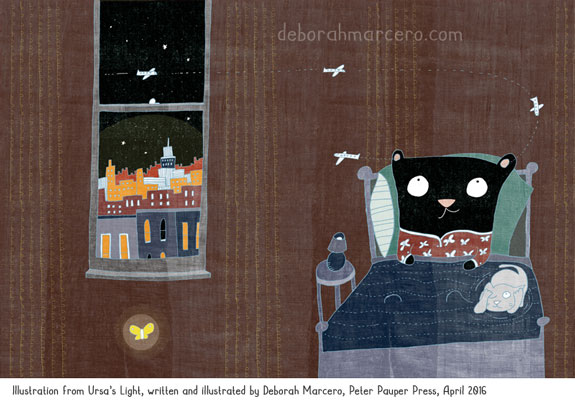
Deborah Marcero received a BFA in drawing, printmaking, and photography from the University of Michigan, and her MFA from the School of the Art Institute of Chicago in Creative Writing. Deborah’s illustration debut in The Backyard Witch series, HarperCollins, released July 2015, her picture book URSA’S LIGHT, Peter Pauper Press, will be published in Spring 2016 and she is also contracted to illustrate Corey Rosen Schwartz’s new picture book, Twinderella, set for publication by Putnam’s Sons (Penguin) in 2017. She has been a member of SCBWI since 2009. deborahmarcero.com


Friday, November 20, 2015

Flashback Friday: Neal Levin's Kiddie Litter Cartoons

We have 10 years of Neal Levin's Kiddie Litter cartoons in our SCBWI-MI newsletter archives. It's a shame to keep them tucked away. Enjoy these Friday funnies, and find more here.


Neal Levin writes short stories and poetry for children as well as drawing cartoons. His work has appeared in several national magazines and collections. You can find out more at www.neallevin.com.