Friday, August 31, 2018

Book Birthday Blog


Welcome to SCBWI-MI's NEW Book Birthday Blog! 
Where we celebrate new books by Michigan's children's book authors and illustrators


BIG congratulations to Lisa Wheeler on the newest book in her Dino series,
 Dino-Christmas!


Q#1: How did you come up with the idea for your book?

LW: Actually, Dino-Christmas is the 11th book in my Dino series. My publisher decided that we should explore how these sports -loving dinosaurs celebrate the Holidays. We decided that Christmas would be the perfect kick-off to this 4 book series within a series.


Q#2: What was the most difficult part of writing this book?

LW: It's always tricky to make the rhyme and meter work with difficult dinosaur names. Also, I wanted to honor some old traditions but make them dino-friendly. That was fun and complicated at the same time.


Q#3: In the voice of your main character, tell us what you hope readers will experience or learn while reading your book. (I love your character voices!!)

LW: There are a cast of characters in these books, so not really a "main character".  But if the troublesome Ptero Twins were to introduce the book, it might sound like this:

Ptero One: "Hey you, knuckleheads!"
Ptero Two: "Don't believe everything you see."
Ptero One: "Or read!"
Ptero Two: "We didn't really cause problems at the ice skating park. . .
Ptero One: ". . .or while decorating Main Street. . ."
Ptero Two: ". . .and definitely NOT at the Christmas Parade!"
Ptero One: "If you don't believe us, ask Santa Claws."
Ptero Two: "Yeah, he was totally there!"


Q#4: Who is your author idol and how have they influenced your work?

LW: I can't pick just one! I was brought up on Dr. Seuss, who I loved for rhyme and word play.  But I also loved the work of Ezra jack Keats, who created a cast of neighborhood kids that looked like the kids I grew up with. I also idolized Mr. Rogers, because he was the calm in the storm when I needed him.

So I guess they all influenced me to write mostly rhyming books that incorporate lots of wordplay, that are all inclusive (even when the characters are anthropomorphic) and speak to the child. At least, that is what I strive for.


Q#5: What are your marketing plans for your book? Where can we find it?

LW: What are marketing plans? LOL. Seriously, I am the worst. I am thrilled that you asked me to do this because I never would have thought of it on my own. I am doing a book signing in conjunction with SCBWI-MI at Barnes and Noble in Brighton on August 25th. Also, I will be signing at the September 8th Thomson-Shore Event in Dexter.
Oh, and I will be doing a children's program and signing books at the Read in the Park event at Beverly Park in Beverly Hills, MI on September 22.

You can order any of my books from your local independent book store. All my books are also for sale on Amazon.com and any online book seller.
My website is www.lisawheelerbooks.com


A little bit about the book: Have yourself a merry Dino-Christmas! Dinos big and small deck the halls and enjoy snowball fights, hot cocoa, a parade, and more. Share in the dinosaurs' delight as they eagerly await the arrival of everyone's favorite . . . Santa Claws!

A little bit about the author: Lisa Wheeler has written many books for children, including The Pet Project, illustrated by Zachariah OHora; Spinster Goose, illustrated by Sophie Blackall; and People Don’t Bite People, illustrated by Molly Idle. She lives with her family in Addison, Michigan. 


Friday, August 17, 2018

The Ten Year Short Story by Julie Angeli


I recently had a serialized short story published in Cricket Magazine. A short story shouldn’t take long to write. Right? Mine took ten years.

It started out late one night while watching a bad movie that featured competitive free divers – individuals who dive ridiculously deep without a scuba tank, using a weighted sled to take them down and a buoyancy bag that shoots them to the surface before they run out of air – assuming it works.

I’m a scuba diver, snorkeler, mermaid enthusiast, and general ocean geek, so this was something I had to check out. While gathering information, I discovered an equally impressive group, the Ama divers of Japan. They are women who dive for shellfish, reaching depths of up to 60 feet on a single breath of air. No sleds for these ladies, they don’t do this for the thrill. They do it for survival.

I thought of them as “Real Mermaids” and decided to write a super short non-fiction piece for young readers. I became obsessed and pored through anything I could find on the internet, magazine articles, a book written in 1962 (the only book I could find about the Ama), a photo essay and pictures of ancient woodblock prints.

My short article morphed into a MG novel, then a YA novel, then back to MG. I started out with a mermaid/underwater theme, but found myself wondering about Japanese culture.

At one point I determined that I shouldn’t be writing this. I don’t have a lick of Japanese blood running through my veins. Surely, someone who is Japanese would do a better job, so I put it away. For years.

No one wrote about it.

I picked it up again.

By this point, both of my kids had decided to study Japanese in school. During conferences with their teachers I brought up the Ama. The teachers would nod their heads, but had little input. This culture keeps to themselves, and little is known about them even in Japan.

I kept plugging away. It seemed too long for a short story, but too short for a novel – a story without a home. I was still nervous about writing something based on a culture that wasn’t mine. But still, I couldn’t let it go.

A writer friend of mine who is Japanese helped me with the details about Japan and encouraged me to keep going. My fate was sealed when I was given the opportunity to travel to Japan with my daughter’s Japanese class. I simply had to finish that story.

The length of my story was still an issue, so I cut my too-short MG novel down to a 6,000 word serialized short story – a painful process, but I had to admit, the shorter version was better. I went to Japan with my daughter’s class and paid attention to how people interacted, how they dressed, what the houses and gardens looked like, and the color of the ocean. Finally, I verified a few last details with our Japanese tour guide.

When I got home, I put the finishing touches on the story, held my breath and submitted. More than ten years after my late-night movie inspiration, part one of THE PEARL INSIDE was published in the May/June 2018 issue of Cricket Magazine, with parts two and three to follow. I’ve learned a great deal over the last several years that never would have made it into that original story. This is the story that was meant to be published, even if it did take ten years. Sometimes even when you give up, the story doesn’t.


Julie Angeli’s first career was as a packaging engineer for IBM where she spent a lot of time dropping printers and copiers to see if they would break. When there was nothing left to break, she moved on to children’s writing. Her short stories have appeared in SPIDER and CRICKET magazines. She has also co-authored two picture books for local Michigan clients. She lives in Bloomfield Township with one husband, two kids, and three cats. 

Friday, August 10, 2018

Bringing a Hidden Figure to Life for Children by Sonya Bernard-Hollins


It was the find you dream about. Boxes of photographs, diaries, tickets to historic events, and letters! When I discovered Merze Tate through the archives at Western Michigan University, I was hooked. My discovery of her being the first African American graduate of Oxford University was just the tip of the iceberg.

Born on a farm in Blanchard, Michigan in 1906, she lived a life without boundaries. She was an inventor, an award-winning writer of international history, world traveler, speaker of five languages, millionaire philanthropist…and (no spoiler alert).

What do you do with all that information? And how do you make it relevant to children? Through photographs!

After years of research to write a biography of Merze Tate, those who attended my lectures in libraries across the state wanted to take something home with them. They wanted something to inspire their children and grandchildren..and themselves. Merze and her life in the 20th century was one of phenomenal accomplishments achieved far beyond what the legendary trio (Harriet Tubman, Sojourner Truth, and Rosa Parks) could have hoped for.

She met with dignitaries around the world and even worked for the State Department. Federal Bureau of Investigations Director J. Edgar Hoover investigated her to learn more about this woman who achieved so much in a time when Jim Crow’s wings cast a dark shadow on the potential of so many African Americans.

The book, Small Beginnings: A Photographic Journey Through the Life of Merze Tate, presents her story in prose and ends with a poem Tate wrote on her way to Oxford University in 1932. Original images from Tate’s own collection bring to life a story told more than 20 years after her death, through the lens of her own camera.

https://www.amazon.com/Small-Beginnings-Photographic-Journey-Through/dp/0999133470/

As I continued to work toward the adult biography, my desire for a children’s book seemed necessary. Illustrators (and I) grew frustrated in trying to narrow down such a complex life in 12 spreads or less. I had a traveling exhibition of Tate’s photographs curated through a grant from Grand Valley State University and viewers were captivated by the places she traveled and the people she met. They also found it astounding, that, through it all, she was a history professor at Howard University.

When I learned she never married or had children, I felt a desire to bring her legacy to life in another way. Her scrapbooks showed a Travel Club she founded in 1928 as a high school history professor at Crispus Attucks High School in Indianapolis, Ind. That black and white photograph of teenagers dressed in their Sunday best and headed to Washington D.C., struck a cord. In 2008, I started a similar club for girls who have traveled the world; working their way to all the places Tate once ventured decades earlier.


As authors, it is our job to inspire the world through our stories. While fiction has its place, I have discovered other hidden figures in our local archives. These hidden figures have contributed to their communities and beyond; never having received recognition. Now is the time!

Sonya Bernard-Hollins graduated from Western Michigan University with a degree in English with an emphasis in Journalism. She has worked as a reporter for various newspapers and magazines and has received recognition for her work by Michigan Press Association and others. Her husband, Sean, uses his talents as a graphic designer to co-produce children’s books on hidden figures in Michigan history through the imprint, Community Voices.

Learn more:
Website: www.merzetate.com
Facebook: Merze Tate Explorers
Twitter: @merzetate
Instagram: merzetate
YouTube: Merze Tate Explorers Channel

Sonya can be reached at: contact@merzetate.com
Books available on Amazon.

Tuesday, August 7, 2018

Welcome to SCBWI-MI's NEW Book Birthday Blog! 
Where we celebrate new books by Michigan's children's book authors and illustrators


BIG congratulations to Josef Bastian on his newest book, 
EXCERPTS FROM AN UNKNOWN GUIDEBOOK
BOOK 1: PHASES OF THE MOON!


Q#1: How did you come up with the idea for your book?

I saw that there was an opportunity to bring folklore back into modern storytelling.

Words have power. Children understand that almost instinctively the first time that they’re insulted by a sibling or on the playground. But something they might not understand quite as well is that stories do too, even (or perhaps especially) the fictional ones. The idea that stories and folktales are powerful inspired me to cofound Folkteller Publishing and to write this series.

Part of my mission is to preserve the craft of storytelling by sharing hidden folktales and stories from around the world. I coin the term for these hidden regional/culture-specific stories: “cryptofolk.” 

Regional folklore can get lost through time. But these folk tales tell a lot about us as humans and who we are in different regions of the world. In Excerpts from an Unknown Guidebook, and in all of my work, I try to resurrect many regional myths and legends from around the globe.” I believe that we have much to learn from one another’s stories. By embracing storytelling, children, with their eternal optimism, can be especially receptive to the lessons therein. 


Q#2: What was the most difficult part of writing this book?

There was a lot of research involved. Also, since this is part of series, it was VERY hard to keep continuity throughout the book and the series.

Another difficult task was writing a creation myth that would encompass the entire world of the Folktellers in the first book. That was a real challenge!


Q#3: In the voice of your main character, tell us what you hope readers will experience or learn while reading your book.

Here’s the thing. If you read this book, you may not believe it, but it’s all true. I’m just a regular kid who never did a single extraordinary thing in my life. Then, one day, my whole world turned upside down and none of it was my fault!

If you like a lot of adventure, danger and dark, creepy stuff, you’ll love this book. Trust me, I lived it!


Q#4: Who is your author idol and how have they influenced your work?

My favorite author is John Bellairs. He is a Michigan native and has such a wonderful, magical style of writing. Bellairs has the innate ability to deal with very scary, intense subject matter without any sex or gore. He is just a great storyteller that creates characters that kids can relate to and root for time and again.

I also love how original his subject matter is. Bellairs creates a magical world of fantasy in ordinary places and I really love that and try to emulate in my stories.


 Q#5: What are your marketing plans for your book? Where can we find it?

We have a full-blown marketing campaign, including social media, video and pre-read opportunities on NetGalley and Goodreads.

We’ve partnered with Smith Publicity to get the word out too.

Book is available on Amazon, Seattle Book Company, and all major retailers.

A little bit about the book: 
Like a wheel within the wheel
Spiraling forever
Through the world we see and feel.
There’s a tale within the fable
Like a gear within the gear
Marking time forever
Until the secret is revealed . . .
There’s a story in the story
In every age, across time and space, there have been Folktellers. These are the select few who have been chosen to collect and share the stories that must be told.
Aaron is an average midwestern teen – or so he thinks. When his grandfather disappears under strange circumstances, Aaron’s ordinary existence changes forever. He will soon discover a mysterious world where stories are powerful and dangerous, where deadly enemies and dark forces lurk just out of sight.
Accompanied by his friend Jake and an odd girl from another dimension, Aaron must save his grandfather from the gathering darkness, and the shadowy creatures that thrive within.
In time, Aaron will learn that whoever holds the story, wields the power, and that the choices he makes will change the destiny of the entire universe.

A little bit about the author:  
Josef Bastian is the Young Voices Foundation Award-winning children’s book author of the Nain Rouge Trilogy, and co-founder of Folkteller Publishing. His new middle grade fantasy book series, Excerpts from an Unknown Guidebook, launches in August 2018 with Book I: Phases of the MoonBastian currently lives in Metro Detroit, Michigan.
For more information, visit www.folktellerstories.com and connect with Josef Bastian on Twitter @NainRougeProj, Facebook at facebook.com/folkteller, and Instagram @folktellerstories. 

Phases of the Moon will be available through all major retailers on August 15, 2018.


Friday, August 3, 2018

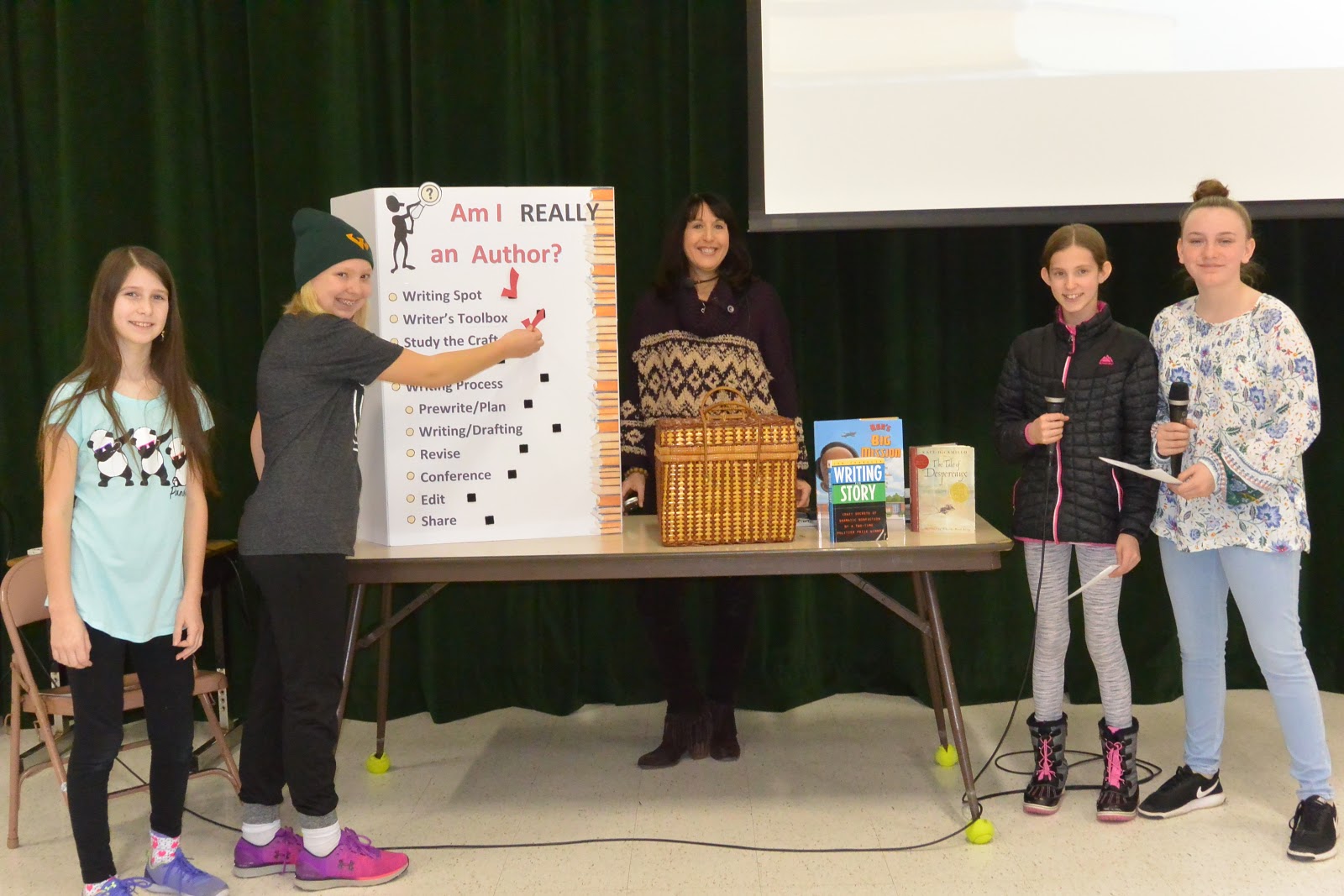
Am I Really a March is Reading Month Author? by Suzanne Jacobs Lipshaw


You’ve only been on this writing journey for a little over a year.
You’re still tweaking your middle grade fiction book that has morphed into a nonfiction picture book.
You’re unpublished.
And speaking in front of a crowd is way out of your comfort zone.

But the principal at the school you’ve just been transferred to tells you there’s no money in the budget to hire an author to speak during March is Reading Month and asks, “Will you be the author for our assembly?”

You surreptitiously gulp.

You scream “no” in your head knowing this will be a ton of work and your teacher plate is filled beyond capacity.

You start your yoga breathing.
You smile and say,
“Of course.”

And then you panic!

You call the reading consultant at the school you got transferred from for advice.
She suggests you do the assembly there first.
Everyone knows you.
It’ll be good practice.

Then she says,
“Don’t tell anyone. We’ll say a surprise famous author is coming!’

“What?!”
“Famous author— the kids will be so disappointed when they see it’s me!”

“They’ll love it; trust me.”

You reluctantly say yes and agree to be introduced as the “Surprise, Well Known Author”.
Like that’s any better.

That night while you’re supposed to be sleeping, inspiration strikes.
You hobble downstairs to your laptop.
And title your presentation “Am I Really an Author?”


You work feverishly on your PowerPoint and gather all your props.
You take the most recent revision of your WIP and illustrate it with photos and add it to your presentation.

You don’t care anymore that your teacher plate is overflowing.
Somewhere along the way this has become fun!

You arrive at your old school hands trembling.
As a special ed teacher, you’re used to working with small groups of kids.
250 kids and all those adult teacher faces—ACK!

You walk into the multipurpose room where you participated in so many assemblies—as an audience member.
You set up.

Three of your former students are going to introduce you.
They’re in on the “big secret.”

Before the classes file in, you hide.
Remember, you’re the “Surprise, Well Known Author”.


You hear your name introduced.
Then massive cheering.
Your fears diminish.

You enter the room, arms pumping in the air like Rocky!

You stumble here and there.
But overall, your presentation goes smoothly.

Students are raising their hands to share.
They laugh at all the right spots.
You’ve avoided looking at any adults in the room the entire time.

You read your manuscript.
The students are mesmerized by your story.
And then, the applause.

You had a blast and you can’t wait to do it again at your current school!

A few days later, you get emails from two other schools.
They heard about your presentation.
They want to PAY you to speak at their March is Reading Month assemblies.

YES, you really are a March is Reading Month Author!


Suzanne Jacobs Lipshaw is a nonfiction picture book author and elementary special education teacher who is passionate about growing young minds through her teaching and writing. The proud momma of two grown boys, Suzanne lives in Waterford, MI with her husband and furry writing companion. When she’s not dreaming up new teaching or writing projects, you can find her kayaking on the lake, hiking a trail, practicing at the yoga studio, or comparing paint swatches at the local Sherwin Williams. Learn more about Suzanne at SuzanneJacobsLipshaw.com.


Note: A brief version of this post was first published on the TeachWrite blog.

Are you an author looking for resources about school visits? Follow the results of this 2018 survey, Transparency in Pay for Author and Illustrator School Visits, in a four-part series here and here on author Michele Cusolito's blog.


Happening right now: the SCBWI Annual Summer Conference in Los Angeles. Follow along on the SCBWI Blog.


Looking for a conference closer to home? Registration is now open for the SCBWI-MI Fall Retreat. This year, we're partnering with the SCBWI-Indiana chapter for a creative weekend at Pokagon State Park, October 5th-7th. Go here to learn more and register online.
Logo by Sara Kendall


Tuesday, July 31, 2018

Book Birthday Blog

Welcome to SCBWI-MI's NEW Book Birthday Blog! 
Where we celebrate new books by Michigan's children's book authors and illustrators


BIG congratulations to Debbie Diesen on her newest book, Hello, Fall!

How did you come up with the idea for your book?
Hello, Fall! grew from a previous book of mine, Bloom.  Hello, Fall! is not a sequel per se, as it has a different main character; but both books feature the natural wonders of the seasons and celebrate the family love that grows from sharing experiences together.

What was the most difficult part of writing this book?
A challenge I faced while writing Hello, Fall!  was the balance of keeping a connection to the style and approach of Bloom while also letting this book be different from and independent of Bloom.

Who is your author idol and how have they influenced your work?
I have many author idols, but I think the most important influence on my work has been the collective mentorship of my writing group.  The nine of them are each talented, kind, and wise.  Their feedback and support have positively impacted every aspect of my development as a writer.  And they’ve made me a better person as well!

Where can we find your book?
Hello, Fall! is carried by many libraries and can be purchased from your favorite bookstore.
Here are different ways to buy Debbie's book: https://us.macmillan.com/books/9780374307547

A little bit about the book: A young girl and her grandfather explore and celebrate the beauty and bounty of autumn in this picture book for children.

A little bit about the author: Deborah Diesen is the author of many children’s picture books, including the NYT-bestselling The Pout-Pout Fish.  She loves playing with words and rhymes and rhythms.  She has worked as a bookseller, a bookkeeper, and a reference librarian.  She and her family live in Michigan.
Web site:  www.deborahdiesen.com


Friday, July 27, 2018

Tamra Tuller Travels the World, Finds a Home in Michigan

Tamra Tuller Travels the World, Finds a Home in Michigan
Young Tamra likes fuzzy animals

Before you got your “feet wet” in publishing, you apparently got your feet wet in the Atlantic Ocean. One biography describes you as a “beach bum on the Jersey shore.”
Can you describe your childhood, and how it led to your pursuit of making books?

Yes, that’s right! I did grow up very close to the beach so I was lucky enough to spend my summers either swimming, fishing, or just lounging on the beach. In the winters my friend and I would camp out in the aisles of bookstores, reading books right off the shelves. This probably annoyed the booksellers like crazy, but they never complained, and we loved it.

You worked for several years at Rutgers University’s Program in American Language Studies in English as a Second Language (ESL). Did you teach new arrivals how to speak proper English? Who was Tamra Tuller at that time?

That’s exactly right. I worked with the international student population to improve their language skills to the point where they’d be able to either attend college or graduate school in the US. Both my parents were educators and I have always had a love for language as well as other cultures, so it seemed like a good fit for me. I would never trade the time I spent teaching. I learned so much from my students. But it wasn’t a good fit. I’m really an introvert by nature, so getting in front of a group of people every day and trying to entertain them was a bit draining and caused a lot of anxiety, so I decided to pursue my love of language in a different way.

You decided at some point to venture into publishing, and sent out resumes for every entry-level job in the field. You ended up with Scholastic Book Club as a proofreader. Did you put together those elementary school pamphlets?

Oh man. I wish I could say that when I started I put together those pamphlets, but the reality is that I had to get promoted first to even be the assistant to the person who puts the pamphlets together. My first job was proofreading the ORDER FORMS! You know those tiny order forms? Talk about
Working her way up to this
tedious. But the great thing about that was that I became exposed to children’s books and learned what all the children’s publishers were doing, and it gave me a sense of where I might want to end up. Prior to that, I really knew nothing about books for young readers except what I read as a child myself. It was eye opening.

You moved up to Scholastic’s trade division, Blue Sky Press. What was new and different at this level?

It was totally different and new and I knew nothing at all about editorial yet. I was still really learning about the whole world of children’s books. It was exciting. Scary, but exciting.

You then moved to Philomel Books, an imprint of Penguin Young Readers. It’s been said that the NY publishing scene is “incestuous,” suggesting that a relatively small number of people hop from one publishing house to the next. How did you come to land at Philomel?

Yeah, it’s totally incestuous. I ended up getting the job with Philomel because a former Scholastic Book Club colleague had also made the transition from clubs to trade editorial, and she was also at Penguin. She was able to pass my resume along for me.

From this point in your career on, a google search turns up dozens of workshops and conferences where you brought your editorial expertise. (You appeared at an SCBWI-MI conference at Mackinac Island in 2011.) Was it your love of travel that took you all over the world? The search for new talent? Or a desire to reach out to writers?

All of the above! I do really love to travel and see new places. I’m also just completely fascinated by people, so while I’m a total introvert, I still love to connect with others. I’ve also always been aware that I had to keep learning and growing and stretching myself if I wanted to be the best editor or mentor or, really, just the best person I could be. And those conferences, much like my time teaching, were ways for me to learn—from the other editors, the agents, and all the writers. And they also took me outside my comfort zone and challenged me. I think that is important.
ps—Mackinac remains one of my favorite conferences that I have ever done. 

You moved from Brooklyn to San Francisco to work for Chronicle Books, East Coast to West. It’s a huge change geographically, but was the move a challenge professionally and personally, too?

Yes, the move was very challenging for me. Chronicle Books was an amazing place to work—full of talented, creative, and innovative people. I have immense respect for the work they do, and how they do it. But I underestimated how difficult it would be to live so far from most of the people in my life. It feels silly to say that now, but I thought about missing NYC or even New Jersey. I never thought about missing people and having friends around. I felt very isolated there, and I often felt that culturally it maybe wasn’t the best match. I guess I’m really an east coast girl at heart.

You’ve worked extensively with Beth Kephart. She credits you with the eventual publication of “Small Damages.” She said that your experiences in Berlin inspired her to write “Going Over.” Your love of Spain inspired another of her YA novels. What is it like to affect an author’s output like that?

Beth is unbelievably kind. GOING OVER was such a special book for me for a few reasons. First and foremost because of Beth’s writing and how ridiculously talented she is. Also because it was inspired by both of our experiences in Berlin. She had just traveled there and I had been there not long before her. So the book sprung from a mutual love of that city. My love of Spain (and I do love Spain!) didn’t actually inspire any of Beth’s books, but her writing about Spain inspired me to acquire SMALL DAMAGES. So I mostly just feel lucky to have been able to work with such talent. I mean, I simply gave Beth a one-sentence elevator pitch about a book I had imagined while I was in Berlin. She took it and ran with it and not only made it hers (though she will generously call it ours), but she made it into a piece of art. 
Still likes them

In an interview with Beth, you describe a typical editorial letter from you as a “long string of questions.” You ask her if those questions sometimes drove her crazy, and she responds that the questions were “sanity-giving, not insanity-making.” Are questions still part of your editorial process?

These days I am only doing occasional editorial work. I’m working more with editors now than as one. But yes, when I do editorial, I prefer to pose things as questions. I feel this gets the authors thinking more critically and analytically about what they’re really trying to express rather than simply mandating a specific change. And anyhow, I’ve always found that when you present questions or potential problems to authors, they then have the freedom to come up with their own solutions without feeling the pressure to do it in a specific way. Of course, when they get stuck, I am more than happy to step in and brainstorm and talk it out. That’s actually my favorite part of editing. It’s like solving a puzzle.  

You worked with Ruta Sepetys on her immensely popular”Between Shades of Gray.” With the other “Gray” bestseller muddying the waters, do you ever wish Ruta’s book had been titled differently?

Haha! Only occasionally when I talk about BETWEEN SHADES OF GRAY and have to clarify that I’m not talking about that “Other Shades of Grey.” But Ruta’s book came out first, and if anything she probably attracted a few more readers as a result of the confusion. I know more than one person had shown up to an event of hers thinking it was for the other book. It’s pretty funny to think about these people expecting to hear about S&M and getting WWII genocide instead.

Ruta said that her original story of internment and genocide in Lithuania was so grim that “everybody died.” She credits you with bringing some of those characters back to life and giving the work more hope. How do you manage a tightrope balancing act like that, acknowledging the horrific nature of the events yet honoring the human spirit?

It’s hard to find that balance, but some of it comes from simple compromises and not being afraid of ambiguity. I’m not a believer that books need every loose end neatly tied up. So at times it was simply leaving it open and maybe not knowing what happened to a character. And some of it obviously just came from my own emotional reactions as I was reading. I remember every time I started to feel like I needed to put the manuscript down because it was too upsetting, I marked that spot with a post it. (I was still editing on paper back then.) And then other times it was finding moments of light that were already there but that could have been more developed. I noted those as well. So it wasn’t always about toning down the horror—I wanted to recognize that horror—but it was about also recognizing the glimpses of light and beauty in the face of horror.

You took chances, saw compelling stories where others saw controversy and problems. You worked with Hannah Moskowitz, with her gender-challenged heroes, and helped shepherd K.A. Holt’s “Rhyme Schemer” to publication, a prose poem where our protagonist begins as a bully. What do you need to see in a manuscript in order to go all in?

That’s the hardest one to answer. I’m sure you’ve heard this a million times, but it’s about connecting with something. Yes, I love that Hannah and Kari took risks. I love that Hannah created characters who challenged our beliefs about sexuality and gender, and she did it with such an amazingly weird story.

And I love that Kari chose such a difficult topic and turned it on its head and did it with POETRY of all things. She has shown so many kids that poetry doesn’t have to be difficult or scary. But it’s really about their writing and how they tell their stories. I never would have thought I’d be interested in a book about fairy prostitutes at war with gnomes. It’s just not my thing. But I was completely won over by the bottom of Hannah’s first page. And I’m not always a poetry person, but I became so emotionally invested in Kari’s stories and her absolute honesty. I admire both Hannah and Kari’s talent and style as much as I do their bravery as storytellers.
So, to get back to the original question, it’s always just “I know it when I read it.” I know that can be frustrating for writers to hear.

You worked as a freelance editor for a while. Freeing, being your own boss? Or terrifying?

Oh, both for sure. I mean it’s totally freeing to wake up when you want to and work in your pajamas and make your own schedule. But, it’s terrifying to not always know where your next paycheck is coming from. Not to mention that it was a little isolating for me.

You’ve ended up as the in-house editor for Thomson-Shore in Dexter, MI. How did you decide to make that move?

So I am actually the Creative Director. I work with the editors and designers to insure that the books
Even editors deserve a break
we create, though mostly self-published, adhere to traditional publishing standards and that they look polished and professional and not…well, self-published. So I oversee the creative process from manuscript to final files.
I came to work at Thomson-Shore actually as a result of one of your lovely Michigan SCBWI-ers, Debbie Gonzales. She knew I was looking for something more stable than freelancing, and she happens to do yoga with the president and CEO of Thomson-Shore. So she played matchmaker and here we are. Thanks, Debbie!

Thomson-Shore does printing for traditional publishers. (Ruth’s Ellie McDoodle Diaries” series is printed there.) But they also offer indie publishing for authors who want to take control of their own books. What services could you offer a writer hoping to bring their work to print?

We offer everything from content/developmental editing or proofreading to cover design and interior design. We can help create a logo if you’re using your own imprint or want to start your own imprint. We also have some in-house imprints that certain authors can use if they don’t have the desire to create their own. We can also register for copyright and Library of Congress. We do eBook conversion. In some cases we create some light illustrations. We’re pretty much a one-stop shop for most author needs in terms of creating the book, and then to some extent putting it out there in the world. 
I serve as a guide to encourage them to make the best decisions for their books. Authors can use as many or as few of our services as they’d like. Additionally, we offer full distribution and fulfillment services as well as printing the actual books right here on site, which is pretty cool. Local authors can come in and tour our facilities while working with us. Another thing that our authors really like about us is that they get personalized attention and can actually speak to us as much as they would like about their book and the process. Not all self-publishers offer that level of personal attention.

A decade ago, self-publishing was scorned as a“vanity press.” The atmosphere has changed so drastically that traditional publishers have stood on stage at national SCBWI conferences and said that indie publishing is a legitimate path to bringing a book to market. What’s different now?

I think a lot of it is just more exposure and people starting to see higher quality books emerging from self-published authors. It also just seems increasingly difficult for authors to get a book deal or an agent. I think some authors with existing platforms are seeing that they’re doing a lot of their own promotion already and have a loyal following, so if they self-publish, they can maintain a level of control over the process that they don’t have otherwise.  

Is there anything you’d wished I asked?

What my favorite food is. It’s pizza.


Tamra Tuller is currently Creative Director for Thomson-Shore, a printer and publisher located in Dexter, Michigan. She's worked as an editor on both coasts, helping to shepherd into the world amazing book titles and authors.
Find Tamra at https://www.instagram.com/tamratuller/
https://twitter.com/TamraTuller  and https://www.facebook.com/tamra.tuller


Charlie Barshaw enjoys asking questions to fascinating people. He loves traveling to schools and book-related events with his wife Ruth. He finds less joy in finishing his YA novel and sending it out into the world.