
Friday, November 27, 2015

Illustrator Insights


what it takes to get published as an illustrator


AN INTERVIEW WITH DEBORAH MARCERO


What is your art background? 
 
I loved to draw from the time I could hold a pencil. My early passion led me to the University of Michigan, School of Art, where I acquired my BFA. Then after living in New York City for three years, (which was an art education in itself) I attended the School of the Art Institute of Chicago where I earned an MFA. 


Have you been published in other illustration related fields?

No. I did not seek publication until I developed my style in Children’s books. I wasn’t ready. In the past I’ve participated in Art Gallery Exhibitions and small poetry publications, but very casually.

How long were you trying before you got a contract?

I officially started my path to publication in 2009. My first book deal came in April of 2014. So: 5 years.


How many hours a day did you work on your illustrations?
 
This varied tremendously. I am also a photographer. In the summer (my busy season) I would say my work on the illustrations was less. Two – six hours per day of daydreaming/ brainstorming/ sketching/ writing/ character designing/ etc. In the winter, however, I would have long stretches of time where I would be able to work 10 – 16 hours of the waking day working on a project.


How many hours a day did you work on your self promotion?
 
VERY LITTLE. Self-promotion was and is a huge weakness of mine, and I never enjoyed doing it. However, my first big step in this area, was building a website and curating a portfolio exclusively for children’s illustrations.


What steps did you take?  

I built and started a website in December of 2012. In making my work visible and public, everything became more real. In May 2013, I attended the Wild Wild Mid-West conference in Fort Wayne, which was a game changer for me. Energized by the conference, and by finding a strong critique partner, I worked even harder on my writing and portfolio that summer.

In August of 2013, I had a full picture book project to pitch (with 3 final art pieces, manuscript and finished dummy book – all uploaded to my website on a password protected page) so I started targeting and soliciting specific agents. Although this first attempt garnered 100% rejections from the 10 or so agents I submitted to, I took everything I learned (which was a lot) and was more motivated than ever. It helped that in some of the rejections I received helpful feedback and encouragement. I decided to start a totally new project that September, and by the end of October it was ready to send out.

I used the Writer’s Market book and the internet to help me find an agent that might be a good fit for me and my new project. Within a week (two agents wrote back or called on the same day of my email submission), I had several interested parties and after several revisions and a few months later, I signed with my current agent, Danielle Smith with Red Fox Literary. Even though I currently have accumulated five book deals with Danielle, I still have room in my schedule for more work, so I continue to send out snail-mail postcards with new art every three months to a list of 100 editors/art directors.


How did you find an agent and how long did it take?

I used the Children’s Writer’s and Illustrator’s Market Book as a starting point in my research, then I followed up by doing online research on each potential agent. From my initial search and submissions (two rounds – with two different projects) to finding and signing with an agent, it took about 6 months.


How many agents/ art directors did you approach?

With my picture book in August, I approached 10. And then with my illustrated early middle-grade project in November, I approached 8.


How many conferences and workshops did you visit?

From 2009-2010 I attended two six-week community education classes with Esther Hershenhorn in Chicago. In 2013 I attended two SCBWI conferences: The Wild Wild Mid-West multistate conference, and a small regional conference on “The Picture Book” in Indiana.


How did you prepare for them?

At the Wild Wild Mid-West Conference, I signed up for the Illustrator Intensive with Laurent Linn. In preparing for the intensive, we needed to come with a finished drawing of the “Mad Hatter”. The critiques gave me amazing insight. I mostly attended the conferences prepared to be a sponge. I took a notebook and a pen, and wrote down all that I could. After each conference, I went back to my studio inspired with a deeper understanding of what I needed to do to make my work stronger.


Is there anything special you did that other people might not think of?

There are two things that stand out to me in answering this question: 1. Putting in the time. 2. Ability to be critical and self-reflective in one’s own work.


Was there a point where you wanted to give up?

I honestly don’t think so. When I made the decision to really give this a go – I knew that it was the long plan. That it would be a journey. I knew I had to take big rejections with the small victories… and that everything moves at a snail’s pace in this industry.


What kept you going?

When moments of doubt crept and creep in, I almost always shift my focus to a new project; re-directing my energies helps keep my creativity flowing.


Do you have any tips to stay motivated? How do you stop procrastinating?

I create routines. I stay disciplined by making lists and creating very specific time-sensitive goals. I try to leave room in the schedule for making mistakes – those are such an important part of the process for me


Do you write too?

Yes – I have always loved both.


Do you approach it the same way as illustrating?

I approach them in very similar ways. I love to create work where the images and words lean on each other for meaning – and in their juxtaposition, they are able create something totally new, that neither words nor pictures can solely do on their own.


What was your biggest aha moment?

This came after the Wild-Wild-Mid-West conference. I walked away realizing that I needed to strengthen the narrative elements in my portfolio. Not only did the art need to have strong color, line, composition, character designs, etc., the art needed to evoke emotion and feel like it was in the middle of a story. I wanted each of the images in my portfolio to prompt the viewer to want to “turn the page” so to speak.


What do you consider your biggest break through?

My process: When I finally figured out a way to merge traditional media with digital to create images that didn’t feel or look “digital”. My biggest compliment came from my editor at Harper Collins when she asked if I worked digital or traditional – because she couldn’t tell!


What people or events helped you most on your journey?

I would have to say that my writing partner has helped me the most on my journey. We met at an SCBWI conference, and even though he lives in another state, we were and are able to share and critique each other’s work via email and on the phone. It has been the most critical part of the journey for me. I don’t feel alone in this work, and when I get stuck, or even when I think I nailed it – I send it to him or now, to my agent (who is editorially hands-on, which I love) and they see things and ask questions that I hadn’t even considered. Having a partner in this work helps me get out of my head and see what I’ve done from a new angle, which leads to revision and consequent improvement.


What is your advice to the aspiring children's book illustrator?

Work hard. Put the time in. Make mistakes. Revise. Make more mistakes. Revise again. Find a writing/art partner or group. Know that it will take time (you will need endurance). Every person’s journey is unique in this field because you have to forge it. Be open to critique. And lastly, the most important thing might be: to believe in yourself. 


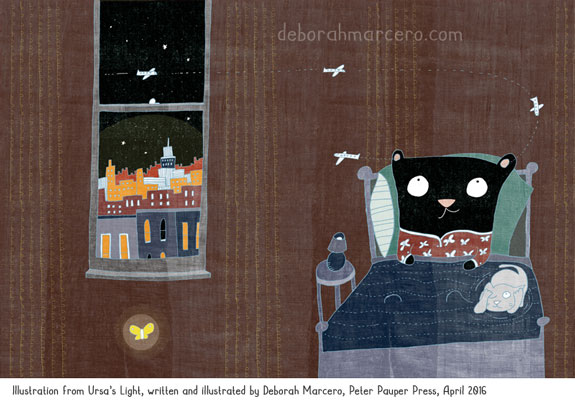
Deborah Marcero received a BFA in drawing, printmaking, and photography from the University of Michigan, and her MFA from the School of the Art Institute of Chicago in Creative Writing. Deborah’s illustration debut in The Backyard Witch series, HarperCollins, released July 2015, her picture book URSA’S LIGHT, Peter Pauper Press, will be published in Spring 2016 and she is also contracted to illustrate Corey Rosen Schwartz’s new picture book, Twinderella, set for publication by Putnam’s Sons (Penguin) in 2017. She has been a member of SCBWI since 2009. deborahmarcero.com


Friday, November 20, 2015

Flashback Friday: Neal Levin's Kiddie Litter Cartoons

We have 10 years of Neal Levin's Kiddie Litter cartoons in our SCBWI-MI newsletter archives. It's a shame to keep them tucked away. Enjoy these Friday funnies, and find more here.


Neal Levin writes short stories and poetry for children as well as drawing cartoons. His work has appeared in several national magazines and collections. You can find out more at www.neallevin.com.


Friday, November 13, 2015

Planning a Critique Group Retreat by Ann Finkelstein

Every summer our critique group goes on a writing retreat. When Kristin noticed the pictures of our dedicated and smiling faces on Facebook, she asked us to write an article. She wanted to know how we scheduled it, organized it and made it work. The group nominated me to write it. I tried to weasel out, but everyone offered suggestions. Here is our joint effort.

Commitment
Most of us go – every year. Obviously, things come up, and we understand that, but our attendance is exemplary. We acknowledge that the weekend is an essential part of our creative processes as well as a natural extension of our commitment to each other.

Our first retreat. 2008
Timing
When we first decided to have a weekend retreat, we polled the group about available summer weekends. We hold the retreat on the same weekend (Thursday to Sunday) every year. This allows us to plan family and professional events around it.

Location
We tried several places before we found The Perfect Spot for Us. This is what we like about it:
  • Number of Beds. We’re a big group. Everyone needs a place to sleep.
  • Space. Everyone needs a place to work. The house has several communal rooms and a shaded front yard.  
  • Kitchen. We have full use of the kitchen and prepare most of our meals.
  • No Strangers. One year we stayed in a B&B that also rented to other guests. People on vacation tend not to realize that working writers and illustrators prefer quiet.
  • Places to Walk. Many of us find fresh air and motion get the creative juices flowing. The house is in a lovely neighborhood and near shops, restaurants and a waterfront. One year, we rented a place in a rural setting, where the only place to walk was along the highway. We didn’t go back.
  • Price: The house is quite affordable.
  • Distance: Most of us have a two-hour drive. No one wants to waste time traveling. If an emergency occurs on the Homefront, we can easily return.

One year, we had a special guest. 2009
Limited Internet Access
We have to walk across the yard to connect with Wi-Fi. Research tools are available if we need them, but we can’t click into the World Wide Time Waster just because a scene isn’t working.

Flexibility/Structure
Each person can work on whatever they want in whichever space they want all day long.
We meet in the evenings. On the first night, each person describes his or her goals for the weekend. On subsequent evenings, we share some of the work we’ve done. This is not critiquing time, but a celebration of the creative process.
Full confession: our evening meetings involve snacks, wine and chocolate.

Here’s to great writing and illustrating. 2013
Food
We surveyed the group about preferences for breakfast and lunch and created a signup sheet. All food is communal. For breakfast and lunch, we eat whenever we want, although people tend to gather in the kitchen around noon. Two members collaborate to make dinner. We have a keen understanding of our fondness for leftovers for lunch so we prepare ample quantities. Every dinner ends with dark chocolate.
Writing and illustrating is hungry work. Our signup sheet incudes both “healthy snacks” and “other snacks.”

Fun
I consider the members of my critique group my best friends and my best colleagues. While we take our work and each other seriously, we all bring love and laughter to the retreat.

The World’s Greatest Critique Group was founded … a long time ago. It’s been holding annual retreats since 2008.

Our most recent retreat. 2015


Thanks to Ann Finkelstein for writing this story and to Debbie Diesen for sharing the photographs.

Coming up on the Mitten blog: more Kiddie Litter cartoons, an illustrator interview, a PiBoIdMo experience, and another round of Hugs and Hurrahs. Please send your good news to Patti Richards (pgwrites5@gmail.com) by December 14th.

Have a great weekend!
Kristin


Friday, November 6, 2015

Writer Spotlight!

Today’s Writer Spotlight features long-time Michigan SCBWI member Lisa Rose! 

Lisa is well known around our Mitten as a lover of all things Detroit and an advocate for diverse books in the children’s writer community. She hosts the Missing Voice Picture Book Discussion Group on Facebook where members focus on a different diverse picture book each month, meet the author and ask questions. Lisa’s journey as a children’s author is inspiring, and she’s here to tell you all about it. Take it away Lisa! 


Mitten: Tell us a little bit about you. Where you’re from, your history in the State (were your born here or did you come from somewhere else, that kind of thing)

Lisa: I’m a life-long Detroiter! I grew up in West Bloomfield, but am related to Oak Park royalty. Seriously, I’m proud to be from Detroit and be a part of its comeback. Creative people are coming to Detroit from all over—even Brooklyn is moving here! I didn’t have to move—I’ve been here all along fighting for the city’s rebirth with both of Joe Louis’ fists.

Mitten: When did you start writing for children or otherwise, and how did you know it was something you wanted to do? 

Lisa: Originally, I wrote plays. At the University of Michigan, I had several produced. But my mother said I had to do something practical and something that would make money. So I became a really rich first-grade teacher….HA! Reading to my class made me fall in love with picture books all over again.

Mitten: How did you find out about SCBWI and how long have you been a member?

Lisa: I think I first heard about in a rejection letter. The editor/agent probably thought, “This is so bad—go see these people, learn, and submit when you know more.”  I’ve been a member since 2002.

Mitten: What genres are you most interested in and why? Picture books, middle grade, YA, chapter books, poetry, nonfiction?

Lisa: I love everything written for children 10 and under. Once puberty strikes, I really suck. I didn’t do very well when I was that age and never want to revisit it with my writing. I’m over 40 on the outside, but really I’m very much a 7-year-old on the inside

Mitten: Tell us about your publishing journey. Are you pre-published or published, and if so where?

Lisa: Oye—my journey has been a looong schlep! There have been many highs and lows. I wouldn’t have gotten through any of it without my SCBWI-MI family! People always ask me to help them write a children’s book—I tell them to run into a brick wall a thousand times and if they still want to write the book after all that, then I can help them. 

Right now I have two e-books published with MeeGenius/Houghton Mifflin Harcourt. They are: 

OH NO! THE EASTER BUNNY IS ALLERGIC TO EGGS!
OH NO! THE TOOTH FAIRY BROKE HER WING!

My debut picture book, SHMULIK PAINTS THE TOWN, will be published in January 2016 by Kar-Ben Publishing. Last week it finally felt real because it was posted on Amazon for pre-order.
From SHMULIK PAINTS THE TOWN, KarBen Publishing, January 2016


Mitten: Many of us have jobs other than writing for children. Tell us something about what you do outside of writing. 

Lisa: I care for my visually-impaired daughter. She is seven and in second grade. My daughter has some sight and very limited color distinction. She has taught me how to look at books differently. I look at the type, spacing and detail of the illustrations. For example: Eric Carle has very clear and simple style, but Jan Brett is a nightmare for my daughter. One of my new favorite books is RED: A Crayon’s Story by Michael Hall. I love so much of this book—but the type is very tiny and scattered in some places. This is also challenging for her. If I were the art director (or in charge of the world) I would have tweaked a few things.

As a former teacher, I know children with ADD/ADHD or if they have been affected by drugs in utero, always crave a very simple style. They can’t handle all of the stimuli in some books.


Mitten: How does what you do every day inform your writing?

Lisa: As I mentioned earlier, I was a teacher. I also have a Masters in Reading. But the biggest influence was where I taught—Highland Park and Pontiac. Most of my students were African American and lived in homeless shelters. I wanted to tell their stories. I believed their voices needed to be heard. My middle grade work-in-progress is about a homeless girl living in Detroit. It led to me meeting Jeff Bass, who produced Eminem’s 8 Mile. He asked me to form a company with him and develop an app. It’s not every day that a person with several Grammys and Oscar invites you to form a company—so I said, “YES!” The app has been its own separate roller coaster…. I hope to share a happy ending for that story very soon!

Mitten: Where do you get most of your writing ideas? Do you write them down, keep them in a computer file or just store them in your memory?

Lisa: I get most of my ideas early in the morning—4-6 am—is what I call magic time. I’m on my elliptical in the basement and just let my mind play.

Mitten: We all have favorite writers that inspire us. Name two of yours and why you like them.

Lisa: I have to say that Judy Blume was my first love and I still have a crush on her. I also adore Jacqueline Woodson. However, Jay Asher really keeps me going. He faced so much rejection and still kept writing. Finally, he produced a book that was on the NYT list for several years!

Mitten: What’s the best piece of advice you’ve ever received as a writer for children? Why?

Lisa: “No amount of sequins can save a bad script.” This was said by my high school drama teacher but applies to all writing and even real life. If your structure is weak, nothing can save the show/book.

Thanks for sharing your story with us Lisa! And be sure and stop by Amazon.com to preorder your copy of Shmulik Paints the Town. I promise, you’ll be glad you did!

Learn more about Lisa at Lisarosewrites.wordpress.com


Friday, October 30, 2015

The Mystery of Writing: Keep Your Readers Guessing by Laura Wolfe

Are you writing a mystery? Or thinking about writing a mystery? These tips will help my fellow mystery writers to keep readers engaged from the first page to the last. 

1.  Start with an intriguing premise. The central mystery in your work should be one that makes a reader turn the page and want to know more. In other words, the premise should raise multiple questions that beg for answers. "Who robbed the bank?" is not as intriguing as "Who emptied the vaults of five banks on the same day in a quaint Midwestern town without anyone seeing?" In the second example the reader automatically wants to know not only Who did it?, but How did the robber hit five banks in one day?, and Why didn't anyone see?, and What's the real story behind this "quaint" town?

2.  Introduce a few seemingly irrelevant clues toward the beginning of your work. Start with a couple of minor clues and build toward more frequent and important clues toward the end. These strategically-placed hints toward the beginning should not be so obvious that they give away the answer to the mystery. Instead, the clue should make the reader think, That's odd. And then later, Aha! It all makes sense now. For example, in Trail of Secrets, the MC, Brynlei, realizes someone stole her deodorant shortly after she arrives at the riding academy. While Brynlei thinks the occurrence is strange, the reader can sense something more sinister. It isn't until the central mystery of the missing girl is solved that the reader realizes its significance.

3.  Give the reader plenty of suspects to choose from (but not so many it becomes confusing.) As your MC discovers new information, she should start to view formerly friendly characters in a more suspicious light. For example, maybe your MC is certain the creepy P.E. teacher is the one who strangled her French teacher, but then she sees the nice man next door digging a hole in his backyard in the middle of the night. Or maybe your MC discovers the new transfer student from France lied about an important piece of her past. Anyone can be a suspect! Just don't go crazy. Keep the viable suspects to less than five, and make sure to explain away any suspicious behavior for people who are not the guilty party.  
                   
4.  Raise the stakes to keep readers turning the pages. Mysteries aren't always page-turners, but they should be! Here are a few ways to raise the stakes and keep readers on the edges of their seats:

  • Put a timeline on solving the crime (e.g. The MC's brother will be sentenced to death if the MC can't find the real murderer in a certain amount of time);
  • Take away your MC's friend, helper,  or support system;
  • Have the police accuse the MC of the same crime she is trying to solve; and/or
  • Make the suspect aware that the MC is onto him, and reverse the chase!

5.  Make sure the answer to the mystery is a good one! When the mystery is solved, keep your promise to the reader. Don't have the MC discover that everything actually happened exactly the way the police said it did, or that the secret room your MC finally uncovers behind the grandfather clock is really just used as a broom closet. Those are NOT the prizes readers want to find at the end of your book. Give them something scandalous and unexpected. Instead, maybe the police chief stages the crime to cover for his son who is the real murderer, or the secret room behind the clock is used to hide a dead body. See the difference?

I hope these tips help you write your next mystery! I can't wait to guess, "Who dunnit'?"

Laura Wolfe lives in Milford, MI. She is a wife, mother, and lover of nature and animals (especially horses!) Her debut novel, Trail of Secrets, was published in August 2015 by Fire and Ice YA. Laura's picture book, Henrietta's Hoof Polish, is forthcoming from Guardian Angel Publishing. Laura is a member of Sisters in Crime and the SCBWI. 

More about Laura here: 


It's time for another SCBWI-MI Member Spotlight. Who will it be? Find out next Friday.
Happy Halloween weekend!


Friday, October 23, 2015

Welcomed into the Kid Lit Community with Open Arms by Christina Fecher

Maybe I’m just cynical, fueled by a career as an inquisitive journalist. Or perhaps it’s just because the writing industry overall – newspapers, magazines, books, you name it – is incredibly competitive.

Regardless of the reason, I’m completely amazed – and admittedly a little overwhelmed – at just how welcome the kid lit community has made me feel so far.

I guess I really shouldn’t be too surprised. I mean, we are a group of individuals striving to inspire, encourage, educate and entertain children. Not to mention foster an early appreciation for reading.

But still …

As a newcomer to the community, I’m so appreciative of how much I’ve been helped by people I’ve only just met at the SCBWI-MI Fall Conference!

My experiences have helped me believe that maybe, just maybe, I can make it as a children’s book author after all. To name a few:

The Michigan Chapter of the Society of Children’s Book Writers and Illustrators is a great resource that I recommend others check out. There’s a mentorship program, webinars and free monthly meet ups to help you further develop your writing. They also have a blog, The Mitten, that I’ve submitted posts to on occasion. They encouraged members to submit a post, so I reached out to Kristin Lenz and her response was both quick and encouraging. That right there spoke volumes because it made me feel as though what I had to say was relevant. It was great meeting her in person earlier this month.

Every writer needs an editor, and I’m so lucky I found Louise Knott Ahern, a former journalist like myself. Maybe found isn’t the correct term since we’ve been Facebook friends for years but have never actually met. Anyway, she took on my manuscript project and helped embolden my voice. Louise smoothed areas in need of TLC, but also highlighted my strengths. She truly made it better, made me stronger. But it was more than that … her feedback built my confidence, declaring me “well-suited to writing children’s books.” And since then, she’s passed along tips and tidbits to help get me noticed.

Christina with Deborah Diesen at the fall conference.
If you have young children, then you’ve certainly read The Pout Pout Fish by Deborah Diesen time and again. In fact, it’s a favorite in our household! Well, after much consideration, I decided to reach out and email Ms. Diesen to introduce myself earlier this summer before the SCBWI-MI Fall Conference. I had never emailed a New York Times Best Selling Author before, and the interaction was nothing like I expected. First and foremost, I never even expected a response. Let alone a same-day response congratulating me on my leap into the children’s picture book world and offering insight into her publishing journey. After a few emails – and the opportunity to meet her in person at the conference – I’m definitely taking her advice to heart.

I’ve only scratched the surface into the encouragement and kindness within the kid lit community, but I already feel a confidence that I didn’t have 6 months ago. And I sincerely thank those who’ve given me a moment to say hello. It’s these simple acts of kindness that set this genre apart.

So I think I’ll go ahead and stow my skepticism, because you’ve all proven I don’t need it anymore!

Christina Fecher is a former reporter at The Detroit News, who now handles corporate communications and public relations in West Michigan where she lives with her husband and their two children. She’s a member of the Society of Children’s Book Writers and Illustrators.


Coming up on the Mitten blog: Adding Mystery to Your Writing, Planning a Critique Group Retreat, more Kiddie Litter cartoons, and another Member Spotlight. See you next Friday!

Friday, October 16, 2015

OH, THE PEOPLE YOU’LL MEET... at an SCBWI conference. (And a scholarship opportunity!)


Registration is now open for the 17th Annual SCBWI Winter Conference in New York City. Have you dreamed of going? What's holding you back? Time, travel, money, fear? Charlie Barshaw is here to share his experience attending a national SCBWI conference, and we'll tell you how you might qualify for a scholarship to cover the cost of the NY conference registration AND airfare.

OH, THE PEOPLE YOU'LL MEET by Charlie Barshaw

In the past I’ve emphasized the talent present at the SCBWI national conferences.(http://scbwimithemitten.blogspot.com/2015/02/one-liners-abound-at-new-york-conference.htmlThe 2015 SCBWI Summer Conference in Los Angeles was no different. From Mem Fox to Kwame Alexander, with agents and editors by the bushel, it was a spectacularly star-studded affair. 

But, keynotes and breakout sessions are only one reason to attend a national conference. Another great reason is the creative community, the people, your peers, who you meet.

Lin Oliver announced that a record 1,173 attendees paid for the conference. Of those, 736 were, as we like to say in the biz, pre-published.

So, more than half of the writers and illustrators at the conference were figuratively in the same boat, and literally in the same ballroom for the opening speech.

Silly me, I forgot the business cards that Ruth had printed and cut for me. (I am, the card proclaims, a writer and literary agency intern.) Almost everyone else I met had one, and I came away, even the introvert I was, with contact information from at least a dozen new creative friends and acquaintances.

It started on Friday morning when I recognized Owen in the registration crowd. He’d been at my a.m. NY round table in February. I’d admired his work, gotten his contact information and promptly lost it. And my brain, usually a rusty trap, gave me his correct name right away. Owen and I would meet several more times over the weekend, and we’ll likely be trading YA manuscripts.

One fortunate encounter happened on Friday night when I participated in a peer group critique. Our mid-grade novel group had me and four other writers, and every single set of pages was uniformly excellent. I met Naz, Tiffany, Eric and Kathryn. Three of them live within driving distance in California and scheduled a date to meet again. Tiffany and I planned to join in electronically, and suddenly I have a new crit group.

Afterwards, outgoing Naz persuaded me to visit the hotel bar, where I paid $13 (!) for a glass of wine and gathered more cards. I met Lori, a YA fiction writer who had written a manuscript about a transgender teen. The story, she said, was semi-autobiographical. That same evening I met writer Jeanette just long enough to snag a card from her, too.

The next day, I sat next to Rhonda, who has a published MG out but was disappointed that her publisher passed on the sequel. However, she had another story in the pipeline and was encouraged at its prospects.

I stood in a long line waiting for Adam Rex to sign my copy of THE TRUE MEANING OF SMEKDAY. I talked with Marshalla, in line ahead of me, about schools and plays; she was a NY educator. I asked if I could use her lovely name for one of my MG characters, and she agreed.

At the “Sparkle Party” that night I ran into former SCBWI-MI member Betty Raum, who’s now RA for North Dakota. I also met Virginia, who is the Illustrator Coordinator for the Louisiana/Mississippi region. Virginia also draws the LSU tiger mascot for the school.

I met Stephen on Sunday when we found the last open table for a luncheon. He’s a balloon illustrator and children’s author. Unfortunately, I didn’t get to explore the balloon thing with him.

Molly, who I met in fast-talking editor Jordan Brown’s breakout, might be able to share notes so we can piece together all the great advice he loosed.

I met Carolyn Flores in New York and was thrilled to meet her mother in LA, a children’s writer in her own right. I declined taking Carolyn’s card early on, but accepted her evocative postcard at the signing party on Sunday because she still had a few left.

I met Owen again on Monday before the Intensives when Stephanie appeared. She’s writing YA and opened one of her WIPs with a suicide note.

These are connections. Some will go nowhere, but some will last a lifetime. Owen met up with author Paul Fleicshman after a 30 year absence, and they reconnected in a heartbeat.

There are many good reasons to attend an SCBWI conference, on the national and local level. Perhaps the best reason, though, is for the people you will meet, the networks that may form, the friendships and creative support that will almost certainly result.

Charlie has recovered fully from a stroke which left him unbalanced. He can now walk a straight line and still twist a sentence into knots. He's currently working on his YA and revising his MG, "Nuts" with his new-found LA crit group. 


Thanks to Charlie for sharing his experience. Are you intrigued? Feeling more comfortable about attending one of the big SCBWI national conferences? If the expense is holding you back, SCBWI-MI member Shutta Crum has the solution:

http://michigan.scbwi.org/2015/10/12/shuttas-scholarship-solution-to-the-winter-doldrums-is-here-again/

Shutta will pay the full early-bird registration fee for a Michigan SCBWI member to attend. ($425.00) The qualifying rules are listed on the application form posted here and on Shutta’s site. (Deadline to apply for the scholarship is by midnight, Dec. 5, 2015.) SCBWI-MI will reimburse the scholarship winner for the cost of airfare.

We're so fortunate to have such a supportive chapter!

Coming up on the Mitten blog: A Kidlit Welcome, Adding Mystery to Your Writing, Planning a Critique Group Retreat, more Kiddie Litter cartoons, and another Member Spotlight. See you next Friday!