Showing posts with label Jen Boehler. Show all posts

Friday, August 22, 2025

Studio Tour with Jen Boehler


The studio in 1965 painted white is sits to the left. 
Do you see the little arborvitae planted next to it? 
Look how far it’s spread in the current exterior photo!

The summer of 2003 found me squarely planted in the estate sale circuit, collecting relics I had no space to store in our tiny condo. 
Luckily, on one of my treasure hunts I stumbled upon an adorable red brick farmhouse that had been vacant for the past ten years.  It was, along with its contents, for sale.  Inside waited a glorious challenge for this interior design student: Pepto-pink walls, a postage stamp-size kitchen and wall-to-wall carpeting straight from the sixties — Oh, the potential!  More favorably, it boasted plaster cove ceilings, built-in curios, and a kitschy telephone nook — Swoon.  My husband’s skepticism melted with my enthusiasm, along with the discovery of a little cedar-sided bunkhouse that sat adjacent to the house.  The previous owner had used it as his clubhouse, evidenced by the cigar smoke stains lining the walls.  Little did I know that in addition to being the perfect storage spot for my treasures, this gem would serve as an invaluable studio space someday, lending daily doses of inspiration and levity with its age-related quirks and storied past.


These photos were taken in 1984 and kindly given to me by the former owner’s daughter.  Oh, to be a fly on that knotty pine wall!


Following our exciting “First Home” purchase, I discovered the little house was originally a barracks at Camp Freeland for German prisoners of war during World War II, and was moved to our new property upon the war’s end.  The ARTICLES I’ve uncovered since reveal favorable conditions with the soldiers earning a living wage for work in nearby crop fields.  The evolution of the building’s purpose has always intrigued me, with the varied inhabitants having little-to-no commonality:  Prisoners of war, card-playing farmers, and illustrator/author.  This history also gives me pause each time I make a new improvement or design choice, as at times it feels I’m permanently tucking the past behind a coat of paint or treated two-by-four. 

The interior right after we bought the house as I was moving my “collection” in (notice Rusty’s easy chair sporting a tired teal brocade).


Shortly after we moved in and I graduated from college with an interior design degree, I used the space on rare occasion to meet with clients, but only seasonally: During the first few years I had to build a fire in the potbelly stove to stay warm in the winter (you can see it in the photos of the clubhouse days).  We relocated the wisteria once it grew too heavy for the aging overhang.

Me at the studio today (December, actually).
When delving into a studio conversion, I waffled over painting the knotty pine walls, but settled on brightening it up with an airy shade of white (followed immediately by plaguing shades of regret for forever erasing the possibility of leaning into its summer-camp vibe).  We removed the drop ceiling added in its card club heyday and covered it with wood extracted from a tumbledown barn out back, installed additional lighting, and replaced the rotted and peeling cedar siding with new.  Architectural details like the front porch and fireplace remain original, and will continue to be there as long as they are intact.  Though nonfunctioning, the fireplace serves purpose as a sanctuary for mother birds to raise their babies each spring, their hungry chirps always a sweet sign of the warm days to come.  The caveat?  On rare occasion, one of these birds will make their way down the chimney and into the studio, with the ensuing mayhem offering that previously mentioned dose of levity!


This tabletop was here when we bought the house,
so my husband used it to build a standing desk to hold my easel.

My daughter Violet with Rusty
after school in her fuzzy chair.
Vintage finds are still spread throughout, but they’ve each now found their purpose.
  At the front of the space are my computer, files, and a fuzzy little chair found roadside and recovered for my daughter to pull up after school and chit-chat about the day’s events.  A standing-height skirted table built from a reclaimed top and salvaged fabric offers storage and surface for my easel.  At the center is a table inherited from my grandmother-in-law to paint and catalog textures for my cut-paper illustrations, surrounded by another collection of roadside chair finds for hosting craft nights with friends. 
My faithful studio-mate Rusty
in his easy chair.

A left-behind shelf, market storage bin and oversize crate house a handful of pieces from my Michigan apparel line, and fabric and crafting supplies have a home on salvaged tables and fruit crates.
  Colored pencils are propped in a quartered barn beam, and patinated tins, vases and drawers house all other art supplies.  Perhaps most importantly, a reupholstered easy chair sits by the fireplace for Rusty, my faithful studio-mate.


This corner tickles me because it houses a little bit of every era and facet of my life, serving as a museum of sorts:  Painting night with my kids, hand-sewn apron, fine art, illustration, dried corn tassels from the garden, Michigan apparel, crafting supplies, SCBWI conference swag, and vintage finds aplenty.

The contempt I have for these shoes destroying my feet in the early 2000’s
is superseded by my captivation with their cuteness.


My husband enlisted a woodworking friend
to create this colored pencil holder out of a salvaged barn beam.


After designing a line of Michigan apparel ten years ago, I used the studio to store, ship and sell merchandise.  I still have a little corner saved for a handful of pieces.


My grandmother-in-law’s old table covered in supplies to paint and cut paper textures.

Though wonky floorboards sometimes evoke shades of the Mystery Spot and boxelder bugs find creature comfort inside the walls, this little bunkhouse is still my favorite part of the property I scored at an estate sale twenty-two years ago.  As time has passed, I focus less on the lives it lived before us and more on its evolution in the years since we’ve owned it, a reflection currently punctuated by a shift in our household.  By the time this article is published, my daughter will be moved into her college dorm, thus ushering in yet a new iteration of inhabitants and daily happenings.  So if anyone finds themselves in the Saginaw area with a hankering for creative chit-chat, let me know: I’ll have a fuzzy, reclaimed chair open for you.


Jen Boehler, Michigan Co-Illustrator Coordinator, is an illustrator, graphic designer and author working on a hobby farm in Saginaw, Michigan. Before pursuing children’s literature, Jen worked as a freelance editorial illustrator, graphic designer, interior/event designer and owned her own line of Michigan travel apparel. She has degrees in both art/graphic design and interior design.


Editor's Note: Thank you, Jen, for sharing your very cool studio with us! If anyone else is interested in sharing their studio with The Mitten, we'd love to see it! You can email me at Sarah.Prusoff.LoCsacio@gmail.com if you might be interested in doing a studio tour post.

Friday, January 10, 2025

6 Reasons to Apply for the 2025 Illustration Mentorship

As the turn of the New Year ushers in a period of possibilities, new horizons and mindful focus on the dreams we dreamt over the previous year, sometimes finding the path to our goals can be a challenge.  In 2025, we are thrilled to offer our region’s illustrators a Mentorship Program designed to refine your craft and take your work to the next level, preparing it to send out into the world.  Though there are dozens of reasons to take advantage of this exciting six month opportunity, here are six of the most important:    


This acclaimed talent has illustrated thirteen books for publishers including Viking, Penguin Random House, Harper Collins, Abrams and many more!  Her extensive knowledge of the industry, expertise in craft, and overall desire to
work closely with other creative folks are just a few of the reasons we enlisted Penelope as this year’s mentor.  She will work one-on-one with you to help bring your creative vision to life, sharpen your skills, and build a path forward on your illustration journey.  


Illustrators and author/illustrators - this year’s program offers the opportunity to perfect either your portfolio OR dummy book!  This flexibility is unique to the 2025 program, and is perfect for each and every illustrator to take your work to the next level.  Illustrators will work toward a polished portfolio ready to send to art directors and/or agents, and author/illustrators will focus on layout, pagination and storytelling techniques to prepare your dummy book for publication. 


What’s even more exciting than a ticket to the chocolate factory?  A Golden Ticket to submit your work, of course!  This ticket will provide you access to an acquiring editor, agent or art director (depending on your chosen path for the Mentorship) that is currently closed to unsolicited submissions.  Though closed doors can sometimes be the biggest hurdle on the path to publication, your submission-ready work will have this opportunity upon completion of the Mentorship.


Have you ever received feedback for your work on an SCBWI Gold Form?  If so, you know the extensive value it offers.  By addressing aspects such as presentation, consistency, perspective, composition, character design, marketability (etc!), these forms are designed to provide the creator with actionable feedback by industry professionals to independently improve their work.  Even better?  You will be receiving THREE separate Gold Forms offering three unique perspectives on your work!  Many other critique opportunities offer feedback from only one reviewer for about the same cost as the Mentorship Application - an incredible value for every. single. applicant!  

BONUS!  The first runner-up will also receive free entry into our annual Critique Carousel!


The illustrators in our region are a super talented bunch and are creating amazing work - we’ve seen it!  Often, it just takes a little direction, honing, and answers to our questions to steer us on the right path.  Whether children’s publishing is your main illustration focus or an avenue you’d like to take but feel a little intimidated, be confident in yourself!  Illustration is a traditionally less crowded field than writing within SCBWI, so you will each stand out in your own unique way.  


Did you know the focus of each year’s Mentorship Program varies, with illustration only coming around once every THREE YEARS?  We won’t see another illustration mentorship of any kind until at least 2028.  That’s a long time to wait in an ever-evolving industry.  Between a stellar mentor, flexibility in focus, submission opportunities, actionable feedback, and exciting odds, now is the time to take advantage of this opportunity.  Make 2025 the year to steer your (already amazing) work down the path to publication!


Here's some additional links in case you want to:
  • Learn more about the mentor, Penelope Dullaghan.
  • Hear what an illustration mentorship is like from a previous winner.

Registration ends January 17 at 9pm (EST), so register soon!


Cheers to an exciting year ahead!

Katie Eberts + Jen Boehler


Friday, February 2, 2024

Why Illustrators Should Attend the Marvelous Midwest Conference in 2024

After years of postponement due to Covid, we are SO EXCITED the highly anticipated Marvelous Midwest Conference is finally just around the corner!  The best part?  It’s chock full of amazing opportunities for illustrators to perfect their craft, meet industry professionals, get their work seen, and connect with one another.  It’s no secret conferences are an excellent way to advance your career and make the necessary connections to move closer to that coveted book deal.  If you haven’t already signed up, here are the reasons you should! 


1.  PORTFOLIO REVIEWS:  Choose from EIGHT marvelous industry professionals for an in-person, 15-minute portfolio review.  This kind of feedback is invaluable to your career! 


2.  MIX & MINGLE:  In addition to an Illustrator Social Saturday night, the weekend is filled with opportunities to meet and learn from fellow illustrators with similar goals and interests.


3.  PERFECT YOUR CRAFT:  Multiple classes geared toward illustrators explore topics such as character design, marrying pictures & words, overcoming artist's block, building an eye-catching portfolio, and MUCH MORE!


4. ENTER AN ART SHOW:  Let your creativity loose and show off your work with a fun illustration prompt - with two chances to win a gift card to the bookstore!  The best part?  It's FREE to enter!


 5. PORTFOLIO SHOWCASE:  Display your work to industry professionals (the people who hire you!) and your peers all weekend!  Bonus: One winner will receive THREE 15-minute meetings (2 ADs and 1 agent).


6.  WEBSITE REVIEW:  Submit your URL at registration for a chance to have your site reviewed by 2 ADs!


7.  DIVE DEEP:  Not one, but FOUR intensives for illustrators dive deep into varying aspects of the KidLit industry!


8.  SCHOLARSHIP OPPORTUNITIES:  The amazing Zeke Peña is generously offering the opportunity to a traditionally underrepresented illustrator to attend the conference for free, PLUS a portfolio review, AND a special meet-and-greet with him!  Do not pass up this amazing opportunity!


We look forward to seeing you there!


Katie + Jen


Katie Eberts, Michigan Co-Illustrator Coordinator, received her BFA in Art & Design from the University of Michigan with a concentration in watercolor. Her debut picture book, Hush-A-Bye Night written by Thelma Godin, was published by Sleeping Bear Press in March 2023.  She is based in Cedarville, Michigan.


Jen Boehler, Michigan Co-Illustrator Coordinator, is an illustrator, graphic designer and author working on a hobby farm in Saginaw, Michigan. Before pursuing children’s literature, Jen worked as a freelance editorial illustrator, graphic designer, interior/event designer and owned her own line of Michigan travel apparel. She has degrees in both art/graphic design and interior design.


Friday, January 12, 2024

Portfolio Field Guide by Jen and Katie

 Hooray!  


2024 is here, along with TWO very exciting SCBWI opportunities!  In addition to the annual Winter Conference in NYC, registration is just around the corner for the (drumroll) MARVELOUS MIDWEST CONFERENCE in Davenport, Iowa!  We will both be there, and hope you will too.


As an illustrator, one of the biggest benefits of a conference is the opportunity for your work to be seen by industry professionals.  We know first-hand how daunting the preparation for this can feel - What should a KidLit portfolio look like?  What type of criteria should we use to select images?  Do we include contact information?  What kind of book should they go in?  Years after attending our first conferences, we both discussed our very similar experiences of scouring the Internet for some direction on what exactly our portfolios should look like.  Our frantic searches were extensive, and we could clearly see the benefit of assembling all our findings into a single, simple Portfolio Field Guide.  


We hope this eases the preparation stress for your upcoming conferences a bit, and we hope even MORE to see you at the Marvelous Midwest Conference April 12th-14th!


Katie + Jen  


SIZE

The size and orientation can vary depending on content, just as a picture book’s can!  Be sure to check the requirements at each conference/showcase, but a general maximum at SCBWI events are open dimensions of 15”H x 32”W.  


BOOKS & BINDINGS

There are so many options available to be the vehicle for your work, but honestly don’t stress about this too much.  Just remember: It is very likely that whomever is looking at your portfolio will have something in their hands (i.e. beverage), so making sure your pages turn very easily and your book lies open flat is essential. 

Some options include:


  • PRESENTATION BOOK

A very easy, cost-effective, versatile way to present your work.  A basic book of bound sheet protectors that will lay flat and allow you to change out images as you wish.  

Presentation Book Example


  • STAPLED BOOKLET

A professional-looking nod to an actual picture book!  Generally made at your local print shop or from online printing services, these have a very custom look, but do not allow for image-swapping.

Stapled Booklet Example


  • SPIRAL-BOUND BOOK

A great option for laying flat and ease of flipping pages (very helpful at a conference).  Also made at a local print shop or from online printing services, these are not quite as professional-looking as a stapled booklet, and also do not allow for image-swapping.

Spiral-Bound Book Example


  • SCREW-POST PORTFOLIO BOOK

This is generally the priciest option, but has a nice professional look that allows images to be changed out.  Can be customized with your logo, and can even be hand-made by you (if you’re up for that)!

Screw-Post Book Example


PRINT QUALITY

This is important for your work to be seen in its best light. Do use a nice paper, and do make sure that the colors are correct and not too saturated or desaturated. This is not the time to print on your home printer using old ink on regular computer paper!  Some options include:


  • PRINT SHOP Check your local listings

  • HOME Only if you have a professional-quality printer

  • LIBRARY They may have a professional-quality printer

  • FRAMER / GALLERY There may be printing services available

  • ONLINE PRINTER If there are no local options available


COVER

This can be dictated by what type of book/binding you choose.  Covers can be an illustrated piece, your contact information (illustrated beautifully, of course!), a logo, or a blank decorative cover such as wood (if you chose a screw-post option).  


CONTACT INFORMATION

Always be sure to include this in an easily accessible location.  Either on or inside the front cover is recommended, however the exact location doesn’t matter as long as it’s easy to find and legible.


CONTENT

Important items to consider when selecting your work include:


  • KIDLIT APPROPRIATE  Include work that is appropriate for board books, picture books, middle grade cover/b&w spots, and young adult cover art.  This is not the place to show off your logo design, surface pattern design, or nakey model studies (no matter how incredible they are).

  • CHARACTER DEVELOPMENT  Include one or more characters with varying poses, facial expressions, and surroundings to show that you are able to take a character through a story. 

  • YOUR BEST WORK  There is always room for improvement, but think about this as a showcase of where you are at this moment in your kidlit career. 

  • WORK YOU WANT TO GET HIRED FOR  If you love drawing crowd scenes, DO include. If you have trouble drawing elephants, DO NOT include.

  • DON’T BE SCATTERED  If you work in different styles – YES it’s ok to include all of them!  However, keep them in separate sections so as not to confuse and disrupt the flow. Make sure you have enough portfolio pieces in each style to show that you would be able to illustrate an entire book like this. If you are not at that point yet – table it for later and include when you are ready.


NUMBER OF PIECES

The general rule of thumb is to include 10-15 pieces.  Editing is tricky for everyone, but try looking at your portfolio with a discerning, fresh eye. Fewer high-quality pieces of artwork are better than a large amount of ok-ish work.  Consider these questions:


  • WHAT ARE YOUR STRENGTHS?  Are you really good at drawing hands? Make sure you get a few pieces in there that highlight that. 

  • WHERE ARE YOUR WEAKNESSES?  Is there a particular piece that would be the reason to not hire you for a book? Get it out of there and make a note to work on it later.  

  • ARE YOU INCLUDING IT JUST TO REACH 10 PIECES?  If you are, leave it out.  Remember, your talent will be judged on your weakest piece.  


POSTCARDS

There is generally an option to bring a stack of postcards to conferences for ADs and agents to take if they’re interested in your work - do not overlook this very important advertising opportunity!  Things to consider when making postcards:


  • HOW MANY?  50 - 100 postcards will suffice.  There is usually a rule of no more than 100 placed by your portfolio. 

  • ARTWORK  The front should have one very strong image.  One or two smaller, supporting and related spot images should be included on the back.  Always have artwork presented on both sides. 

  • CONTACT INFO  This can be placed on the front or back, and should include your name, website, phone number, email and (possibly) IG handle.  Remember: ADs often hang these on bulletin boards, so be sure to include it somewhere that will be visible along with your art.  

  • DON’T INCLUDE  A mailing or physical address - there is no reason for this information to be there.

  • BLANK SPACE  A little breathing room on the back for recipients to make notes about your work is something you may want to consider.


(scroll down…)


BOOK DUMMY  

If you’re an author-illustrator and have a dummy book, great!  Many conferences will allow you to display these next to your portfolio, but they aren’t mandatory if you don’t have one.  Items to consider when creating a dummy:


  • FORMAT  This is your manuscript sketched and laid out in the size you envision your book being published in.  It should include a title page, end pages, room for copyrights/dedications in a (generally) 32-page, stapled format.  Each page sketch should convey the vision you have for your book, with text laid out on each page accordingly.

  • ARTWORK  Though most of the dummy book should simply be sketched, one or two pages should be fully-fleshed out color artwork.  This will show what your vision is for the final look of the book.

  • CONTACT INFORMATION  Be sure to include this on the front or back cover!


OTHER HELPFUL STUFF

Here is a great article written by the wonderful Eliza Wheeler about her SCBWI portfolio journey.  It is from 2011, but the information in it is still very relevant:

Portfolio Comparison: What made an SCBWI Winner


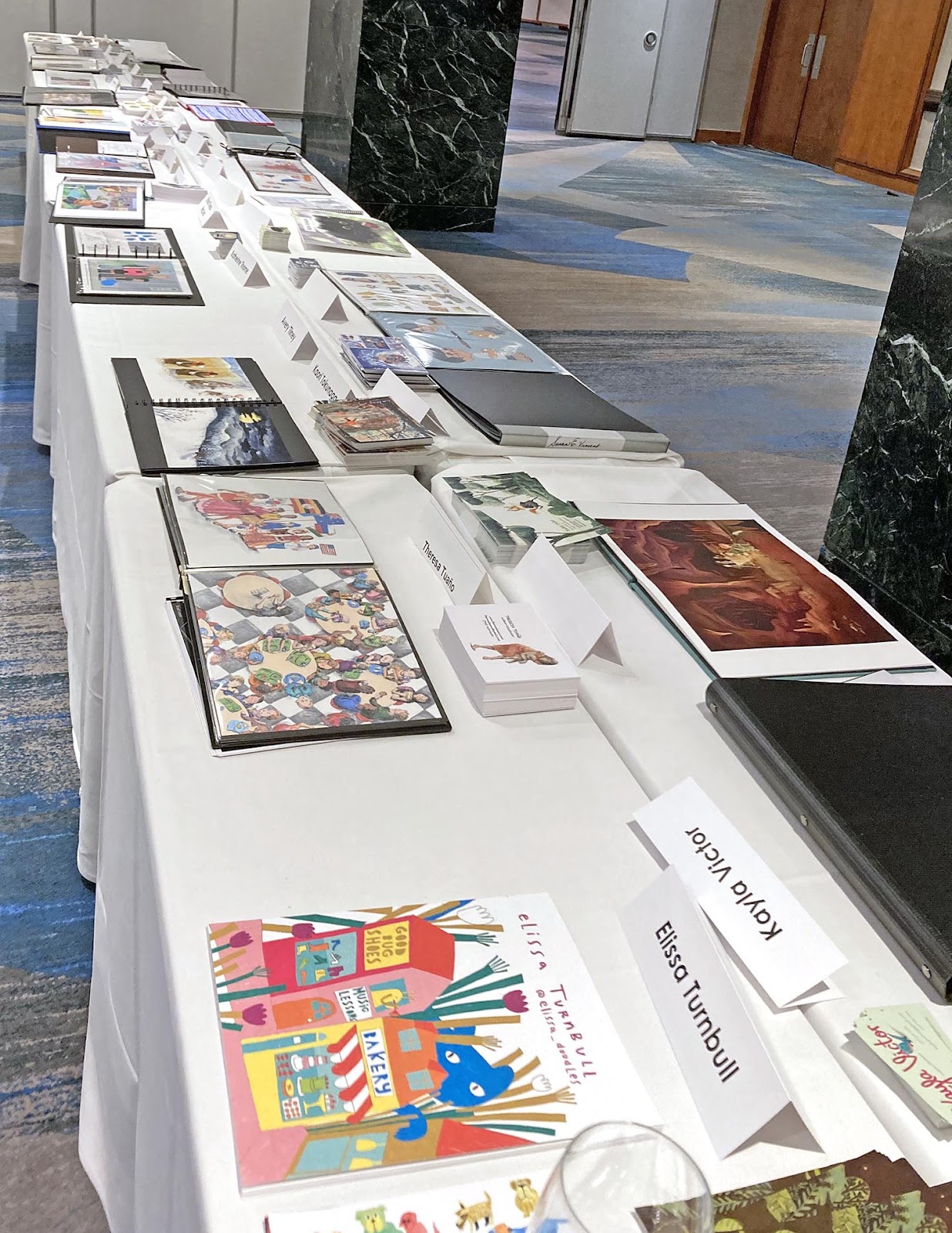
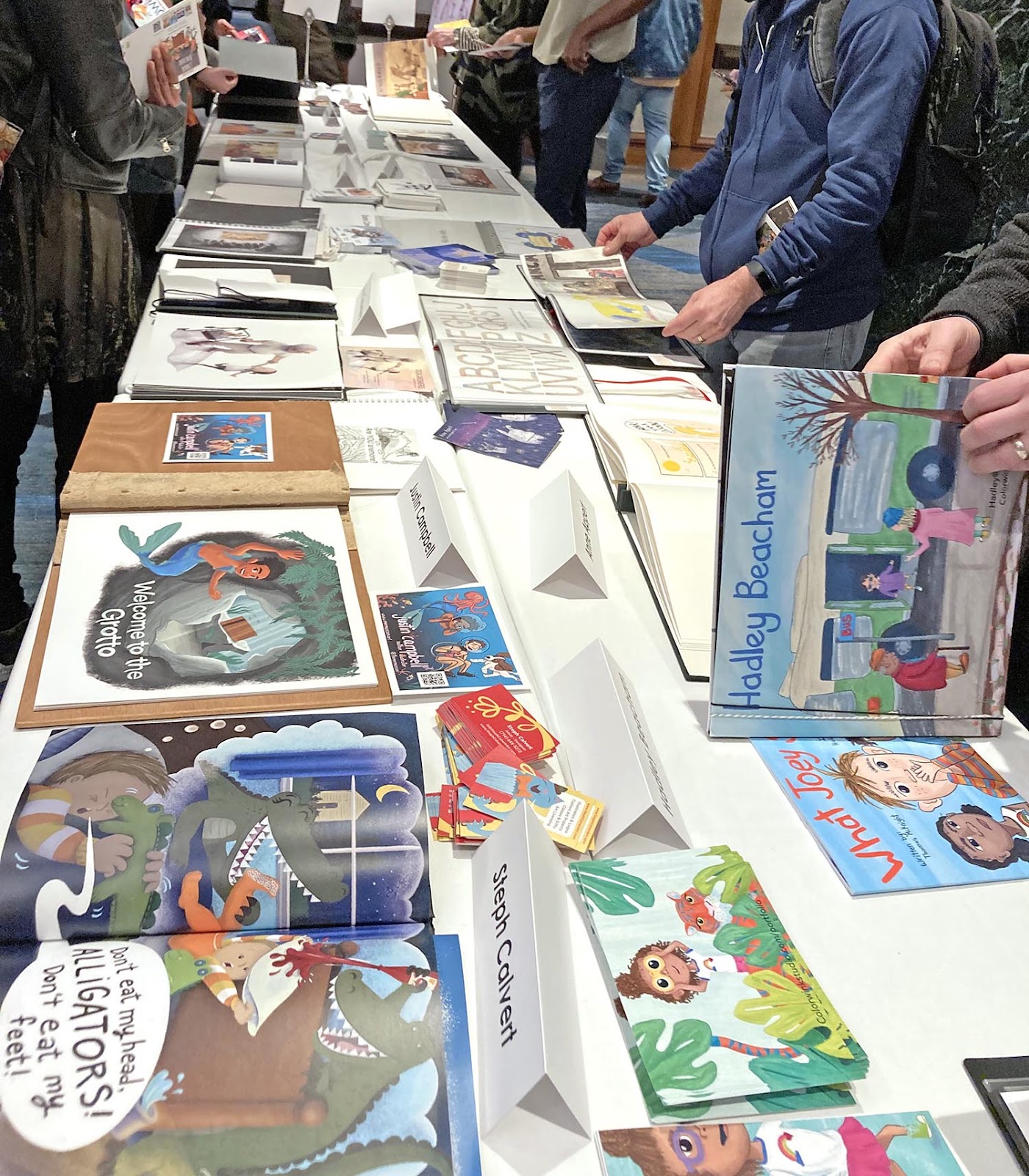
Photos of the Portfolio Showcase from the 2023 NYC Conference:

We can’t wait to see all your beautiful work!


Jen Boehler, Michigan Co-Illustrator Coordinator, is an illustrator, graphic designer and author working on a hobby farm in Saginaw, Michigan. Before pursuing children’s literature, Jen worked as a freelance editorial illustrator, graphic designer, interior/event designer and owned her own line of Michigan travel apparel. She has degrees in both art/graphic design and interior design.

Katie Eberts, Michigan Co-Illustrator Coordinator, received her BFA in Art & Design from the University of Michigan with a concentration in watercolor. Her debut picture book, Hush-A-Bye Night written by Thelma Godin, was published by Sleeping Bear Press in March 2023.  She is based in Cedarville, Michigan.