Showing posts with label VCFA. Show all posts

Friday, February 26, 2021

Three SCBWI Regions and Various Ventures: Catching up with Author/Editor Diane Telgen


Diane Telgen lived in Canton, Michigan, for many years and volunteered for SCBWI-MI in numerous capacities, including webmistress. After spending a few years in Chicago, she now lives in Nashville and has ventured in several exciting new directions. We invited her back on our Mitten blog to fill us in. Let’s catch up!

You’ve been away from Michigan for how many years now? Are you involved with your new regional SCBWI chapter?


My husband and I moved to Chicago in 2013, and within a year I took over as listserv coordinator for the Illinois chapter of SCBWI. I also contributed several articles to their newsletter, the Prairie Wind. When his job took us to Nashville in 2018, I quickly made contact with the MidSouth regional advisor and she invited me to join their conference planning committee. I’ve been so lucky to land in regions with very active and welcoming SCBWI chapters!

You graduated from Vermont College of Fine Arts in 2017. How has your degree guided and shaped your writing career?


Before VCFA I was confident in my skills as a writer, but working with the faculty helped me become a better storyteller—I learned so much about structure, character building, and revision that it ramped up my ability to fully develop an idea into a complete story. My critique partners noticed a big difference! Plus, all the writer friends I made there have become a lifeline.

Tell us about your work with Angelella Editorial.


Former Simon & Schuster editor Kate Angelella is one of those good writer friends I made at VCFA. When she decided to expand her freelance editing business, she invited me to join the staff. Through AE I’ve done everything from helping polish verse in picture books to developing chapter books and novels to copy editing adult works for indie publication. I love working with clients to make their writing shine!

I recently read Foreshadow: Stories to Celebrate the Magic of Reading and Writing YA. Tell us about your involvement in this project and how it came about.


I served as slush queen, then managing editor, of the Foreshadow online serial anthology. I’d met Nova Ren Suma in a VCFA workshop, and when she and coeditor-in-chief Emily X. R. Pan announced plans for a new outlet for YA short stories, I wanted to help out. I coordinated the reading of some 1000 submissions to find the 20 or so that we published along with stories we solicited from more established writers. As managing editor, I kept our editorial process on schedule so we could release three stories each month. I loved seeing those 13 New Voices stories published in the print anthology, along with Emily and Nova’s wise words about craft. It’s both a lovely collection to read and a useful resource for writers.

Congrats on your recent and upcoming books! Tell us about them.


Nova Ren Suma knew the editor of the new Arcadia Children’s Books imprint, and she thought I might be a good match for their first series, “Spooky America.” She put me in touch, and my background—MFA in writing for kids plus experience writing historical nonfiction—proved just right. For The Ghostly Tales of Michigan’s West Coast and The Ghostly Tales of Pittsburgh (both 2020), I took a collection Arcadia had previously published for adults and chose the best stories for a young audience. Then I completely rewrote them to suit a kid’s sensibility. I had so much fun that I took on another volume in the series. It’s tentatively titled The Ghostly Tales of Michigan’s Haunted Lighthouses and will come out later this year. I loved sneaking fun facts about my home state into the ghost stories!

Is there anything else you’d like to share?


I’ve been a member of SCBWI for more than twenty years, and only recently made it to PAL status. It took a combination of hard work, persistence, and being open to trying new things. SCBWI always has something to offer, whether it’s a business webinar or just the simple gift of connection. You never know who might have something to teach you, so don’t be afraid to participate!


You can order autographed copies of Diane’s Ghostly Tales books from her website; find out more about her editorial services here


Coming up on the Mitten Blog:

A new kidlit podcast, a Writer Spotlight with a behind the scenes look at virtual conference planning, SCBWI Winter Conference takeaways, children's books in the classroom, writing action scenes, and another round of Hugs and Hurrahs! 


Coming up this spring:

Registration is now open for the SCBWI-MI spring conference! An all virtual weekend event for you to attend when it suits YOU. Intensives, workshops, socials, plus a limited number of manuscript critiques and portfolio reviews. Don't delay, register today! Discounted fee for SCBWI members and scholarships available.


Friday, October 14, 2016

K.A. Barson and Cori McCarthy: Sophomore and Junior Books

K.A. (Kelly) Barson and Cori McCarthy teamed up to launch their new books this year, and I attended their event at Nicola's Books in Ann Arbor. I wondered how this book launch was different than their debut experience, and what we could learn from them. And because they're so generous, they took it from there. Please welcome, Cori and Kelly.

Cori: I’m excited to interview someone I’ve had the pleasure to know since 2009. Kelly and I met at grad school—VCFA’s MFA program in Writing For Children & Young Adults. We graduated together in 2011 and set off on our publishing careers shortly thereafter. Our debut novels were published in 2013, and this past spring, Kelly’s second book, CHARLOTTE CUTS IT OUT, and my third book, YOU WERE HERE released only a few weeks apart. 


So let’s compare and contrast the debut season and the sophomore and junior release! 

Q: Kelly, I found debut season to be a nightmare. It was much like being a clueless freshman. I didn’t know what I was doing or where I should go or who I should talk to, and I spun in a bunch of circles. How did you find debut season?

KA: I actually loved the debut season because I was part of several groups—the Lucky 13s (very large group) and the Class of 2k13 (only 20 members). We navigated the waters together, asking questions, comparing situations. I felt like I had support. Plus, I liked learning about the process. Being a newbie gave me a safety net to ask questions and not feel dumb. 

Cori: My sophomore book did much better than my debut title, which is a very bittersweet fact. I even had several bloggers and reviewers try to “redub” me as a debut author, and I had to scramble around to make sure that people didn’t think I was trying to pull a fast one. All in all though, I found my sophomore release and plugging season to be much more relaxed, and I finally started talking to classrooms (something I had feared too much during my debut season), and I realized that I LOVE talking to young writers. I now Skype with classrooms all over the country as often as possible. 

Q: Kelly, what have been some of the differences in your release season for CHARLOTTE from your debut release season for your first book, 45 POUNDS (More or Less)? Have you enjoyed it more? Or less? Oh, I swear I didn’t mean to pun…☺

KA: Ha! Again, my experience was the opposite. Because of the debut groups and promo push from my publisher, 45 POUNDS got more buzz. I also did more speaking, both with the groups and smaller subsets of the groups. My editor left my publisher shortly before CHARLOTTE was released, so I felt kind of orphaned. It hasn’t been that long, though, so I’m still hoping readers will find CHARLOTTE. 

Cori: One of the great upsides of being on my junior novel release is that things are starting to feel a bit more normal. When YOU WERE HERE came out in March, I got right to business on scheduling talks and panels at all the bookstores I’ve enjoyed attending. I took care of the blog tour. I made some swag, and I disappeared from my family and my writing for almost every weekend for nearly three solid months. Something new for this third book, I started working with a freelance publicist to help me think “outside of the box” when it comes to marketing ideas. (I work with Kirsten Cappy at Curious City, and she’s fabulous!)

Q: Kelly, tell us about your latest release season and how you’ve tackled publicity. What are some things that worked really well in helping get the word out about a book, and what things have not worked out?

KA: I have a tendency to accept nearly all invitations for speaking and/or signing. Some have been more successful than others. I find that making appearances with other authors—like you—are more successful. I also find that bookmarks are the best swag. I have both book covers on my latest bookmarks, and they come in handy when visiting libraries and bookstores. Or even when I run into teachers and teen readers. Handing out bookmarks feels like I’m giving them something, but really it’s keeping my books in their sightlines. 

Cori: Looking forward now to NEW books! One of the great things about my publisher is that they’ve supported my books even though they are vastly different from one another. My second book was genre YA and my third was contemporary with mixed format (including graphic novel and word art poetry). I’m currently in the editorial stage on my fourth book, NOW A MAJOR MOTION PICTURE, which will come out in April 2018. I’m already starting to scheme some potentially bigger release ideas including music videos and a cross-country tour (and by scheme, I mean start to save $ for). I’m excited and scared. There is so much pressure on the first weeks of a book release, and it took me several titles to figure that out. 

Q: Kelly, what do your future writing plans look like? What have you learned over the first two books that you will bring to the third one? Do you have new goals or priorities now that you’re a couple books deep?

KA: Starting in October I’ll be teaching a Writing the Middle Grade Novel class for UCLA Extension Writers’ Program online, so that seemed like the perfect time to write a middle grade novel that’s been tumbling around in my head for a while now. I still have YA book ideas, so I’m sure I’ll return to them, too. I’m planning to go kind of underground for a while and focus on writing. I’ll think about promo when I have something more to promote. 

Thanks for the discussion, Cori. If there’s one thing I’ve learned from my limited experience it’s that nothing is predictable. Every author’s experience is unique. It’s best to focus where you have control—on the work—and not where you don’t—publishing, marketing, and bookselling.

Cori McCarthy studied poetry and screenwriting before falling in love with writing for teens at Vermont College of Fine Arts. From a military family, Cori was born on Guam and lived a little bit of everywhere before she landed in Michigan. Learn more about her books at CoriMcCarthy.com.


K.A. (Kelly) Barson earned an MFA in Writing for Children and Young Adults from Vermont College of Fine Arts. She and her husband live in Jackson, Michigan, surrounded by kids, grandkids, unruly dogs, a cat, and too many pairs of shoes. She feels most like herself when her hair is purple.  Learn more at http://www.kellybarson.com/home.html


Thanks for sharing your time and experience with us, Cori and Kelly!

Coming up on the Mitten blog: SCBWI-MI Fall Retreat Recap and a new Writer's Spotlight - it could be you! Did you notice our new blog banner? Learn more about the artist, Bradley Cooper, here.

The SCBWI Book Blast is back! The promotion only runs for six weeks from Oct 10-Nov 18. Spread the word, support your author friends, and find a book to give or enjoy at http://www.scbwi.org/bookblast.

Have a great weekend!
Kristin Lenz

Sunday, August 28, 2016

Back to School: MFA Week, Day Three

Welcome to Day Three of our special Back to School: MFA Week! Six SCBWI-MI members (representing three different MFA programs) answer a question a day for seven days. It's everything you ever wanted to know about getting your MFA.

Just joining us? Go here to read the first and the second post in our MFA series.

Team MFA: Jennifer (Jay) Whistler, Diane Telgen, Anita Pazner, Erin Brown Conroy, Rebecca Grabill, and Katie Van Ark.

What's it like to spend a semester in your program?

Jay: VCFA is a low-residency program. For eleven days each in January and July, students live on campus. Days usually start around 8:00 a.m. and end around 10:00 p.m. with lectures, readings, workshop intensives, special guest presentations, poetry readings, and more. During this time, you also meet with your advisor to work out a semester plan for your writing (both creative and academic) and reading.

Once back home, you send in what are called packets once a month for five months. Packets include approximately 40-50 pages of creative pages, 10 pages of critical/academic writing, an annotated bibliography of the month’s reading (usually 10-12 books plus 1-2 books on craft), and a letter that summarizes your progress for the month, including successes, struggles, and questions. Generally, you receive feedback within a few days, and you start all over. I spend about 30 hours per week on my packets, but I am also a slow reader and an even slower writer. Some people spend less time, some more.
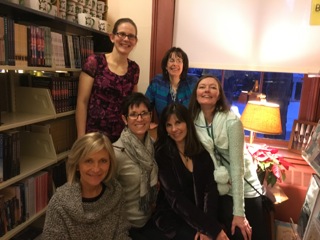
VCFA students from Michigan: Katie Van Ark, Diane Telgren, Marty Graham, Jay Whistler, Anita Pazner and Tina Vivian

Diane: At VCFA you also write a critical thesis of 25-plus pages in your third semester, while in your fourth and final semester you leave critical work behind and focus on your creative thesis. The program recommends you devote 25 hours a week to homework, but I probably averaged around 30, or even more closer to packet due dates. You get out of it what you put into it, so “your mileage may vary.”

Anita Pazner: Since Jay and Diane have already described the academic portion of the program, I feel it my duty to discuss the aspects not listed on the brochure. Yes, we spend countless hours going to lectures and readings, but we also have fun, staying up late into the night discussing everything from politics and religion to the adult humor in Spongebob Squarepants. Did you know that Mr. Krabs lives in Bikini Bottom? Yeah, it’s a little disturbing.

When we finally get a break on laundry day, we venture into Montpelier to savor real food in real restaurants. It’s also around this time that the fourth-semester students throw a themed costume party for the graduating class. I’m not calling anyone out on this, but students have been known to dance in the fountain located in front of College Hall on their way back to the dorms—at least they did until the fountain was shut down for “health reasons.” Hmm.

There are also amazing opportunities, such as the chance to spend a summer residency in Bath, England, where you can meet Phillip Pullman and David Almond, and literally walk in Jane Austen’s footsteps. As you can see, there is so much more to an MFA program than simply reading a few hundred books, writing a thousand pages of creative work and completing twenty or more academic essays on the craft of writing for children and young adults.

Erin: A semester at WSCU’s MFA program is like any online class, but with more: It was a support system of cohort members sharing your passion and open to giving more to help with success (a we’re-in-the-same-boat attachment and desire). I won’t downplay the work. It’s hard. Many hours. You have to be super disciplined, and I spent many a day up at 5:30 AM, when the coffee shop opened, to get in word count and quality writing time.

I liked the idea of one two-week summer residency in the summer in the mountains of Colorado (who wouldn’t?!)... and it didn’t disappoint. Yes, we worked incredibly hard, but the environment was beautiful, memorable, and special.

Rebecca: Hamline has five 11-day residencies and four six-month(ish) long semesters, which involved one-on-one work with a faculty advisor: four packets due roughly a month apart, each with creative work, critical work (essays on topics like “Rhyme in Picture Books” or “Verse Novels”). A letter or phone call from the advisor provided feedback and instruction for the next packet. Over the first two semesters, every student had to complete an annotated bibliography based on a reading list of 120 notable children’s books. The third semester involved the usual creative work plus a critical thesis. Students presented a lecture on their thesis topic during fourth residency, while the final semester was geared toward creating a creative thesis--a collection of picture books or a finished, full-length novel.

In summer residencies, we lived on campus and worked. Hard. Dark-o’clock workshops ran until noon, then lectures and hands-on lessons until dinner, then readings and outings and signings.

In winter, we stayed in a nearby hotel (with a bar! And a pool!) and, after a hotel-provided breakfast, rode the shuttle to campus in the morning, where we followed our summer routine. Evenings were adventures of walking in the dark to local eateries (or the dining hall), back for readings, off to the shuttle and back to the hotel for drinks and pick-up games of Dixit (because what OTHER game would a bunch of writers play?). I loved the camaraderie of dorm life during the summer, but I adored the luxury of hotel life in winter. 


Thanks to Team MFA for giving us a behind-the-scenes peek into their programs!

Come back tomorrow for MFA Week, Day Four. Our MFA team will answer the questions, "How did you research programs to find the best fit for you?" and "What's available after you graduate?"

Friday, January 15, 2016

Everything I Need to Know About Writing, I Learned From Figure Skating by Katie Van Ark


I skated my way into writing. At first reading, this may seem to imply that writing glided to me, as natural as sleeping and waking. It didn't. Writing came with the bruises of repeated Axel attempts: soaring jumps of hope crashed by rejections from agents. Writing came with the ice burn of editors' criticisms, the pulled muscle torture of a high school English teacher reading the short stories of our entire class aloud. (Two minutes in, I became painfully aware that mine would have been better targeted to a middle grade audience; half a class period later I was scrunching in my seat with the realization that I had written not a short story but a novella.)

No, when I say I skated into writing, I mean it literally. My passion for skating cultivated my passion for writing. Though I played with writing as a child, earning invitations to young author events and winning a poetry contest, my heart belonged to skating. I acted out entire competitions with my dolls, scrutinized the biographies of top competitors, and longed to try it myself. I took ballet and piano lessons, but the nearest ice rink was forty-five minutes from our house and there honestly wasn't money, or, with my competitive swimming and supercharged class load, time for much else.

With the help of adult-learn-to-skate classes, I came to skating as an adult and fell head over skates...in love. I thought I loved skating before; now, I breathed skating. This sounds perhaps like something that might happen to a character in a novel, but the passion was so overwhelming that my husband and I saw a marriage counselor over it. (Success – we just celebrated our ten year anniversary.) Even pregnant with my first daughter, I skated until my seventh month. The evening I realized I was too pregnant to skate anymore, I came home and cried for two hours. What was I going to do? Pouring the intensity of that emotion onto the page, I rediscovered my passion for writing. And realized that everything I needed to know about writing, I learned from figure skating.

  • First, it's okay to start small. I have a favorite childhood memory of building a backyard ice rink with my father. Our city backyard was tiny, and our rink was about six swizzle pumps wide and only a little bit longer. It had giant potholes where leaves from our crabapple tree froze under the surface and then caught the heat of the winter sun and melted the ice. Bumpy at best and treacherous at worst, it was ice. That my father cared enough to help me with this time-consuming, and in fickle west Michigan weather, often futile effort, gave me the seed of the idea that skating was something I could do. It's the same for writing. Even one frozen drop of water can be enough if you want it, really want it. For me, this was when I dared to show my mother, a writer and librarian, the beginning ramblings of my first book. She had lots of advice and areas to improve but, “Sure, this could be a novel,” were the words I took with me as my droplet of hope.
  • Second, however small your start, you must put in the time. It's about repetition. With good daily practice routines, the elements on ice come. With good daily writing routines, the words flow. Practice never makes perfect, but quality practice builds improvement bit by bit. Listen to your coaches, aka your trusted critique group, because whether you like it or not, they're right most of the time. But know that sometimes you have to follow your heart, sometimes you just have to know when it's time to ditch a project. I once completely changed programs three weeks before a national competition, much to the chagrin of my coach. That new program won me a national gold medal. So go ahead, re-write that novel in first person. Cut those scenes. Start over with a blank page. And take comfort in the fact that least in writing you can save all your old versions on the computer and pull out an old routine with the click of your mouse.
  • On the ice or on the page, you will fall down. A lot. All you can do is pick yourself up, the sooner the better. You must try again. It took me almost a year to learn a loop jump, two years for the flip, and five years for the lutz. I'm still working on that Axel and I won't even tell you how many hours I worked at writing, but I try to remember that everyone is afraid sometimes, that everyone struggles with some things. You must believe you can do it.
  • Take advantage of camps, clinics, and retreats. Fresh opinions can help you get over a rut. I had been struggling with a loop jump for months when I attended a skating camp in Aspen. New phrasing and the trick of jumping out of a backspin helped me master the element that week. And when asked for advice, give it when you can. Helping others can help you, too. It's so much easier to see the faults when watching, or in the case of writing, reading someone else's technique. And of course every once in a while you'll happen upon a move you can borrow and make your own.
  • Just like skating, writing is also about acting. To make your characters real to your audience, you need to feel them, get inside their heads. Wear your heart on your sleeve and keep a box of tissues nearby for the tears and runny noses. Because in skating, you only need to do one character per program but in writing you're going to need to do them all.
  • And finally, sweat the small stuff. Yes, pay attention to details in your routines and in your novels but don't forget about your actual real world. I used to have one of those t-shirts proclaiming that “figure skating is life, the rest is just details!” I gave it to Goodwill. Skating, writing, whatever your passions – life is in the details, and not the sequin-covered, rhinestone-studded variety. Don't forget to live.


Katie Van Ark lives in Michigan with two little girls who love mud, a cat that thinks it's a dog, and a very patient husband. The Boy Next Door, a YA figure skating love story, is her first novel. Visit her online at katievanark.com or on Twitter @kvanark.


Katie is one of the busiest people I know - mom, teacher, figure skater, author, and she's about to graduate with her MFA in Writing for Children and Young Adults at Vermont College of Fine Arts. Through all of this, she's been very giving of her time to help other writers. 

A master's degree in fine arts: The best career move? What will I gain from all of that time and expense? Can it be affordable? Questions about MFA programs are often posed to editors and authors at writing conferences. Katie has offered to gather her fellow students at VCFA to answer your questions. What would you like to know about the MFA experience? Leave your questions in the comments or email me at kristinbartleylenz@gmail.com. We'll share the answers in a future post.

Happy New Year!
Kristin Lenz