Showing posts with label Deborah Diesen. Show all posts

Wednesday, February 26, 2020

Book Birthday Blog with Deborah Diesen

Welcome to SCBWI-MI's Book Birthday Blog! 
Where we celebrate new books by Michigan's children's book authors and illustrators


Congratulations to Deborah Diesen on the release of her new book, Equality's Call!


Equality's Call, released on February 18th, follows the history of voting rights and voting rights activists in America

Congratulations on the release of Equality’s Call! How did the inspiration for this book come about?

Thank you! And thank you for hosting me here on the SCBWI-Michigan blog!

Equality’s Call came about after a conversation that I had with my younger son a few years ago, as we were noting that the 100th anniversary of the 19th Amendment was coming up.  We talked about how it hadn’t really been that long since women gained the right to vote.  Our conversation got me to thinking about perhaps writing a picture book about a few of the well-known figures of the women’s suffrage movement, showing how their commitment and efforts led to the passage of the 19th Amendment.

As I began to work on the book, though, my manuscript evolved.  As I learned more about the women’s suffrage movement, I realized that my understanding of the movement was very incomplete.  For instance, I discovered that the women I was most familiar with, while important and significant, did not represent the full depth or breadth of the women who spoke up about the right to vote.  I also discovered that many white suffragists excluded women of color from their activities.  And I learned that the passage of the 19th Amendment didn’t mean that all women could vote as of 1920.  Barriers to citizenship as well as racially-motivated voter suppression profoundly limited the right to vote.  This changed my perspective on the story I had thought I was going to tell.

Another component of my manuscript evolving was that I realized that looking at only one aspect of enfranchisement (in this case, of women gaining the right to vote) without looking at the whole of our country’s voting rights history is not possible.  We cannot understand changes in voting rights without examining the interconnectedness of who has and hasn’t been allowed to vote at various points in our country’s development, and of how voting rights connect to larger themes of our country’s history.

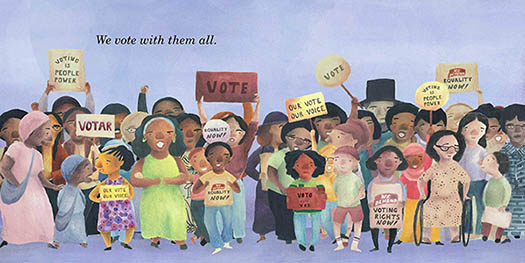
What emerged from this process was a picture book that takes readers from our nation’s founding, when only white men with property were allowed to vote, to the present.  It highlights milestones of progress as well as issues that remain.  The main story is written in an accessible style – it’s a brief 400 words, in rhyme, with a recurring refrain – in order to allow even very young children to hear it and learn from it; there are also several pages of backmatter to provide a deeper dive for older readers.  The book is honest – it doesn’t mythologize the past or minimize the concerns of the present – but in a way that I hope will uplift and encourage kids.  Voting rights are a critical component of our civil rights, and it’s never too soon for young people to start learning about the importance and power of standing up for and using those rights.

Magdalena Mora’s wonderful art for Equality’s Call brings the book alive.  It’s her first picture book, but I know you’ll be seeing many more from her.  She’s an amazing artist who is passionate about visual storytelling as a tool for social change.
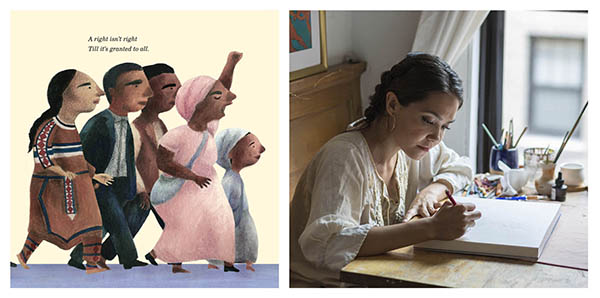

Illustrations for Equality's Call were created by Magdalena Mora

How did the writing and research process of Equality’s Call compare to your previous books?

Equality’s Call is my 15th picture book, but my first ever nonfiction picture book, and nonfiction research is quite a bit different than writing dialogue for talking fish!  In fact, not long after starting the story, and again when working on the backmatter, I nearly threw in the towel.  I’m not a historian or a voting rights expert, and I was overwhelmed by the complexity of the history and the issues.  I felt profoundly unqualified to be writing on the topic of voting rights.

But even as I struggled, I realized that the struggle could and should be a part of the process.  Putting myself in the position of being a learner, and going on a learning journey, is what allowed me to create a book that I hope will take kids on that journey, too.  Equality’s Call is not a comprehensive reference work, but it’s a synthesis of what I learned and is meant to serve as an engaging entry point for kids to begin to learn more.
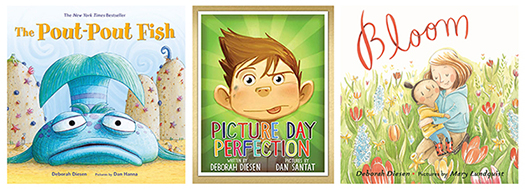
Deborah's previous books include titles like Picture Day PerfectionBloom, and the New York Times Bestseller, The Pout-Pout Fish! Find more of her books here.

You’re well known for that poetic, rhyming style of writing that’s featured in many of your books, including your latest one! How did you develop that voice?

I’ve always loved the way words sound, and I’ve been fond of writing in rhyme since elementary school.  My earliest creative efforts were rhyming poems, and my interest in rhyme has been lifelong.  Not everything I write lends itself to rhyme, but I love to work with it when I can, because I think rhythm and rhyme in writing can help a story cohere in a uniquely layered way.  It’s also a fun challenge to write in rhyme.  It’s frustrating when it isn’t working, but very satisfying when it finally comes together.


In addition to talking about the history of voting rights, you’ve also used Equality’s Call and its teacher and student handouts to encourage voting participation in local communities! Was this message and call to action something you saw happening with your book from the beginning? 

In writing Equality’s Call, the learning journey that I took into the past heightened my awareness of present-day voting rights issues.  It also impressed upon me the importance of sharing that knowledge with kids so that they will know what their rights are, how those rights came to be, and what we need to do to ensure those rights remain in place.  I didn’t anticipate taking on an advocacy role when I began, but I’m glad it’s where I ended up!


What’s one thing you hope your readers will take away from Equality’s Call?

There are actually three main ideas I hope young readers will take away from Equality’s Call.

The first is a recognition of the importance of voting.

The second is a clear understanding that barriers to the right to vote are wrong.  We can and should expect our government officials to make voting easy, accessible, convenient, accurate, and fair.

The third is an expectation of all of us to speak up for voting rights and civil rights.  There’s a question posed on the last page of the book, after the mini-biographies of voting rights activists:  “How will you answer equality’s call?”

Answering that question is on all of us.

What’s next for you? Do you have any events coming up or new books in the works? Where can people connect with you and learn more about your work?

My web site (www.deborahdiesen.com) is the best place for finding updates about my upcoming books and events.  Also on my web site are some handouts for teachers and parents to use with Equality’s Call.

Thank you so much for giving me this opportunity to talk about Equality’s Call.  I’ve enjoyed your questions, and I really appreciate you hosting me here today! 

A little bit about the book:

The founders of the United States declared that consent of the governed was a key part of their plan for the new nation. But for many years, only white men of means were allowed to vote. Equality's Call looks back at the activists who worked to secure the right for all to vote, and it also looks forward to the future and the work that still needs to be done.  

A little bit about the author:

Deborah Diesen is the author of many children’s picture books, including The Pout-Pout Fish and Equality’s Call. She loves playing with words and rhymes and rhythms, and she believes everyone should own at least one rhyming dictionary.


Friday, June 10, 2016

SCBWI-MI Picture Book Text Mentorship

In just two weeks, submissions open for the 2016-2017 Picture Book Text Mentorship.

Really? Who’s the mentor?
Deborah Diesen. Did you miss the Mitten interview with Debbie last week? Go here to read it, and check out her website, too.


Has SCBWI-MI done this before?
SCBWI-MI has been offering mentorships since 2000. Here’s what some previous winners have to say.

Shanda Trent (2004, picture book text with Rhonda Gowler Greene)I strongly encourage any picture book writing Mich-kidders to write, edit, rewrite, share with your peers, edit, rewrite and polish your best work and submit it for this amazing mentorship opportunity. I did, several years ago. My manuscript was selected; I was very lucky to work with Rhonda Gowler-Greene, another magnificent Mich-kidder. I learned so much in the mentorship. My writing improved, and (cue happy ending) I am now a published author.”

Tracy Bilen (2009, novel with Shutta Crum) “My mentorship with the amazing Shutta Crum helped me to really slow down and dig deep into the revisions of my YA novel. Shutta’s perfect blend of editorial notes, articles to study, and in-person craft/pep-talk sessions led to a much stronger book…and a sale to Simon Pulse!”

Jeff Morrissey (2015, illustration with E.B. Lewis) “Working with EB Lewis helped me realize that a children's book illustration isn't just a depiction of action--it's storytelling!” 

Daniel Burns (2015, diverse books with Patricia Hruby Powell) “I've greatly appreciated the time Patricia Hruby Powell has already invested. Her comments are always well constructed and push me to step back and look anew at what I've written. She clearly has an amazing ability to teach, and I'm honored to have the chance to learn from her.”

Leslie Helakoski (2003, illustration with Lori McElrath-Eslick) “Working with a local illustrator, who treated me as a peer, gave me much needed confidence about my artwork…and gave me a dear friend."

Cool. But what about this mentorship? Where can I find out the details?
Everything is on the website.

Okay. So, what’s Event Brite?
It’s an easy way for applicants to register and for SCBWI-MI to electronically count submissions and collect the registration fee. Before you ask, the fee is $15 and nonrefundable.

Right. How do I find this event on Event Brite?
Click or tap here.

I’m on it. This bit about uploading a manuscript sounds difficult.
No special computer skills are required. The link leads you to an email address. All you need to do is send an email with your manuscript attached as a word document. Please check the instructions before you send.

What should I title the attachment?
Use the title of your manuscript. Don’t put your name anywhere on the manuscript.

Remind me when I can submit.
The submission window is June 24-July15, 2016.

There’s no need to shout.
I’m really excited about this mentorship.

Whatever. Do you have any other advice?
We expect the mentorship to fill up quickly. Pop on over to the website now and review the application instructions. Then you’ll be ready to submit your manuscript on June 24 or soon after.

What if I think of another question?
Contact SCBWI-MI Mentorship Coordinator, Ann Finkelstein.


Thanks for your hard work coordinating the mentorship competition, Ann! The mentorship winner will be announced during the fall retreat:
http://michigan.scbwi.org/2016/04/19/the-days-and-nights-of-the-roundtable-fall-retreat-october-7-9-2016/

Coming up on the Mitten blog: Ask Frida Pennabook, the Making of a Book Cover, an Indie Bookseller Interview, MFA Q&As, and more!

Nina Goebel is preparing to announce our new Featured Illustrator on July 1st, and Patti Richards is gathering your good news for another round of Hugs and Hurrahs. To be included, email Patti by June 19th.

Have a great weekend!
Kristin Lenz


Friday, June 3, 2016

SCBWI-MI Picture Book Mentorship and Interview with Mentor, Deborah Diesen

SCBWI-MI is offering a twelve month picture book text mentorship with the amazing Deborah Diesen. Submission guidelines, eligibility rules, and FAQs can be found on the SCBWI-MI websiteThe submission window is June 24-July 15, 2016.

Ann Finkelstein, Mentorship Coordinator, is here to tell you all about author/mentor Debbie Diesen. Here's Ann:

Debbie has a way with words, a brilliant rhyming mind and tells fantastic stories. Her manuscript critiques are both insightful and empowering. She is the author of the New York Times best-selling picture book, THE POUT-POUT FISH and its three companion books: 
THE POUT-POUT FISH IN THE BIG-BIG DARK
THE POUT-POUT FISH GOES TO SCHOOL
THE NOT VERY MERRY POUT-POUT FISH. 

She has also written three Pout-Pout Fish mini-adventures for babies and young toddlers: 
SMILE, POUT-POUT FISH
SWEET DREAMS, POUT-POUT FISH
KISS, KISS POUT-POUT FISH. 

Debbie’s other picture books include: 
CATCH A KISS
PICTURE DAY PERFECTION
THE BARE-FOOTED, BAD-TEMPERED BABY BRIGADE. 

Two additional Pout-Pout Fish mini-adventures will come out next year, and we can look forward to three more hardcovers in 2017-2018, all published by Farrar Straus Giroux.

I asked my friends, including Debbie, to help me think of interview questions.

AF: What do you like best about writing picture books?
DD: My favorite aspect of writing picture book stories is that the requirements of the format inspire my creative side. A picture book story has to appeal to both children and adults; has to be told in a way that lends itself to being repeatedly read aloud; and has to be told in about 500 words or fewer.  Limitations are a writer’s friend: in learning and embracing the requirements of a particular writing genre, one’s writing becomes freer and fuller.
Plus, in what other genre can you write about a talking fish and still be taken seriously? I’d pout-pout if I were writing anything else.

KG: How long did it take from when you started writing to getting published?
DD: I’ve always loved writing, but I didn’t try my hand at writing picture book stories until my kids (now 17 and 14) came along. After dabbling a bit, I began to write more seriously by around 2000, and I started submitting stories in 2001. Spread across multiple stories, I received 99 rejections before I received my first contract in 2005. That book, The Pout-Pout Fish, was published in 2008. An eight-year timeline from start to book is not atypical in this industry. Holding tight to the right combination of persistence and patience (call it persipatience, perhaps?) is a real necessity.

KG: How many drafts or revisions do you typically do before you submit?
DD: I go through a lot of drafts and revisions. I start my stories longhand on paper, and then when I feel I have enough clay to throw on the potter’s wheel, I enter my chicken-scratches into a word processing document. I prefer to have a pen or pencil in my hand when I’m revising, so I print the story out and then sit down with it, away from the computer, to read it out loud to myself numerous times and to mark up my changes. I then head back to the computer to enter my changes and reprint, then back to my Barcalounger to revise. Some revisions are of the Start Over nature; others are micro adjustments. By the time a story is “done” (anywhere from the rare case of a month or so after I began it, to the more likely case of a year or five or more), I’ll usually have two to four inches of drafts of it in my file.
(Note that I don’t actually have a Barcalounger, but it’s a fun word to say, so let’s pretend.)

RMB: How do you know when a manuscript is both good and done?
DD: In fact, I’m never certain of either good or done; but I’ve learned how to triangulate the position of a manuscript by taking multiple measurements. The first is an internal measure. I keep revising until a story has a certain resonance or vibration within me when I read it. When I’ve gotten a story to that point, or when I’m stuck because I can’t find a way to get it to that point, I bring the story to my critique group for a reality check. Their collective wisdom and their individual perspectives help me assess whether the story is good and/or done.

TG: How much money is in this gig?
DD: The field of children’s book writing and illustrating is populated with tens of thousands of hard-working, devoted, and talented individuals, some of whom are able to make a living at it; some of whom have hit-or-miss income from it; and some of whom will never make a dime, despite having great stories and doing everything they can to get published. Money can happen, but it’s impossible to predict or guarantee. It’s best to enter the field for the love of it rather than for its lucrativity (which is not really a word, but when you’re sitting in an imaginary chair, you get to be Queen of the Dictionary).

BS: I know the plot and characters are supposed to drive the story. How often does the rhyme change the story?
DD: Writing in rhyme tends to bring out my playful side, so typically for me rhyme has a positive impact on my exploration of a story’s plot and characters. It makes more things possible. It also makes me more likely to try out and experiment with word choice and wordplay. But a story has to want to be in rhyme, or it’s no good to impose rhythm and rhyme on it. If it’s not meant to be in rhyme, writing in rhyme will limit the story’s characters, plot, and potential. Forcing a story to fit into a garment that doesn’t suit it is not going to work, no matter how many times you try on or accessorize the stanzas.

AH: What is the most important thing you’ve learned about writing picture books?
DD: The most important thing I’ve learned from my writing experience is that I’ve still got a lot to learn! Every story I write teaches me something new about writing (and I usually learn it the hard way).

AH: What will the mentor expect of the mentee?
DD: I don’t have any particular expectations, other than that the mentee have an enthusiasm for writing, a willingness to learn, and enough of a sense of humor to put up with my quirkiness.  (Barcalounger not required.)

DD: What have I gotten myself into?
DD: I’m actually looking forward to serving as a mentor. But since I’ve never been a mentor before, I’m a bit nervous at the prospect! The stereotype of a mentor is guru-like and wise; but I can’t rock the guru-robe look, and I’m definitely still working on the wisdom thing.

That said, I guess I’ve learned a few things along the way, and so I look forward to sharing what I know and learning some more. It’ll be an enjoyable growth experience for both of us!


Coming up on the Mitten blog: Mentorship coordinator Ann Finkelstein will be back next week with explanations, endorsements, and enthusiasm. Until then, read the guidelines on the SCBWI-MI website, or email Ann directly.

Nina Goebel is preparing to announce our new Featured Illustrator on July 1st, and Patti Richards is gathering your good news for another round of Hugs and Hurrahs. To be included, email Patti by June 19th.

Have a great weekend!
Kristin Lenz

Friday, November 13, 2015

Planning a Critique Group Retreat by Ann Finkelstein

Every summer our critique group goes on a writing retreat. When Kristin noticed the pictures of our dedicated and smiling faces on Facebook, she asked us to write an article. She wanted to know how we scheduled it, organized it and made it work. The group nominated me to write it. I tried to weasel out, but everyone offered suggestions. Here is our joint effort.

Commitment
Most of us go – every year. Obviously, things come up, and we understand that, but our attendance is exemplary. We acknowledge that the weekend is an essential part of our creative processes as well as a natural extension of our commitment to each other.

Our first retreat. 2008
Timing
When we first decided to have a weekend retreat, we polled the group about available summer weekends. We hold the retreat on the same weekend (Thursday to Sunday) every year. This allows us to plan family and professional events around it.

Location
We tried several places before we found The Perfect Spot for Us. This is what we like about it:
  • Number of Beds. We’re a big group. Everyone needs a place to sleep.
  • Space. Everyone needs a place to work. The house has several communal rooms and a shaded front yard.  
  • Kitchen. We have full use of the kitchen and prepare most of our meals.
  • No Strangers. One year we stayed in a B&B that also rented to other guests. People on vacation tend not to realize that working writers and illustrators prefer quiet.
  • Places to Walk. Many of us find fresh air and motion get the creative juices flowing. The house is in a lovely neighborhood and near shops, restaurants and a waterfront. One year, we rented a place in a rural setting, where the only place to walk was along the highway. We didn’t go back.
  • Price: The house is quite affordable.
  • Distance: Most of us have a two-hour drive. No one wants to waste time traveling. If an emergency occurs on the Homefront, we can easily return.

One year, we had a special guest. 2009
Limited Internet Access
We have to walk across the yard to connect with Wi-Fi. Research tools are available if we need them, but we can’t click into the World Wide Time Waster just because a scene isn’t working.

Flexibility/Structure
Each person can work on whatever they want in whichever space they want all day long.
We meet in the evenings. On the first night, each person describes his or her goals for the weekend. On subsequent evenings, we share some of the work we’ve done. This is not critiquing time, but a celebration of the creative process.
Full confession: our evening meetings involve snacks, wine and chocolate.

Here’s to great writing and illustrating. 2013
Food
We surveyed the group about preferences for breakfast and lunch and created a signup sheet. All food is communal. For breakfast and lunch, we eat whenever we want, although people tend to gather in the kitchen around noon. Two members collaborate to make dinner. We have a keen understanding of our fondness for leftovers for lunch so we prepare ample quantities. Every dinner ends with dark chocolate.
Writing and illustrating is hungry work. Our signup sheet incudes both “healthy snacks” and “other snacks.”

Fun
I consider the members of my critique group my best friends and my best colleagues. While we take our work and each other seriously, we all bring love and laughter to the retreat.

The World’s Greatest Critique Group was founded … a long time ago. It’s been holding annual retreats since 2008.

Our most recent retreat. 2015


Thanks to Ann Finkelstein for writing this story and to Debbie Diesen for sharing the photographs.

Coming up on the Mitten blog: more Kiddie Litter cartoons, an illustrator interview, a PiBoIdMo experience, and another round of Hugs and Hurrahs. Please send your good news to Patti Richards (pgwrites5@gmail.com) by December 14th.

Have a great weekend!
Kristin


Friday, October 23, 2015

Welcomed into the Kid Lit Community with Open Arms by Christina Fecher

Maybe I’m just cynical, fueled by a career as an inquisitive journalist. Or perhaps it’s just because the writing industry overall – newspapers, magazines, books, you name it – is incredibly competitive.

Regardless of the reason, I’m completely amazed – and admittedly a little overwhelmed – at just how welcome the kid lit community has made me feel so far.

I guess I really shouldn’t be too surprised. I mean, we are a group of individuals striving to inspire, encourage, educate and entertain children. Not to mention foster an early appreciation for reading.

But still …

As a newcomer to the community, I’m so appreciative of how much I’ve been helped by people I’ve only just met at the SCBWI-MI Fall Conference!

My experiences have helped me believe that maybe, just maybe, I can make it as a children’s book author after all. To name a few:

The Michigan Chapter of the Society of Children’s Book Writers and Illustrators is a great resource that I recommend others check out. There’s a mentorship program, webinars and free monthly meet ups to help you further develop your writing. They also have a blog, The Mitten, that I’ve submitted posts to on occasion. They encouraged members to submit a post, so I reached out to Kristin Lenz and her response was both quick and encouraging. That right there spoke volumes because it made me feel as though what I had to say was relevant. It was great meeting her in person earlier this month.

Every writer needs an editor, and I’m so lucky I found Louise Knott Ahern, a former journalist like myself. Maybe found isn’t the correct term since we’ve been Facebook friends for years but have never actually met. Anyway, she took on my manuscript project and helped embolden my voice. Louise smoothed areas in need of TLC, but also highlighted my strengths. She truly made it better, made me stronger. But it was more than that … her feedback built my confidence, declaring me “well-suited to writing children’s books.” And since then, she’s passed along tips and tidbits to help get me noticed.

Christina with Deborah Diesen at the fall conference.
If you have young children, then you’ve certainly read The Pout Pout Fish by Deborah Diesen time and again. In fact, it’s a favorite in our household! Well, after much consideration, I decided to reach out and email Ms. Diesen to introduce myself earlier this summer before the SCBWI-MI Fall Conference. I had never emailed a New York Times Best Selling Author before, and the interaction was nothing like I expected. First and foremost, I never even expected a response. Let alone a same-day response congratulating me on my leap into the children’s picture book world and offering insight into her publishing journey. After a few emails – and the opportunity to meet her in person at the conference – I’m definitely taking her advice to heart.

I’ve only scratched the surface into the encouragement and kindness within the kid lit community, but I already feel a confidence that I didn’t have 6 months ago. And I sincerely thank those who’ve given me a moment to say hello. It’s these simple acts of kindness that set this genre apart.

So I think I’ll go ahead and stow my skepticism, because you’ve all proven I don’t need it anymore!

Christina Fecher is a former reporter at The Detroit News, who now handles corporate communications and public relations in West Michigan where she lives with her husband and their two children. She’s a member of the Society of Children’s Book Writers and Illustrators.


Coming up on the Mitten blog: Adding Mystery to Your Writing, Planning a Critique Group Retreat, more Kiddie Litter cartoons, and another Member Spotlight. See you next Friday!

Thursday, July 16, 2015

Nick Adkins - Winner Of The Conference Logo Contest

The Michigan SCBWI Fall Conference is less than two months away! Earlier this week, we shared the winning logo for the conference on our Facebook page and it definitely sums up the theme of the day.
Congratulations to Nick Adkins for winning our conference logo contest! Please read our spotlight below!

All of our speakers either live here in Michigan or grew up in our great state. So they are all examples of the amazing homegrown talent that Michigan shares with the children’s writing community. We have two editors coming who will also be offering written critiques, four amazing authors, one speaker on literacy and an illustrator sharing his time for portfolio reviews. Here’s a little breakdown:

Kathryn Jacobs
is a Senior Editor at Roaring Brook Press, which is part of the Macmillan Children’s Publishing Group.

Kathleen Merz 
is a Managing Editor for Eerdmans Books for Young Readers which is located in Grand Rapids.

Deborah Diesen 
is the award-winning author of the New York Times bestselling THE POUT-POUT FISH series and other picture books.

Kelly DiPucchio 
is the award-winning author of over twenty picture books, including New York Times bestsellers, GRACE FOR PRESIDENT, and THE SANDWICH SWAP.

Lynne Rae Perkins 
was awarded the Newbery Medal for CRISS CROSS. She has authored other novels and also written and illustrated several picture books.

Ruth McNally Barshaw 
is the author/illustrator of the popular Ellie McDoodle series and her first illustrated picture book, LEOPOLD THE LION, will be released this fall.

Dr. Mary Bigler 
is a Professor at Eastern Michigan University where she teaches courses in reading and language arts. She is a past president of the Michigan Reading Association.

Wong Herbert Yee 
is an award-winning author/illustrator of numerous picture books and early readers. His first picture book, EEK! THERE’S A MOUSE IN THE HOUSE, released in 1992 and is still in print.


It’s an event you won’t want to miss. Mark your calendars for Saturday, October 3 at Thomson-Shore publishing in Dexter. Registration will open on August 1.


Nick Adkins, Author/Illustrator, SCBWI member since 2014


As soon as I heard about the contest the idea of a flower kind of blossoming into an open book popped into my head.  When I originally sketched it out, I wanted the roots to grow into the conference title, but it just wasn’t legible. After some struggle and some consultation with my wife, I decided to go with straight text and add the texture to the grass and dirt. I left the pages blank, because it’s our job to fill them. It took four iterations before I was happy with it. Five before my wife was happy with it.


I’m a lifelong doodler. A favorite birthday present growing up was always a pad of paper and a box of colored pencils or crayons. I loved making things up and drawing them. Eventually that grew into writing stories. I didn’t take any of it seriously until I was part way through college and remembered how much fun it was.
That moment when everything comes together. I often go into the creative process with a pretty
basic idea and trust that it will change and grow into something better. When it does and I can take a step back and take it in—I live for that! And if I can get a classroom full of kids to laugh, that’s pretty good too.


I’m working on a series of early chapter books about a quirky fourth grader. She is trying to navigate the ups and downs in the life of a ten year old, but chaos ensues when a sassy little robot joins the family. My goal is to find an agent to represent me and then get the books into the hands of young readers.
My mission since the start has been getting kids interested in reading. At school visits, I’ve found kids that have already started to bottle up their imaginations and I do my best to inspire them to be super creative.


For writers and illustrators:
Create something that excites you. Find your happy place, turn on your happy music, and just work. And if it stops working, walk away and come back in a day or two. If it’s still not working, change your place or music or project and try again. For me, developing a process has really helped the ideas to flow from mind to hand to paper.