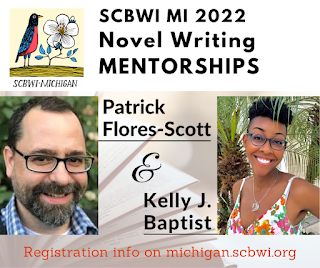
SCBWI-MI is holding
two novel mentorships this year. The mentors are Patrick Flores-Scott
and Kelly J. Baptist.
Today, we have an interview with Patrick. Please come back on April 15 for an
interview with Kelly. Everything you need to know about these mentorships can
be found on the mentorship page of the SCBWI-MI website. The submission window for both mentorships
opens on April 25, 2022.
Patrick
Flores-Scott was a long-time public school
teacher in Seattle, Washington. He’s now a reading tutor and early morning
writer in Ann Arbor, Michigan. Patrick’s first novel, Jumped In, was
named to the 2014 YALSA Best Fiction for Young Adults list, a Walden Award
finalist, a Washington Book Award winner, an NCSS/CBC Notable Book for the
Social Studies, and a Bank Street College Best Books of 2014. His second
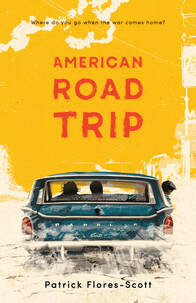
novel, American Road Trip, received multiple starred reviews
and is a 2019 Best Fiction for Young Adults pick, and a TAYSHAS Texas reading
list selection
1) What do you like
best about writing novels?
 That moment of inspiration where a fire is lit as you come
up with an idea that you think is worth exploring for the length of time it
takes to complete a novel. This is it! Later
on down the road it gets exciting again when you find that scene or that new
character that feels like you’re putting a puzzle piece into the exact right
spot. There are moments where you craft a sentence and it just feels right when
you’re done. All that stuff is great—but it’s so solitary. I think what I
actually like the very best about writing novels is the conversations that
happen along the way. Handing a messy draft over to a trusted friend who you
know will give feedback that challenges you, and frustrates you, but always leads
to better writing--and more interesting conversations. Conversations with your
editor about new ideas for that character that just isn’t sitting quite right.
Conversations with readers in schools and libraries. Email exchanges with
students who are working on their own writing or who identified with the book
in some way. It feels like, for me, writing and putting ideas out there is a
way to get to those great conversations.
That moment of inspiration where a fire is lit as you come
up with an idea that you think is worth exploring for the length of time it
takes to complete a novel. This is it! Later
on down the road it gets exciting again when you find that scene or that new
character that feels like you’re putting a puzzle piece into the exact right
spot. There are moments where you craft a sentence and it just feels right when
you’re done. All that stuff is great—but it’s so solitary. I think what I
actually like the very best about writing novels is the conversations that
happen along the way. Handing a messy draft over to a trusted friend who you
know will give feedback that challenges you, and frustrates you, but always leads
to better writing--and more interesting conversations. Conversations with your
editor about new ideas for that character that just isn’t sitting quite right.
Conversations with readers in schools and libraries. Email exchanges with
students who are working on their own writing or who identified with the book
in some way. It feels like, for me, writing and putting ideas out there is a
way to get to those great conversations.
2) What do you like
least?
Worst of all is the waiting. I’m a slow writer to begin
with. For me, one book equals a lot of years of work. The publishing industry
is slow as well. There is a lot of “waiting to hear back” in the sales process
and the editing process. You wait for the book to come out. You wait for
reviews. I think I could handle a bad review a lot better than the waiting for reviews part.
3) Describe a typical
writing day.
After writing my first book, and the majority of my second
book, as a full time school teacher, I am now really lucky to have the role of
stay-at-home dad and writer. On a typical day, I get up about 5 in the morning. I make some coffee and do a little
reading and then write until about eight. Then I help get my boys ready and
take them to school. Lately, there’s been an all-family walk included. After I
get back, I try to write a couple more hours and then deal with
e-mail/website/whatever until about noon. Afternoon, I’ll turn to
family/household stuff. That’s an ideal writing day. The last couple years
everything else has been so topsy-turvy so I’ve tried to keep that early
morning stretch sacred.
4) When you’re reading for pleasure, what
features of a book typically impress you the most?
I just started Colson Whitehead’s Harlem Shuffle. A page and a half in and I’m immersed in the protagonist’s
world—his neighborhood, his job, his ethics—as he goes about a typical day on
the job. I love that; learning about a character right off the bat by the way
they do things. I like short chapters
and great, snappy dialogue. And I love being surprised by plot turns, and when
a flawed character stays flawed, but manages some brief moment of bravery or
heroism.
5) What inspires you?
I am truly inspired by anyone who is trying their best under
difficult circumstances.
As a teacher, I was inspired by students who showed up every
day, trying their best, when I knew that, at the time, their families where
dealing with the housing crisis, with parents or older siblings who were at
war, or coming home from war, or they or someone close to them was struggling
with mental illness.
Right now, I’m inspired by the young adult women who are
leading with their voices and putting their lives on the line to make
difference on all kinds of justice and climate issues. As difficult as these
times are, there continue to so many young people displaying resilience and
courage, in an attempt to make this place better for all of us.
6) What aspects of
being a novel mentor are you most looking forward to?
I’m really excited and grateful for this opportunity. I’m looking forward to meeting and interacting
with a dynamic creative person I’ve never met before. I’m looking forward to
reading a cool new novel in its early form. I’m looking forward to engaging in
the creative back and forth. And, while thinking I have something to offer an
up-and-coming novelist, I anticipate learning a lot about writing and
creativity through this process.
7) Can you tell us
about any upcoming projects?
I have a book under contract that I’m waiting to hear back
on. It’s tentatively titled, No Going
Back. It’s about a kid who has been paroled after a year and a half in
juvenile prison. Over his first weekend out, we watch him struggle and succeed
at putting the pieces of his life back in order under circumstances that make
meeting his parole terms nearly impossible.
I’m also in the very early stages of writing a book set in a
2027 USA functioning under an authoritarian regime. It’s about an underground
resistance movement at a small-town Michigan high school. The future will determine
whether this novel will be considered dystopian, or realistic contemporary fiction.
Ann Finkelstein is a former scientist who
discovered that writing novels is more fun than wrangling test tubes. She
coordinates the mentorship program for SCBWI-MI. For mentorship questions, email
Ann.


.png)


.png)